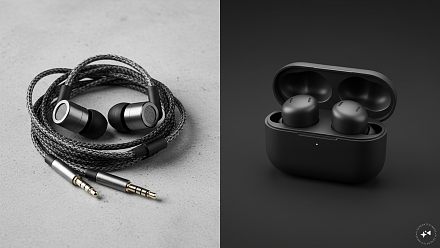
Wired Vs Wireless Earphones: Which Is Better For Daily Gym Use?
Earphones can make a workout easier to get through, but the wrong pair can quickly become annoying. A cable that keeps catching on your clothes is frustrating during weights or running, while wireless earphones are not m
লেখক Consumer Trends Desk··24K বার পড়া
Wired Vs Wireless Earphones: Which Is Better For Daily Gym Use?
Earphones can make a workout easier to get through, but the wrong pair can quickly become annoying. A cable that keeps catching on your clothes is frustrating during weights or running, while wireless earphones are not much help if you reach the gym and discover the battery is dead.
For daily gym use, the choice comes down to more than sound quality. Fit, freedom of movement, sweat resistance, battery life and convenience matter just as much. Wired and wireless earphones both have advantages, but they suit rather different workout habits.
Which should you choose?
Choose wired earphones if:
You do not want to worry about charging.
You want an inexpensive pair primarily for gym use.
Your phone has a compatible 3.5mm or USB-C port.
You mainly do walking, cycling or workouts where the cable does not get in the way.
You want a simple plug-and-play option.
Choose wireless earphones if:
You do strength training, running, HIIT or other workouts involving plenty of movement.
You do not want a cable hanging between your phone and ears.
Sweat resistance is important.
You want to leave your phone on a bench or in your pocket while exercising.
You are happy to charge another device regularly.
For most active gym workouts, wireless earphones are more convenient because there is no cable connecting you to your phone. Wired earphones, however, remain a practical and considerably cheaper alternative if charging and battery life are bigger concerns.
Top picks
1. Portronics Conch Theta C
Price: Was – Rs 799 | Now – Rs 311 | Discount: 61%
2. JBL C100SI
Price: Was – Rs 1,299 | Now – Rs 599 | Discount: 54%
3. Ambrane Stringz 38
Price: Was – 449 | Now – Rs 329 | Discount: 27%
4. JLab Go Pop ANC
Price: Was – Rs 3,599 | Now – Rs 2,499 | Discount: 31%
5. OnePlus Nord Buds 3r
Price: Was – NA | Now – Rs 1,999 | Discount: NA
6. Portronics Harmonics Z7
Price: Was – Rs 1,999 | Now – Rs 535 | Discount: 73%
Quick comparison
Feature
Wired earphones
Wireless earphones
Freedom of movement
Limited by cable
Excellent
Battery
No charging required
Requires charging
Sweat resistance
Depends on model
Common on gym-friendly models
Convenience during exercise
Good for lighter workouts
Better for active workouts
Connection
Physical
Bluetooth
Risk of losing an individual earbud
Low
Higher with TWS earbuds
Price
Usually cheaper
Usually more expensive
Best for
Budget and simple use
Running, weights and active workouts
How do wired earphones work for the gym?
Wired earphones connect directly to your phone through a 3.5mm headphone jack or USB-C port. There is no pairing process, no battery to monitor and no charging case to remember.
That simplicity is their biggest advantage. You can keep a cheap pair in your gym bag and know they will be ready whenever you need them. Models such as the Portronics Conch Theta C use USB-C, making them compatible with many newer phones that no longer have a headphone jack.
The problem is the cable. During exercises such as bench presses, rows, burpees or running, it can catch on your hands, clothes or gym equipment. You also need to keep your phone relatively close.
Where wired earphones perform best
Walking and treadmill sessions
Stationary cycling
Less movement-intensive workouts
Budget gym setups
Long workouts where battery life is a concern
Where wired earphones struggle
HIIT
Free weights
Running
Exercises involving frequent changes in position
Workouts where the phone is kept away from you
If you regularly move between machines or do exercises requiring a wide range of movement, the cable can become the biggest drawback.
How do wireless earphones work for the gym?
Wireless earphones connect to your phone over Bluetooth, removing the physical cable between the phone and your ears. For gym use, that is a substantial practical advantage.
You can leave your phone on a nearby bench, keep it in a pocket or place it on the treadmill without worrying about pulling the earphones out accidentally. True wireless earbuds also give each ear complete freedom of movement.
Battery life has improved considerably. The OnePlus Nord Buds 3r, for example, advertise up to 54 hours of total playback with the charging case, while the JLab Go Pop ANC offers more than 24 hours of total playtime. The Portronics Harmonics Z7 neckband claims up to 40 hours.
Where wireless earphones perform best
Running
Strength training
HIIT
Cross-training
Workouts involving frequent movement
Where wireless earphones struggle
When you forget to charge them
Very long periods away from a charger
If earbuds do not fit securely
If you frequently misplace small earbuds
For daily gym use, a secure fit matters almost as much as battery life. An earbud that keeps loosening during a run can be more distracting than a cable.
Which is better for freedom of movement?
This is where wireless earphones have the clearest advantage.
With wired earphones, your phone and ears remain physically connected. Put your phone on a bench and walk away without thinking, and you can pull the earphones straight out. The cable can also interfere with dumbbells or your hands during certain exercises.
Wireless earphones remove that problem. This is particularly useful during squats, deadlifts, bench presses, functional training and treadmill running.
Movement comparison
Wired: Fine for relatively stationary workouts
Wireless: Better for workouts involving frequent or unrestricted movement
Which is better for sweat and intense workouts?
The answer depends on the individual product rather than simply whether it is wired or wireless.
For gym use, look for a model with a stated water or sweat-resistance rating. The JLab Go Pop ANC, for instance, carries an IP55 rating, while the Portronics Harmonics Z7 is rated IPX4.
An IP rating does not automatically make earphones suitable for swimming or heavy water exposure. But sweat resistance is worth prioritising if you train hard every day.
Basic wired earphones often do not advertise the same level of sweat protection, so check the specifications rather than assuming they can cope with repeated heavy workouts.
What about battery life?
Wired earphones win this comparison for a simple reason: they do not have a battery.
Plug them in and they work. There is no charging case and no chance of arriving at the gym with dead earphones.
Wireless models require more planning, but modern battery life makes this much less troublesome than it once was. A pair offering several dozen hours with its charging case may only need charging occasionally, even if you exercise every day.
Neckband-style wireless earphones provide a useful middle ground. The Portronics Harmonics Z7, for example, claims up to 40 hours of playback while retaining a cable between the two earpieces, so there are no individual buds to lose.
Which gives better sound?
Do not assume that wired automatically means better sound or that wireless means worse sound.
At these prices, sound quality depends heavily on the individual earphones, their drivers, tuning and fit. A well-fitting pair of wireless earbuds can sound better than inexpensive wired earphones, and vice versa.
For the gym, powerful bass and a secure seal may matter more to many users than fine audio detail. The JBL C100SI, for instance, is marketed around its Pure Bass sound, while the Ambrane Stringz 38 emphasises high bass.
Which is more practical for everyday gym use?
Convenience depends on your routine.
If you walk into the gym, put your phone on the treadmill and exercise for 45 minutes, wired earphones can do the job perfectly well for a few hundred rupees.
If you move between weights, machines and floor exercises, wireless earbuds become much easier to live with. You can keep your phone in one place and move without constantly thinking about the cable.
There is also a cost difference. The wired models here cost between Rs 311 and Rs 599, while the true wireless options cost around Rs 1,999 to Rs 2,499. A wireless neckband such as the Portronics Harmonics Z7 offers another option at Rs 535.
Common gym scenarios
Situation
Better choice
Treadmill walking
Either
Running
Wireless
Weight training
Wireless
HIIT
Wireless
Stationary cycling
Either
Long workouts without charging
Wired
Keeping phone away from you
Wireless
Lowest possible budget
Wired
Avoiding charging completely
Wired
Maximum freedom of movement
Wireless
What to consider before buying
Fit: For workouts, secure earphones are more important than impressive specifications. Look for ear tips that sit firmly without becoming uncomfortable.
Sweat resistance: If you sweat heavily, check the IP rating. Do not assume every pair of earphones is designed to handle repeated exposure to moisture.
Battery life: With wireless earphones, consider both the earbuds’ battery and the total battery available with the charging case.
Your phone: Many newer phones no longer have a 3.5mm headphone jack. If you want wired earphones, check whether you need a USB-C model such as the Portronics Conch Theta C.
Workout style: The more you move, the more noticeable a cable becomes. Running, HIIT and strength training generally benefit more from wireless freedom than walking or stationary cycling.
FAQs
1. Are wireless earphones better for the gym?
For active workouts, usually yes. The lack of a cable makes running, weight training and exercises involving frequent movement more convenient.
2. Can sweat damage earphones?
Yes, particularly if the earphones are not designed to resist moisture. Look for an appropriate IP rating if you sweat heavily or exercise outdoors.
3. Are wired earphones good for running?
They can be used for running, but the cable may bounce, rub against clothing or get pulled accidentally. Wireless earphones are generally more convenient for running.
4. Do wireless earbuds need charging every day?
Not necessarily. Battery life varies considerably between models, and charging cases can provide multiple additional charges. If you only use them for an hour at the gym each day, many models can go several days before the case needs charging.
5. Are neckband earphones good for workouts?
Yes. Neckbands provide wireless connectivity without completely separate earbuds, making them useful if you are worried about losing an individual bud. They can also offer long battery life.
6. Should I buy expensive earphones just for the gym?
Not necessarily. For gym use, secure fit, sweat resistance, reliable connectivity and sufficient battery life are generally more important than premium audio features.
Disclaimer: The product descriptions mentioned in the article are solely based on the primary and secondary research conducted by our experts. To keep you ahead of the curve with these latest products, News18 utilises affiliate links. This means if you decide to shop through our recommendations, we may earn a small referral commission at no extra cost to you. Please be advised that News18 is not responsible for any claims under the Consumer Protection Act, 2019, or other applicable laws regarding the final performance, quality, or safety of these products.