Technology Has Killed Waiting - And I'm Not Sure That's Entirely a Good Thing
I remember sitting next to a cassette recorder waiting for a favourite song to come on the radio. There was no search, no playlist and obviously no Spotify. You waited for the RJ to play it, punched Record and hoped he w
লেখক Anjan N Ghosh··39K বার পড়া
Technology Has Killed Waiting - And I'm Not Sure That's Entirely a Good Thing
I remember sitting next to a cassette recorder waiting for a favourite song to come on the radio. There was no search, no playlist and obviously no Spotify. You waited for the RJ to play it, punched Record and hoped he wouldn’t start talking over the song. He usually did.
The strange thing was, once you had that song on your cassette, you were ridiculously pleased with yourself. Now I can play pretty much any song I can think of within seconds. Of course I prefer this. I’m not saying we start using cassette recorders again!
But it got me thinking about something else we’ve sort of lost along the way. We hardly wait for anything anymore.
Do you remember waiting for photographs?
Anyone who has used a film camera will remember this. You’d go away on holiday with 24 or 36 exposures and have absolutely no clue whether the photographs were any good. There was no screen at the back, no way of checking them and certainly no taking fifteen shots of the same sunset just in case.
You’d come home, give the roll for processing and wait. A few days later you’d collect that little packet of prints and finally see what you’d actually photographed. Some were good. Some were blurred. Someone’s eyes were inevitably closed. And occasionally your thumb became part of the composition.
As an amateur photographer, I love what digital photography has given us. I can take 200 photographs, edit them on my phone and send them anywhere in the world before breakfast. Would I go back to film because waiting was more romantic? Absolutely not. Still, opening that little packet had an excitement that tapping the thumbnail at the bottom of my iPhone screen doesn’t quite have.
Music was also different
Buying an album was actually an event for me. I’d go to the music store, browse through the records, cassettes or CDs, finally choose one and come home. I’d read the sleeve notes and usually listen to the whole album from beginning to end.
Now I probably have more music available than I could listen to in several lifetimes. And yet, if a song doesn’t grab me within 20-30 seconds, I’ll often skip it. Quite a change from the days when I’d spent good money on an album and that album was getting a proper listen whether track three impressed me or not!
Streaming hasn’t made music worse. It has made discovering music unbelievably easy. But I do think unlimited choice has made me a less patient listener.
Do you remember planning your evening around a movie?
If a film you wanted to watch was coming on television at 9 PM on Sunday, you were in front of the television at 9 PM on Sunday. Missed it? Tough luck.
Now I can watch basically anything I want, pause it, continue the next day or abandon it halfway through. Yet I’ve also spent twenty minutes browsing Netflix and announcing there’s ‘nothing to watch’. Thousands of films and series available instantly, and apparently none of them will do.
I’m not entirely sure technology is to blame for that one. Maybe we’re just difficult people.
Communication is the bit where things really changed
Earlier, if you called someone and they weren’t available, you called again later. And that was basically it. Now I send a WhatsApp message. Delivered. Two ticks. Read. Blue ticks. No reply. Hmm.
Of course I’m exaggerating. Only slightly. But somehow instant communication has created this expectation of instant availability as well. Even email, which once felt incredibly fast, can now seem slow if somebody doesn’t respond the same day.
I love being able to contact family and friends instantly, particularly when people are travelling or living in another city or country. But I do think we’ve made ourselves unnecessarily anxious about response times. Sometimes the person is just busy. A revolutionary concept, apparently.
And what happened to delivery times?
I remember ordering things and being perfectly happy if they arrived within a week. Now my phone says Delivery in 10 minutes, and if the delivery guy takes fifteen I’m checking the app to see what’s happening.
Think about that for a second. Someone receives my order, finds the item, packs it, gets onto a bike, navigates traffic and delivers it to my house in roughly the time it takes me to decide what I want for dinner. That’s extraordinary.
And yet we’ve become accustomed to it so quickly that ten minutes doesn’t feel extraordinary anymore. It feels normal. That’s the funny thing about technology. Yesterday I couldn’t believe something could arrive in ten minutes. Today, if it takes fifteen, I want to know what’s gone wrong!
Now even information doesn’t require much waiting
There was a time when you didn’t know something, you looked it up. Or asked somebody. Or read about it. And occasionally, after all that, you still didn’t know. Then came Google and changed a lot of that. Now we have AI.
I can ask a fairly complicated question and get a structured answer within seconds. I use that capability myself, so obviously I’m not complaining about it. It’s incredibly useful. But I do wonder whether getting answers instantly changes the way we think about questions.
Sometimes you find interesting things along the way. One article leads to another. You realise your original question wasn’t quite right. You disagree with something, so you look elsewhere. That takes time, but the wandering around can be useful too.
I’m not saying we go back to encyclopedias. Mine would probably take up an entire room by now. I just don’t want ‘give me the answer quickly’ to completely replace ‘let me understand this’.
Four seconds is apparently a long time now
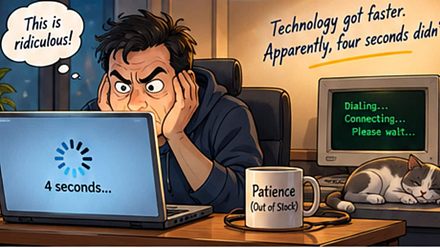
This is the bit that makes me smile. A webpage takes four seconds to load and I assume something is wrong with the internet. Netflix buffers and I get annoyed. A UPI payment takes slightly longer than usual and I’m staring at the screen wondering whether it’s gone through.
Twenty-odd years ago I was on dial-up internet and watched webpages appear gradually on the screen. Downloading a large file involved planning, patience and sometimes prayer.
Now YouTube hesitates before starting in 4K and suddenly my broadband provider has personally let me down. It’s incredible how quickly our definition of ‘slow’ changes.
No, I don’t want the old days back
Whenever you write something like this, there’s always a risk of sounding as if everything was better earlier. It wasn’t.
Waiting three days to find out half your holiday photographs were useless wasn’t fun. Neither was waiting for a song on the radio, missing a film because you came home late or listening to that dial-up modem making noises that sounded like two fax machines getting into an argument.
Modern technology is better. Much, much better. I like streaming. I like instant payments. I like digital photography. I like things being delivered quickly and being able to talk to somebody halfway around the world whenever I want.
What interests me isn’t whether all this convenience is good. Obviously it is. It’s how quickly we adapt to it.
My Take
We’ve spent decades making things faster because waiting was inconvenient. And we’ve been ridiculously successful at it. Music is instant. Photographs are instant. Messages are instant. Payments are almost instant. Shopping can be ridiculously fast. Information is available within seconds.
Yet I don’t really feel surrounded by all this extra time we’ve apparently saved. Maybe that’s because every time technology removes one delay, we simply reset our expectations and start getting annoyed by the next one.
I’m certainly not going back to cassettes, film processing or dial-up internet. Nostalgia is fun, but let’s not get carried away.
Still, the next time a webpage takes four seconds to load, I might try something revolutionary.