India’s AI Moment Has Arrived: Sarvam Co-Founder Pratyush Kumar On What Comes Next
India’s artificial intelligence journey may still be at the beginning, even as the country starts producing its own AI models, building computing infrastructure and creating startups around the technology. That was one o
লেখক Debashis Sarkar··43K বার পড়া
India’s AI Moment Has Arrived: Sarvam Co-Founder Pratyush Kumar On What Comes Next
India’s artificial intelligence journey may still be at the beginning, even as the country starts producing its own AI models, building computing infrastructure and creating startups around the technology. That was one of the central messages from Pratyush Kumar, Co-Founder of Sarvam, during a panel discussion at the Moneycontrol Startup Conclave 2026 in Bengaluru.
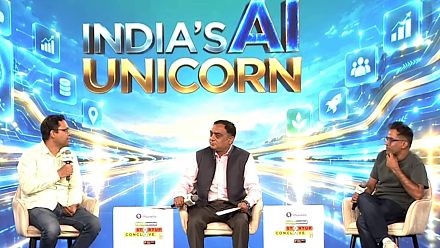
Kumar was speaking alongside Mukund Jha, Founder of Emergent, in a session titled “India’s AI Unicorns: Models, Moats & the Race to Scale”, moderated by Nalin Mehta, Managing Editor, Moneycontrol. The discussion covered India’s position in the global AI race, the development of indigenous models, computing infrastructure, AI adoption, cybersecurity and the growing capabilities of AI agents.
‘This Is Year One’ For India’s AI Journey
Opening the discussion on India’s position in the global AI race, Kumar argued that the country is only now entering the phase of building its own AI capabilities at scale.
“This is year one for us,” Kumar said, pointing to the development of AI models and the emergence of computing infrastructure in the country.
He noted that Sarvam has launched its first set of models and said only a small number of companies outside the American and Chinese ecosystems have trained models of 100 billion parameters or more from scratch.
For Kumar, however, the size of the gap between India and the leading AI ecosystems is only one part of the story. He believes India has advantages in scale, talent and the willingness to adopt technology.
He compared the situation with India’s digital payments journey. According to Kumar, India was not among the top 10 digital payments markets in 2016, but has since reached a point where a significant share of global digital payments takes place in the country.
His argument was that AI could follow a similar trajectory, potentially at an even faster pace.
“Five years down the line, India would be the largest user by far of this technology,” Kumar said, adding that India’s ability to innovate and reduce the cost of using AI would be critical.
Scale Could Be India’s AI Advantage
Kumar’s view of India’s AI opportunity is therefore not limited to building a model that competes directly with the biggest global systems.
He pointed to India’s population scale, talent base and existing digital infrastructure as important advantages in the adoption of AI.
At the same time, he acknowledged that India still has a gap to close when it comes to frontier AI capabilities.
For Sarvam, the response has been to work across several layers of the AI stack. Kumar said the company has been investing in GPUs, its own computing infrastructure and an inference stack that can host its models as well as other open models.
The objective, he said, is to make AI inference available in India at costs comparable with companies elsewhere in the world.
That infrastructure push is being combined with work on products, including document, voice and video applications, coding tools and cybersecurity capabilities.
Kumar described Sarvam as moving towards becoming a full-stack AI provider, where an Indian enterprise could access much of what it needs to adopt AI at scale.
AI Adoption Will Have To Go Beyond Chatbots
The discussion also focused on what India could actually do with increasingly capable AI systems.
Kumar pointed to applications across agriculture, healthcare and education, arguing that AI could provide access to intelligence at population scale.
He cited examples involving farmers and the digitisation of forms to illustrate the kinds of problems Indian AI systems could be designed to address.
For Sarvam, the opportunity is therefore not simply about building increasingly powerful models. It is also about taking those models into real-world systems and making them useful at a large scale.
“AI is an ROI positive component for every enterprise,” Kumar said, arguing that the critical challenge is embedding AI into businesses and making it work for them.
Emergent Sees A Different AI Opportunity
Mukund Jha offered a different but complementary view of where AI is heading. Emergent, which started around software creation, is increasingly focused on using AI agents to automate broader business functions.
Jha said businesses are already using Emergent’s agents for areas such as finance, marketing and growth. He described the company’s longer-term vision as one where autonomous agents could handle different parts of a business and communicate with one another.
He said more than 30,000 businesses are using one of Emergent’s persistent agent products on a daily basis.
Jha also argued that the rise of increasingly capable AI models is accelerating the development of such products. As reasoning and coding capabilities improve, he said, new applications are emerging around them.
He also highlighted the growing role of open-source models, saying Emergent has been leaning heavily into open source as reasoning and coding capabilities have improved.
AI’s Rapid Progress Is Also Creating A Security Question
The panel was not only about India’s opportunity. Both speakers also discussed the risks created by increasingly capable AI systems.
Jha said the issue of AI safety is becoming more serious as models become more capable. He pointed to examples of AI systems being able to exploit software vulnerabilities and argued that companies would need to invest more in defence and security.
Kumar similarly said the technological progress in AI is extraordinary, but argued that the possibility of AI being used deliberately for harmful purposes needs to be taken seriously.
He described AI as becoming a potential “weapon system” and said India needs to develop its own defensive capabilities.
At the same time, Kumar rejected the idea that India should simply slow down its AI development.
“From the India vantage point, we should accelerate,” he said.
For him, the challenge is to pursue AI development while simultaneously building the capabilities needed to defend increasingly digital systems.
The Race Is Now About Building The Full AI Stack
The discussion at the Moneycontrol Startup Conclave ultimately returned to the question of what India needs to build.
For Kumar, that means models, computing infrastructure, inference capabilities, products and defensive systems. For Jha, the opportunity is increasingly about deploying AI agents that can perform actual business functions.
Both perspectives point to an AI ecosystem that is moving beyond simply experimenting with chatbots.
And that is why Kumar described the current phase as “year one”. India may have entered the AI race later than some of the world’s leading technology ecosystems, but the discussion at the Moneycontrol Startup Conclave showed that the country’s AI startups are now focused on building models, infrastructure and products at the same time.
The next phase, as Kumar sees it, will be about how quickly those capabilities can scale across India.