India’s AI Future Could Be Built Around Enterprise AI, Not Just Consumer Chatbots
India’s artificial intelligence story may not be defined only by how many people use consumer AI chatbots. The bigger opportunity could come from putting AI directly into businesses, government services and large-scale w
লেখক Debashis Sarkar··24K বার পড়া
India’s AI Future Could Be Built Around Enterprise AI, Not Just Consumer Chatbots
India’s artificial intelligence story may not be defined only by how many people use consumer AI chatbots. The bigger opportunity could come from putting AI directly into businesses, government services and large-scale workflows, according to comments made by leading Indian AI startup founders at the Moneycontrol Startup Conclave 2026.
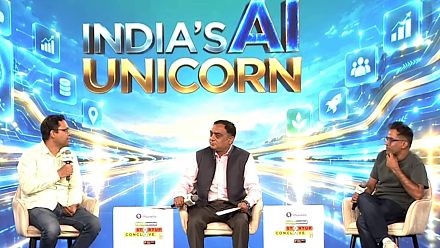
The discussion took place during a panel titled “India’s AI Unicorns: Models, Moats & the Race to Scale” on September 26. The session featured Pratyush Kumar, Co-Founder of Sarvam, and Mukund Jha, Founder of Emergent, and was moderated by Nalin Mehta, Managing Editor, Moneycontrol.
AI Could Move Beyond The Chatbot
Much of the public conversation around artificial intelligence has centred on consumer chatbots. However, the examples discussed during the panel showed how Indian AI companies are looking at a much broader set of applications.
Kumar spoke about building AI systems that can be used across areas such as agriculture, education and healthcare, while also highlighting the importance of making AI affordable enough to operate at India’s scale.
One example he gave was the potential to work with the government to reach around three crore farmers at extremely low cost. The idea, as described during the discussion, is not simply to give people access to another chatbot, but to use AI to understand problems at population scale and reach people with relevant information and assistance.
That approach could become an important part of how AI develops in India: as infrastructure and a layer within existing systems rather than simply another consumer application.
Sarvam Is Building For Large-Scale Workflows
Kumar also described how Sarvam is building beyond its underlying AI models. The company is working on its own GPU cluster, software stack and inference stack, while also looking at hosting its own models as well as open models.
He said the company is also building a platform covering documents, voice and video, alongside tools for internal coding and cybersecurity.
Another example discussed during the panel involved the digitisation of around four crore LIC forms. Kumar said Sarvam is using a custom model for this because people continue to fill out physical forms by hand.
The example illustrates the type of problem where enterprise AI can have a direct role. Rather than asking consumers to change their behaviour and move to a new AI product, the technology can be deployed behind the scenes to process information and automate existing workflows.
Emergent Is Taking AI Into Business Automation
Mukund Jha offered another view of the same shift through Emergent’s focus on AI agents.
During the panel, Jha spoke about the company expanding from software creation towards autonomous business automation. He said more than 30,000 businesses use one of Emergent’s persistent agent products every day.
The idea is to move beyond an AI system that simply answers a question or generates a response. AI agents can instead be used to carry out tasks and become part of how businesses operate.
Jha also said that Emergent is seeing faster growth in Western markets, while India currently accounts for around 8-10 per cent of the company’s revenue.
AI Could Become Part Of The Business Stack
The comments from the two founders point towards different applications of the same broader trend.
For Sarvam, the focus discussed at the panel included models, infrastructure and applications that can operate across large Indian populations and existing institutional systems. For Emergent, the focus is increasingly on AI agents that can automate software and business tasks.
Neither approach depends entirely on consumers opening an AI chatbot and asking questions. Instead, AI becomes embedded in the systems that people and organisations already use.
That could include processing documents, handling voice and video, building software, automating business processes or providing information to large groups of people.
Cost Will Be Critical For India
Kumar repeatedly highlighted the importance of reducing the cost of AI. For Indian companies and users, the ability to deploy AI at scale depends not only on how capable the models become but also on how cheaply those capabilities can be delivered.
He said Indian buyers demand most features at the lowest possible cost, while noting that more than 90 per cent of Sarvam’s revenue comes from the private sector.
This creates a different challenge for Indian AI startups. Building a powerful model is only one part of the equation. Companies also need infrastructure, inference capabilities and applications that can deliver useful AI within the cost constraints of Indian businesses and institutions.
India’s AI Story Is Still In Its Early Stages
Kumar described the current phase as “year one” for India’s AI journey. He said the country is now entering a phase of building capabilities around models, GPUs and talent.
His comparison with India’s digital payments journey was also central to his argument. He suggested that the adoption of AI in India could move quickly once the technology becomes affordable and is deployed at scale.
The panel therefore offered a view of India’s AI future that extends beyond the consumer chatbot. From digitising handwritten forms to building autonomous business agents and creating AI systems for agriculture, education and healthcare, the applications discussed were largely tied to real-world workflows.
If that approach continues, the next phase of India’s AI story may be less about which chatbot people use and more about where AI gets embedded into the way businesses, governments and large organisations work.