Independence Day 2026: From A Rocket Carried On A Bicycle To Making iPhones- 80 Years Of Indian Technology In 25 Photos
80 Years Of Indian Technology: The Thread Running Through All Of ItEighty years of Indian technology has one recurring pattern: someone abroad says no, and India builds it anyway.The Americans refused to sell a supercomp
লেখক Ayush Mukherjee··41K বার পড়া
Independence Day 2026: From A Rocket Carried On A Bicycle To Making iPhones- 80 Years Of Indian Technology In 25 Photos
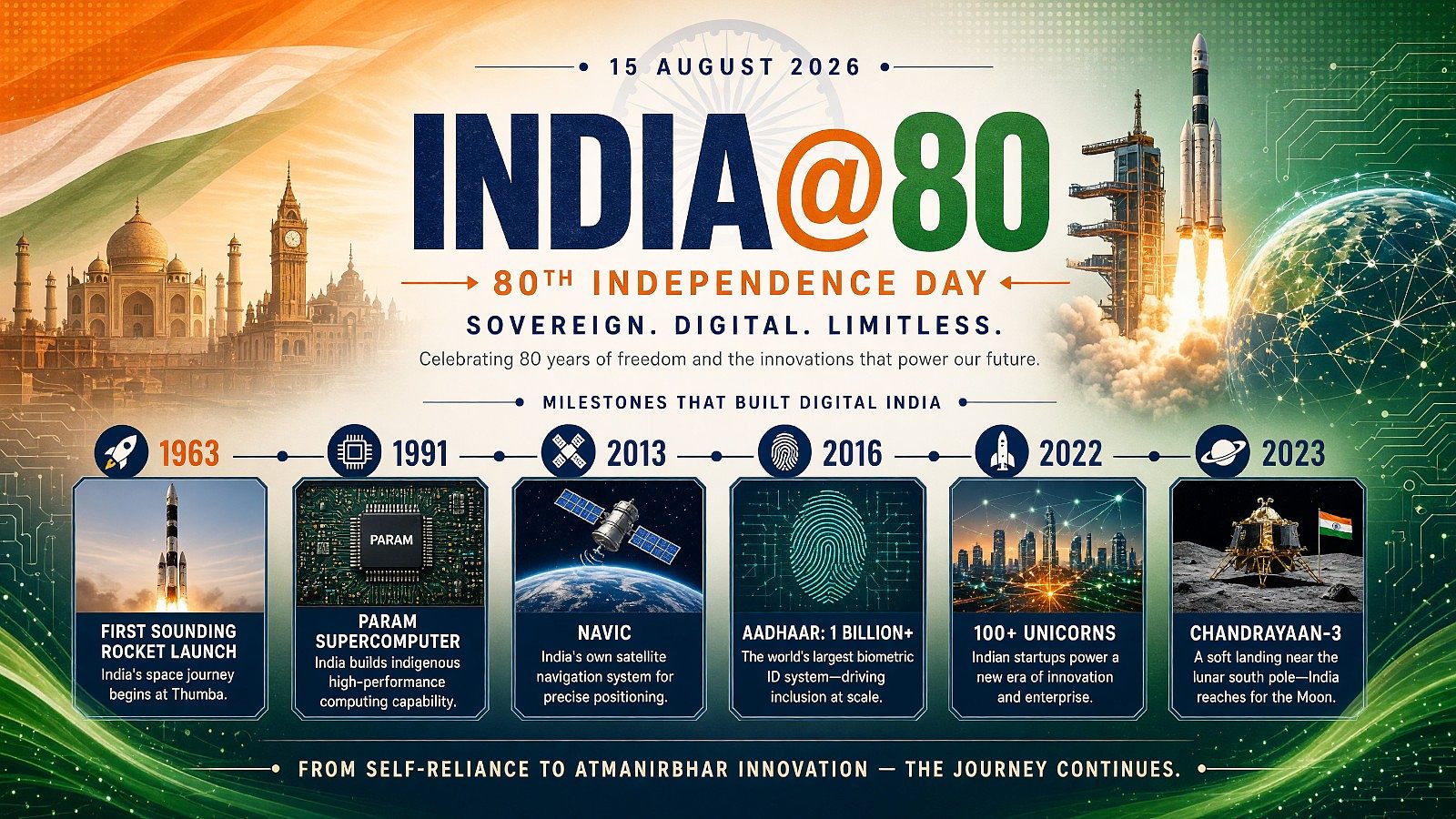
80 Years Of Indian Technology: The Thread Running Through All Of ItEighty years of Indian technology has one recurring pattern: someone abroad says no, and India builds it anyway.The Americans refused to sell a supercomputer. India built one in three years. Cryogenic engine technology was blocked. India developed its own. Nobody thought a country could reach Mars on its first attempt for less than a Hollywood budget. India did.Here is how the country got from a rocket carried to the launch pad on a bicycle to processing 763 million digital payments a day.
1948, Starting Almost From ZeroAt independence, India had almost no industrial technology base. Hindustan Aircraft, set up in Bangalore in 1940 and taken over by the government in 1942, was one of the few serious engineering operations in the country.It would become Hindustan Aeronautics Limited in 1964, and it remains the spine of Indian aerospace manufacturing. (Image: HAL Museum)
1955, The First Computer ArrivesThe Indian Statistical Institute in Calcutta installed the HEC-2M, a British machine and the first digital computer in India.Five years later, in 1960, the Tata Institute of Fundamental Research completed TIFRAC, the first computer designed and built in India. It took five years to construct and occupied an entire room. (Photo credit: Central Library, Indian Statistical Institute, Kolkata)
1963, The Rocket On A BicycleOn 21 November 1963, India launched its first sounding rocket from Thumba in Kerala, a fishing village chosen because it sat near the magnetic equator.The mission control room was a converted church. Components were transported to the launch pad on bicycles and bullock carts. The photograph of a rocket cone strapped to a bicycle is the most-reproduced image in Indian space history, and for good reason. (Image: thiruvananthapuramupdates.wordpress.com)
1969, ISRO Is BornThe Indian Space Research Organisation was formed on 15 August 1969, on Independence Day itself, succeeding INCOSPAR which Vikram Sarabhai had set up in 1962.Sarabhai’s argument was not about prestige. He insisted that a developing nation should use space technology for practical problems: communications, weather, resource mapping. That framing still shapes ISRO’s programme today.
1975, Aryabhata Goes UpIndia’s first satellite launched on 19 April 1975, aboard a Soviet rocket. Named after the fifth-century mathematician, it weighed 360kg and carried instruments for X-ray astronomy and solar physics.A power failure ended operations after four days. It stayed in orbit for 17 years, and it proved India could build a satellite. (Image: Prasar Bharti Archives/ DD YouTube)
1980, India Joins The Launch ClubOn 18 July 1980, the SLV-3 put the Rohini satellite into orbit from Sriharikota. India became the seventh country capable of launching a satellite using its own rocket.The project director was a young aerospace engineer named A P J Abdul Kalam. (Photo: HT Archive)
1984, Saare Jahan Se AchhaWing Commander Rakesh Sharma flew aboard Soyuz T-11 on 3 April 1984, spending eight days aboard the Salyut 7 station.Asked by Indira Gandhi how India looked from space, he replied “Saare jahan se achha.” It remains the most quoted sentence in the history of Indian spaceflight.
1986, India Gets NetworkedERNET, the Education and Research Network, connected Indian academic institutions and became the country’s first computer network.It ran between IITs, IISc and the Department of Electronics, long before the public had any concept of the internet. Almost everything that followed in Indian computing ran through people who first got online here. (Image: ERNET Team, ECE, IISc/ Research Matters)
1988, The RefusalIndia wanted to buy a Cray supercomputer for weather forecasting. The United States refused, citing concerns the machine could be used for weapons development.It was a straightforward denial of technology, and it produced the single most consequential response in Indian computing history. (Image: Wiki)
1988, Bhatkar’s PromiseRajiv Gandhi asked Vijay Bhatkar what building one indigenously would cost. Bhatkar’s answer was that the whole effort, including creating an institution, developing the technology and installing the machine, would come to less than the price of the Cray.He was given three years and about ₹30 crore. The Centre for Development of Advanced Computing was set up in Pune to do it. (Image: Wiki)
1991, PARAM 8000C-DAC delivered in July 1991, within deadline and within budget.PARAM 8000 used 64 processors built around British Inmos T800 transputers in a distributed-memory parallel architecture, assembled largely from off-the-shelf components because the sanctioned technology was unavailable. Benchmarked internationally, it was rated among the fastest machines in the world at the time.An American newspaper headline captured it: Denied a supercomputer, angry India does it.India then exported PARAM systems to Germany, the UK and Russia. (Image: Wiki)
1991, The Economy OpensThe same month PARAM was completed, India began dismantling the licence system that had governed its economy since independence.Liberalisation did not create Indian software talent, which already existed. It removed the barriers stopping that talent from selling to the world. Everything that followed in Indian IT services traces back to this. (Image: India History Collection/ Facebook)
15 August 1995, India Gets The InternetOn Independence Day 1995, VSNL launched public internet access in India.It was expensive, agonisingly slow and available in a handful of cities. Thirty-one years later, India has more internet users than any country except China.(Image: Wiki)
1995, The First Mobile CallOn 31 July 1995, West Bengal chief minister Jyoti Basu called union telecom minister Sukh Ram from Writers’ Building in Calcutta to Sanchar Bhavan in Delhi.Incoming calls cost money. Handsets cost more than most people earned in months. The idea that this would become the primary computing device for a billion Indians would have sounded absurd.
1999, Y2K Changes EverythingThe millennium bug required millions of lines of legacy code to be checked and rewritten. It was tedious, urgent and enormous in scale.Indian firms took the work, delivered it, and in doing so proved to global clients that complex software could be executed reliably from Bangalore, Hyderabad and Chennai. Infosys, Wipro and TCS built their international reputations on it.The IT services industry that defined Indian tech for two decades effectively starts here. (Image: Wiki)
2003, The Phone That Reached EveryoneThe Nokia 1100 was designed with emerging markets in mind: a torch for power cuts, a dust-resistant keypad, a battery that lasted days.It sold around 250 million units and remains the best-selling phone ever made. From 2006, Nokia’s Sriperumbudur plant near Chennai became one of its largest factories anywhere, and for a period India was making phones for the world.That plant later closed amid a tax dispute. Two decades on, the same district assembles iPhones. (Image: Wiki)
2008, Water On The MoonChandrayaan-1 launched on 22 October 2008 and did something nobody expected from a first lunar mission.Its Moon Impact Probe and the onboard instruments confirmed the presence of water molecules on the lunar surface, a finding that rewrote assumptions about the Moon and reshaped planning for every mission that followed. (Image: WikI)
2009, One Billion IdentitiesThe Unique Identification Authority of India was established in 2009 to give every resident a verifiable digital identity.Aadhaar became the largest biometric identity system ever built, and the foundation layer for the digital public infrastructure that followed. It has also been the most contested piece of Indian technology of the last two decades, with the Supreme Court eventually placing limits on how it can be used.The biometric lock facility is available to Aadhaar holders who have a mobile number registered with UIDAI. The registered number is required to access the feature through the Aadhaar app.
2013, Mars On The First AttemptMangalyaan launched on 5 November 2013 and entered Martian orbit on 24 September 2014.No country had ever reached Mars on its first attempt. The mission cost roughly ₹450 crore, less than several Hollywood films made about space, and it became the standard reference for what frugal engineering can achieve.Designed for six months, it operated for around eight years. (Image: Wiki)
2016, Mobile Data Becomes Free (Almost): Reliance Jio launched commercially on 5 September 2016 with free voice calls and data priced at a fraction of the market rate. The effect was violent. Data prices collapsed, incumbents consolidated or folded, and Indian mobile data went from among the world's most expensive to among the cheapest.The effect was violent. Data prices collapsed, incumbents consolidated or folded, and Indian mobile data went from among the world's most expensive to among the cheapest." width="1600" height="900" class="wp-image-9853272 size-full" />2016, Mobile Data Becomes Free (Almost): Reliance Jio launched commercially on 5 September 2016 with free voice calls and data priced at a fraction of the market rate.The effect was violent. Data prices collapsed, incumbents consolidated or folded, and Indian mobile data went from among the world’s most expensive to among the cheapest.
2016, The Payment RailNPCI launched the Unified Payments Interface in April 2016. It was interoperable, free to use, and open to any bank or app.The design decision that mattered was making it public infrastructure rather than a product. No single company owns the rail, which is why every payment app in India runs on the same one.
2023, The Lunar South PoleChandrayaan-3 landed on 23 August 2023, making India the first country to touch down near the Moon’s south pole and the fourth to soft-land on the Moon at all.It came four years after Chandrayaan-2’s lander failed in the final moments of descent. ISRO went back, redesigned the landing system around the failure, and succeeded.
2026, The Payments NumberUPI processed 23.66 billion transactions worth ₹29.88 lakh crore in July 2026, its highest month on record.That works out to 763 million transactions a day. Volume is up 22 percent year on year, and India now accounts for roughly half of all real-time payment transactions on the planet.What began as a government payment rail in 2016 is now how a subcontinent buys vegetables. UPI has evolved from a new payment platform into the world’s largest real-time payment system. As transaction volumes surge, the focus is now on how to sustainably fund the infrastructure supporting billions of secure transactions while protecting consumers and small merchants. (File Photo)
2026, Making The World’s PhonesIndia is on track to build roughly 26 percent of the world’s iPhones in 2026, up from about 6 percent four years ago.Apple has begun assembling the iPhone 18 Pro and Pro Max here from the start of the production cycle, for export to the United States and Europe. Tata Electronics has overtaken Foxconn on the value of iPhones exported from India, at $26.3 billion against $25.6 billion over the PLI period.Smartphone exports reached a record $9.84 billion in a single quarter.