I Have Too Many Chargers - So Why Am I Still Looking for One?
There are old USB-A chargers, newer USB-C chargers, laptop chargers, watch chargers, wireless chargers and a frightening number of cables that all look almost identical. I don’t throw them away because experience has tau
লেখক Anjan N Ghosh··16K বার পড়া
I Have Too Many Chargers - So Why Am I Still Looking for One?
There are old USB-A chargers, newer USB-C chargers, laptop chargers, watch chargers, wireless chargers and a frightening number of cables that all look almost identical. I don’t throw them away because experience has taught me that the cable I haven’t touched for four years will become critically important approximately 24 hours after I discard it.
USB-C was supposed to simplify all this.
And to be fair, it has. My phone, tablet, laptop, headphones and several other gadgets can now use the same little reversible connector. No more staring at a plug, turning it over, discovering it was correct the first time, and turning it back again.
So why, when someone asks me, “Do you have a charger?”, do I still respond with another question?
“For what?”
USB-C Is a Shape, Not a Promise
This is where things become unnecessarily confusing.
Two USB-C cables can look virtually identical and still have very different abilities. One may happily charge your phone but charge a powerful laptop slowly. Another may handle much more power. Data speeds can differ too.
The USB organisation itself now requires certified USB-C to USB-C cables to show their power capability as 60W or 240W, precisely because staring at the connector tells you very little about what the cable can actually do.
In other words, we finally got one plug.
We forgot to make everything behind the plug equally simple.
Can My Laptop Charger Fry My Phone?
This is probably the question ordinary users care about most.
Suppose I have a 65W or 100W USB-C laptop charger and my phone came with something much smaller. Am I about to send 100 watts screaming into the phone and cook it?
With properly designed, compatible USB Power Delivery equipment, no. The charger and device communicate, and the device requests the power it needs. USB Power Delivery was specifically designed so devices can negotiate their power requirements rather than simply accepting everything the charger can provide.
Apple, for example, explicitly says you can charge a USB-C iPhone using a higher-wattage USB-C adapter such as one supplied with a Mac laptop.
Think of the number printed on the charger as what it can provide, not what it will forcibly push into everything connected to it.
That was one of those things I understood eventually and immediately wondered why nobody had explained it that simply before.
Then Why Isn’t Everything Charging at Full Speed?
Because the charger is only one part of the conversation.
The phone has to support that charging speed. The charger has to support the right charging method. The cable has to be capable of carrying the required power. And some manufacturers use particular fast-charging systems.
Samsung, for example, says its Super-Fast Charging requires a compatible USB Power Delivery charger, and availability varies by device. Apple similarly specifies USB Power Delivery-compatible adapters for fast charging its iPhones.
Then there’s heat. Phones can deliberately slow down charging when things get too warm.
So when your friend’s phone charges astonishingly quickly using a particular charger while yours appears to be enjoying a leisurely lunch, nothing necessarily needs repairing.
They may simply be speaking different charging languages.
The Cable Drawer of Mystery
The cables annoy me more than the chargers.
At least a charger usually has tiny writing somewhere telling me what it is capable of, assuming I can find my glasses and am willing to read lettering apparently designed for ants.
USB-C cables often just sit there looking innocent.
I have cables I trust for charging my laptop, cables I use for phones and others whose origins have been lost to history. They probably arrived with something. What that something was is now between the cable and God.
This is why I’ve gradually started keeping the better high-power cables identifiable rather than throwing everything into one drawer. It saves the peculiar experience of plugging in a laptop and wondering why something that fits perfectly isn’t doing quite what I expected.
One Good Charger Can Actually Replace Several
This is where modern charging has genuinely improved my life, particularly while travelling.
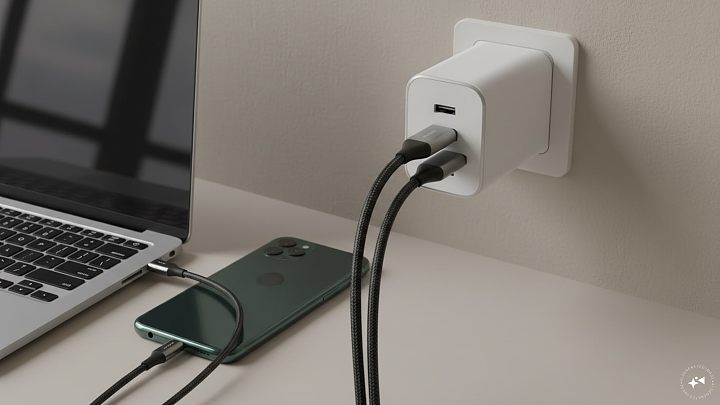
Compact high-power chargers, especially newer GaN designs, can provide enough power for several types of devices without requiring a huge brick. Give me a good multi-port USB-C charger and suitable cables and I can potentially handle my laptop, phone, tablet and earbuds without packing separate chargers for everything.
That’s progress I genuinely appreciate.
Of course, I will carefully pack the charger, organise all the cables and arrive at my destination having forgotten the one cable I actually needed.
Technology can only do so much.
We Asked for One Connector. We Got It.
USB-C has unquestionably made my gadget life easier. I would not voluntarily return to the days of carrying different connectors for half the things in my bag.
But we’ve reached a slightly strange point where several cables have the same plug while doing different things, several chargers have different abilities, and “fast charging” depends on the charger, cable and device all agreeing with each other.
So my advice is simple: don’t collect chargers endlessly. Buy a good-quality USB-C charger powerful enough for the devices you regularly carry, pair it with properly rated cables and actually know which cables are which.
Then perhaps we can finally close that drawer containing seventeen mysterious cables.