BLDC Vs Regular Ceiling Fan: Which Saves More On Electricity Bills?
Ceiling fans are among the most frequently used appliances in Indian homes, particularly during the long summer months. With fans often running for several hours a day, their electricity consumption can make a noticeable
লেখক Consumer Trends Desk··26K বার পড়া
BLDC Vs Regular Ceiling Fan: Which Saves More On Electricity Bills?
Ceiling fans are among the most frequently used appliances in Indian homes, particularly during the long summer months. With fans often running for several hours a day, their electricity consumption can make a noticeable difference to monthly power bills. This has made BLDC ceiling fans increasingly popular as an alternative to conventional induction-motor fans.
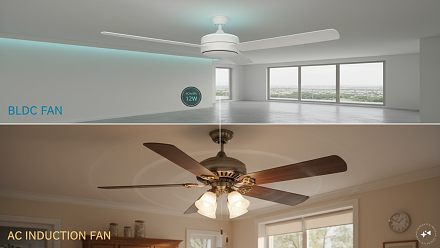
BLDC stands for Brushless Direct Current. These fans use a brushless motor designed to deliver the required airflow while consuming less electricity. Regular ceiling fans generally use conventional induction motors, which have been the standard choice in Indian homes for decades.
The biggest difference between the two is power consumption. A conventional ceiling fan can consume considerably more electricity than a comparable BLDC model while delivering similar everyday airflow. BLDC fans can therefore reduce running costs, although their higher purchase price means the savings need to be considered over the longer term.
The right choice depends on how many hours the fan runs each day, the number of fans in your home and how long you expect to keep them.
Verdict: Which one should you choose?
Choose a BLDC ceiling fan if:
You run ceiling fans for several hours every day.
You want to reduce recurring electricity costs.
You have multiple fans running in your home.
You want energy-efficient appliances.
You are comfortable paying more upfront for long-term savings.
Choose a regular ceiling fan if:
You use the fan only occasionally.
Your priority is a lower purchase price.
You are replacing a fan on a limited budget.
Electricity savings are less important than upfront cost.
You do not expect the fan to run for long hours every day.
BLDC ceiling fans are generally the better choice for reducing electricity consumption because their motors are designed to operate more efficiently. Regular fans remain attractive because of their lower initial price and familiar technology.
1. Havells REO BLDC 1200MM – Best BLDC Ceiling Fan for Maximum Energy Savings
Price: Was – 4920 | Now – Rs 2,850 | Discount: 42%
2. Orient Electric 1200 mm Zeno BLDC – Best BLDC Ceiling Fan for Everyday Home Use
Price: Was – 4,600 | Now – Rs 3,299 | Discount: 28%
3. LONGWAY Aero 1200 mm BLDC Ceiling Fan – Best BLDC Ceiling Fan with Remote Control
Price: Was – 4,181 | Now – Rs 1,299 | Discount: 52%
4. Crompton Surebreeze Sea Sapphira – Best Regular Ceiling Fan for Everyday Use
Price: Was – 2,599 | Now – Rs 1,799 | Discount: 31%
5. LONGWAY Creta P1 – Best Budget Regular Ceiling Fan
Price: Was – 2,481 | Now – Rs 1,065 | Discount: 57%
6. MILTON Brezza 1200 mm – Best High-Speed Regular Ceiling Fan
Price: Was – 3,199 | Now – Rs 1,599 | Discount: 50%
Quick comparison
Feature
BLDC Ceiling Fan
Regular Ceiling Fan
Motor type
Brushless DC motor
Conventional induction motor
Power consumption
Lower
Higher
Electricity savings
Excellent
Moderate
Purchase price
Higher
Lower
Running cost
Lower
Higher
Speed control
Usually electronic
Usually regulator-based
Remote control
Common
Less common
Noise
Generally quieter
Can be more noticeable
Performance during voltage fluctuations
Generally better
Can vary
Maintenance
Low
Low
Long-term value
Excellent for frequent use
Good for occasional use
Best for
Long daily usage
Budget-conscious buyers
Overall energy efficiency
Excellent
Moderate
How does a BLDC ceiling fan work?
A BLDC ceiling fan uses a brushless DC motor instead of the conventional induction motor found in many regular fans. The motor uses electronic control to regulate its operation, allowing it to consume less power while maintaining useful airflow.
One of the biggest advantages is that BLDC fans can deliver similar everyday cooling performance while using substantially less electricity than conventional fans. This becomes more significant when a fan operates for many hours each day.
Many BLDC fans also come with remote controls, allowing users to change the speed without getting up to adjust a wall-mounted regulator. Some models include additional features such as sleep timers, boost modes and memory functions.
The combination of lower power consumption and convenient controls makes BLDC fans particularly suitable for bedrooms, living rooms and other spaces where fans remain switched on for long periods.
Where BLDC ceiling fans perform best
Long daily operating hours
Energy-conscious households
Multiple-fan homes
Bedrooms and living rooms
Homes looking to reduce recurring electricity costs
Users who prefer remote controls
Where BLDC ceiling fans struggle
Higher initial purchase price
Electronic components add complexity
Some models may require compatible installation components
Savings take time to offset the higher upfront cost
The main benefit of a BLDC fan becomes more noticeable over time. The longer it runs each day, the greater the potential electricity savings compared with a conventional fan.
How does a regular ceiling fan work?
A regular ceiling fan generally uses a conventional induction motor to rotate the blades and generate airflow. The design is simple and has been widely used in Indian homes for many years.
Traditional fans are available across a wide range of prices, sizes and speeds. Their lower upfront cost makes them attractive to buyers who need to replace a fan without spending significantly more on an energy-efficient model.
Speed is commonly controlled through a wall-mounted regulator. Depending on the regulator and fan design, changing the speed alters the amount of electricity consumed by the motor.
Regular fans can provide strong airflow and remain perfectly suitable for many homes. Their main disadvantage compared with BLDC models is higher electricity consumption during extended operation.
Where regular ceiling fans perform best
Budget-conscious purchases
Occasional fan usage
Basic home cooling
Rental homes
Straightforward installations
Buyers who prioritise upfront cost
Where regular ceiling fans struggle
Long daily operating hours
Higher electricity consumption
Homes with several fans running simultaneously
Long-term energy savings
Frequent summer use
For buyers focused primarily on the initial purchase price, regular fans remain practical. However, their higher power consumption can make them more expensive to operate over several years.
Which consumes less electricity?
BLDC fans have a clear advantage in electricity consumption. Their brushless motor technology allows them to operate using significantly less power than conventional induction-motor fans.
The exact saving depends on the wattage of the two fans being compared, their speed settings and the number of hours they operate. A fan running for a few hours a day will naturally generate smaller savings than one operating continuously for much of the day.
This is why BLDC technology makes particular sense in bedrooms, living rooms and other areas where fans are used extensively.
Power consumption comparison
BLDC Ceiling Fan: Lower electricity consumption and running costRegular
Ceiling Fan: Higher electricity consumption but lower upfront price
How much can a BLDC fan save on electricity bills?
The actual saving depends on the difference in wattage, daily usage and electricity tariff. For example, if a conventional fan uses around 70-75 watts while a comparable BLDC fan uses around 30-40 watts, the difference becomes significant when the fan runs for several hours every day.
The calculation is straightforward:
Electricity consumed = Fan wattage × Hours of use ÷ 1,000
For example, a 75-watt regular fan running for 10 hours consumes approximately 0.75 kWh per day. A 35-watt BLDC fan under the same conditions consumes approximately 0.35 kWh.
The actual bill saving will depend on the electricity tariff applicable to your household. Users with higher daily fan usage are likely to recover the additional purchase price of a BLDC model faster.
Which is better for long-term value?
A regular ceiling fan usually costs less at the time of purchase, while a BLDC fan requires a higher initial investment. However, the comparison changes when electricity costs over several years are included.
For households where fans operate for many hours every day, lower power consumption can gradually offset the higher purchase price of a BLDC fan. If the fan is used only occasionally, the electricity savings may be too small to justify the extra upfront expense.
Therefore, long-term value depends heavily on usage. High-usage households are more likely to benefit from BLDC technology.
Which is quieter?
BLDC fans are generally known for quieter and smoother operation because of their motor design and electronic speed control. This can be useful in bedrooms and study rooms where motor noise is more noticeable.
Regular fans can also operate quietly when they are well maintained and properly installed, but their conventional motors may produce more audible hum or vibration depending on the model.
Noise should not be the only reason to choose a BLDC fan, but it can be a useful additional advantage for users who value quiet operation.
Which offers better convenience?
BLDC fans commonly include remote controls, allowing users to adjust speed, switch the fan on or off and sometimes use additional functions without reaching the wall regulator.
Regular fans traditionally rely on wall-mounted regulators. They are straightforward but offer fewer controls unless the specific model includes additional features.
For bedrooms, remote control convenience can be particularly useful. A regular fan remains perfectly adequate for buyers who prefer simple operation.
Which should you buy for your home?
If your fans run for long hours every day and reducing electricity consumption is a priority, a BLDC ceiling fan is the better investment. Its lower power consumption can translate into meaningful savings over the life of the fan.
If you are primarily concerned about the initial purchase price or use your fans for relatively short periods, a regular ceiling fan can still make sense. It costs less upfront and provides the basic airflow most homes require.
For Indian households with heavy summer usage, however, the higher upfront cost of a BLDC fan can be easier to justify because the savings continue every time the fan is switched on.
Common usage scenarios
Situation
Better choice
Fan runs 8-12 hours daily
BLDC Ceiling Fan
Fan runs occasionally
Regular Ceiling Fan
Multiple fans used every day
BLDC Ceiling Fan
Lowest upfront cost
Regular Ceiling Fan
Reducing electricity bills
BLDC Ceiling Fan
Bedroom use
BLDC Ceiling Fan
Rental home with limited appliance budget
Regular Ceiling Fan
Long-term home ownership
BLDC Ceiling Fan
Remote-control convenience
BLDC Ceiling Fan
Basic cooling on a budget
Regular Ceiling Fan
Frequent summer use
BLDC Ceiling Fan
Energy-efficient home
BLDC Ceiling Fan
Short-term or temporary use
Regular Ceiling Fan
Maximum long-term savings
BLDC Ceiling Fan
FAQs
1. Is a BLDC fan better than a regular fan?
A BLDC fan is generally better for households that run fans for long hours because it consumes less electricity. A regular fan can be more suitable when the upfront purchase price is the main consideration.
2. How much electricity does a BLDC fan consume?
Consumption varies by model and speed setting. Many BLDC fans use substantially less power than conventional fans, but buyers should compare the rated wattage of specific models before purchasing.
3. Does a BLDC fan really reduce electricity bills?
Yes. Lower power consumption means a BLDC fan can reduce the electricity used for cooling. The actual saving depends on fan wattage, daily operating hours and the household’s electricity tariff.
4. Are BLDC fans worth the higher price?
They can be worth the additional cost if the fan is used for several hours every day. Lower electricity consumption can gradually offset the higher initial purchase price.
5. Do BLDC fans work during power cuts?
A BLDC fan itself still requires electricity, so it will not operate during a power cut unless the home has backup power. Its ability to operate on backup power depends on the inverter and electrical setup.
6. Are BLDC fans quieter than regular fans?
BLDC fans are generally quieter and smoother in operation, although actual noise levels depend on the specific fan, installation and condition.
7. Do BLDC fans require special maintenance?
Routine maintenance is broadly similar to other ceiling fans, mainly involving cleaning and checking the installation. However, the electronic components should be handled according to the manufacturer’s instructions.
8. Which should I buy overall?
Choose a BLDC ceiling fan if electricity savings, long daily usage and convenience are your priorities. Choose a regular ceiling fan if you want a lower upfront cost and do not use the fan extensively.
Disclaimer: The product descriptions mentioned in the article are solely based on the primary and secondary research conducted by our experts. To keep you ahead of the curve with these latest products, News18 utilises affiliate links. This means if you decide to shop through our recommendations, we may earn a small referral commission at no extra cost to you. Please be advised that News18 is not responsible for any claims under the Consumer Protection Act, 2019, or other applicable laws regarding the final performance, quality, or safety of these products.