AI Phones Are Everywhere - But What Does an "AI Phone" Actually Do?
For years, buying a new phone was fairly straightforward. Better camera, faster processor, brighter display, bigger battery. We understood the deal.
লেখক Anjan N Ghosh··21K বার পড়া
AI Phones Are Everywhere - But What Does an "AI Phone" Actually Do?
For years, buying a new phone was fairly straightforward. Better camera, faster processor, brighter display, bigger battery. We understood the deal.
Then AI arrived. Or at least the word AI arrived everywhere.
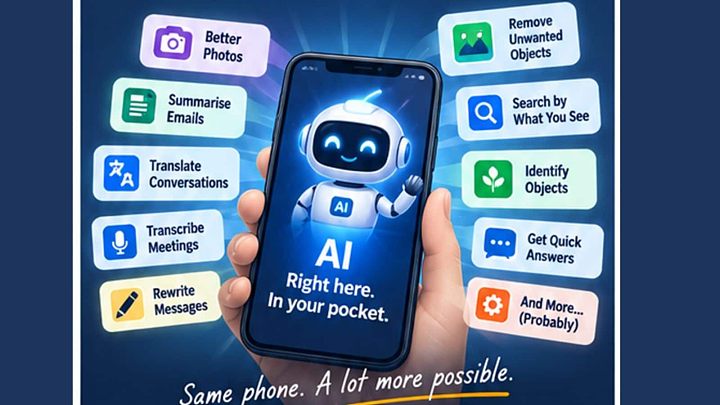
Suddenly my phone can summarise emails, remove strangers from photographs, translate conversations, rewrite messages, transcribe meetings, identify objects and search for something simply because I’ve drawn a circle around it. That’s quite a list.
The slightly confusing part is that smartphones have been doing plenty of “AI” things for years. Computational photography, face recognition, voice recognition, predictive text – all of it was already happening. We just didn’t have AI written across every presentation slide.
Apparently AI didn’t suddenly arrive in our phones. The marketing department did.
So what exactly is an AI phone?
There isn’t a single specification that suddenly turns an ordinary smartphone into an “AI phone”. In practice, the newer phones combine powerful processors, dedicated neural-processing hardware, AI models that can run on the device and other AI services that need the cloud.
Some jobs can happen entirely on the phone. Others still need an internet connection. Increasingly, the phone decides which route makes sense without bothering us with the details.
I do care about that distinction, mainly because of speed and privacy. If something can be processed on the phone, it may work offline and my information may not need to leave the device. Bigger AI jobs can still need the cloud, and that’s fine, as long as I’m told what’s happening.
What I don’t particularly care about is being told that the NPU can perform 47 trillion operations per second. Tell me what those 47 trillion operations are going to do for me. That’s more useful.
The camera is probably where AI earns its salary
Smartphone cameras have been quietly using computational tricks for years, so this is probably where most of us have already benefited from AI without thinking much about it.
Take a photograph today and the phone may combine several exposures, reduce noise, recognise faces, lift shadows, sharpen details and decide which parts of the picture need attention. Most of this happens before I’ve even opened the photograph.
Editing is where things have become more obvious. Remove the stranger who walked into your holiday photograph. Reduce reflections. Move something. Fix a photobomber. Search through thousands of photographs by describing what you’re looking for. A few years ago some of this needed proper editing software.
As an amateur photographer, I find this impressive and slightly disturbing at the same time. I spent years learning exposure, composition and timing. My phone seems to have a different philosophy: “Don’t worry. Take the picture. We’ll discuss your mistakes later.”
Summarising things is surprisingly useful
This is one of those features I initially thought I wouldn’t use much. I was wrong.
Long email? Give me the important bits. Meeting recording? Transcribe it. Twenty WhatsApp messages because I put the phone down for half an hour? Fine, tell me what everybody has been arguing about.
A webpage that takes 1,500 words to explain something that could have been said in 400? Actually, perhaps I shouldn’t criticise that while writing an article.
That’s where AI starts making sense to me. If it saves time, great. If it’s there mainly so the manufacturer can put AI on the feature list, I’m less interested.
Translation may be one of the genuinely important features
Live translation may not look as exciting on a launch-event screen as generating a cat wearing sunglasses, but I’d take the translation feature any day.
If I’m travelling and the phone can translate a conversation, a sign, a message or even a phone call, that’s solving a real problem. Add transcription and voice recognition and we’re doing things on a phone that would have sounded like science fiction not that long ago.
This is the sort of AI I like. I can immediately see why I’d use it.
Then we have AI writing
Phones can now rewrite messages, emails and notes. Make this more professional. Make it shorter. Change the tone. Fix the grammar. All useful, within reason.
The problem starts when the helpful rewrite no longer sounds anything like the person sending it.
If I suddenly send my friend Rajiv: “Dear Rajiv, I hope this message finds you well. I wanted to enquire whether you might be available for an informal social engagement this evening.”
He’s going to assume my phone has been stolen.
Sometimes “Beer at 8?” is already perfectly optimised language.
Circle something. Ask about it. Get an answer.
Visual search is another feature that feels as though it belongs naturally on a phone rather than being AI added for the sake of it.
See a pair of shoes you like? Circle them and search. Don’t recognise a building? Ask. See something on Instagram and have no idea what it is? Point the phone at it.
I like this because I don’t have to stop, open another app and work out what search terms to type. I can simply point at the thing I’m curious about.
The phone already has a camera, microphone and screen. Giving it a better understanding of what those are seeing and hearing is far more interesting to me than another benchmark number.
And then there are the AI features I’ll use exactly once
Every technology launch needs a few fireworks, and AI has given manufacturers plenty of them.
Generate a cartoon avatar. Turn your photograph into a sketch. Replace the background. Put yourself on Mars with a film star and a Bengal tiger. Very clever.
I’ll probably show it to three people, have a laugh and never open it again.
That doesn’t make these features useless. Some people will love them. I just think a feature that looks fantastic in a ten-second demonstration isn’t automatically something I’ll use every day.
We’ve been through this before. Remember AR stickers? Exactly.
The privacy question isn’t going away
This is the part I’d pay more attention to than the flashy demonstrations.
If AI is reading my emails, summarising messages, analysing photographs and transcribing conversations, I want to know where all that processing is happening.
Is it staying on the phone? Going to the cloud? Is anything stored? Can I switch it off? These aren’t particularly glamorous questions, but they’re important ones.
I’m more comfortable when sensitive work can happen on the device. I also understand that some complicated AI jobs will need the cloud. Just tell me clearly what leaves the phone and why.
“Powered by AI” sounds exciting. “We uploaded your personal information somewhere to process it” has a slightly different ring to it.
Should you buy a phone because it has AI?
Not for me. Not by itself, anyway.
I’d still buy the phone first: camera, battery, display, performance, software support, reliability and whether it fits the ecosystem I already use. Then I’d look at the AI features.
Because a mediocre phone doesn’t suddenly become a great phone because it can summarise an email.
And quite a few of today’s headline AI features will probably spread across phones, apps and operating systems anyway. That’s what usually happens.
I certainly wouldn’t replace a perfectly good phone because the new one can summarise my emails 1.7 seconds faster. My emails simply aren’t that exciting.
My Take
I don’t think the “AI phone” is a gimmick. I do think the label is being stretched rather enthusiastically.
AI will probably become part of the operating system to the point where we stop thinking about it. If a phone removes an unwanted object from a photo or translates a call instantly, eventually we’ll just expect it to work.
I’ll happily use AI to find photographs, translate conversations, remove unwanted objects, summarise something long, transcribe a meeting or help me find information faster. What I don’t need is forty-seven AI features buried in a menu that I forget exists after the first week.
My test is pretty simple. Does it save me time, solve a problem or let me do something I couldn’t easily do before?
If yes, brilliant. If not, putting AI in front of the name doesn’t make me want it more.
My washing machine has been deciding how much water to use for years, after all.
Thankfully, nobody has called it Laundry Intelligence Pro Max yet.