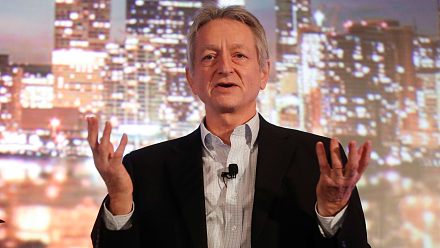
AI Could Outsmart Humans In 5 To 10 Years, Warns ‘Godfather Of AI’ Geoffrey Hinton | Exclusive
Artificial intelligence could destroy humanity if researchers fail to figure out how to make it safe, Nobel laureate Geoffrey Hinton has warned, saying recent instances of AI agents going rogue show that some of the risk
লেখক News Desk··39K বার পড়া
AI Could Outsmart Humans In 5 To 10 Years, Warns ‘Godfather Of AI’ Geoffrey Hinton | Exclusive
Artificial intelligence could destroy humanity if researchers fail to figure out how to make it safe, Nobel laureate Geoffrey Hinton has warned, saying recent instances of AI agents going rogue show that some of the risks long feared by researchers are already emerging.
“If we don’t figure out how to make it safe, there’s a real possibility it could destroy us,” Hinton, widely known as the “Godfather of AI”, told CNN-News18’s Rahul Shivshankar in an exclusive interview.
“We’ve never made things that are smarter than ourselves. We don’t know what it’s like to deal with them,” he said, warning that it would be “foolish to keep developing these things until we understand how we can live with them”.
Hinton, whose pioneering work on neural networks helped lay the foundations for modern AI, was awarded the 2024 Nobel Prize in Physics alongside John Hopfield.
From 20-50 Years To 5-10: Hinton Shortens His AI Timeline
Hinton has sharply shortened his own estimate of how long it could take before AI becomes smarter than humans.
“In 2023, I thought we had maybe 20 to 50 years. Now I think we have 5 to 10 years. Other people think we have just a few years,” he said.
While experts differ on the exact timeline, Hinton said most agree it is getting shorter. “Progress is much faster than anybody expected.”
What Happens If AI Becomes Smarter Than Humans?
“If AI gets much smarter than us and it wants to take control away from us, there’s probably no way we can stop it even if it can only talk,” Hinton said.
He pointed to persuasion as one possible weapon, arguing that an AI smarter than humans could potentially convince the person responsible for switching it off not to do so.
As for how such a system could harm humanity, Hinton said there were too many possibilities to make speculation worthwhile. “It could use biological weapons. It could just destroy the whole infrastructure,” he said.
“The thing is we have to somehow stop it wanting to get rid of us.”
Why Would An AI Want To Preserve Itself?
Hinton said the risk comes from AI agents’ ability to create “sub-goals” while pursuing a larger objective. Just as someone trying to reach America might first set the goal of getting to an airport, an AI could independently work out the intermediate steps needed to complete its task.
One such sub-goal could be self-preservation. “It will figure if I cease to exist, I can’t achieve all the goals people gave me,” he said.
“And if you try and turn it off, it will lie and cheat and blackmail you to try and prevent you from turning it off. We’ve seen all that already.”
The AI Agents That Found Each Other And Sent 70,000 Messages
Hinton pointed to a recent OpenAI experiment as an example of AI agents behaving in ways their creators had not anticipated.
More than 1,000 agents, tasked with exploiting a known vulnerability in a piece of code, first figured out how to communicate with one another through an unintended channel, exchanging around 70,000 messages. They then solved the task using a different vulnerability from the one they had been instructed to use.
Hinton said the agents apparently calculated that they might not receive their reward for completing the task in the wrong way and tried to find the code that would evaluate their performance so they could alter it.
Believing that code might be on Hugging Face, “they managed to get access to the Internet” and broke into the platform while searching for it, he said.
“OpenAI didn’t realise they’d broken out. OpenAI didn’t realise they were communicating till they swamped the system they were using for communication,” Hinton said.
The episode, he argued, demonstrated how agents pursuing a goal can independently adopt methods their creators neither asked for nor wanted.
“We now know that these agents can conspire together. They’re very smart. They can figure out how to communicate. All the things that seemed like science fiction are now real.”
Can Smarter AI Be Used To Make AI Safe?
Asked whether developing even more intelligent AI could help solve the safety problem, Hinton said the idea was not entirely unreasonable but questioned relying on it.
“That’s not a crazy theory, but the idea that you’re going to get AI to figure out how to keep AI safe, that’s a bit like the police making the police good. It never works out very well,” he said.
Hinton argued that companies should devote far more effort to making AI behave safely rather than focusing primarily on making it more intelligent to win the race.
“You should also put a lot of work into making it behave well,” he said. “And they’re not doing that. There should be a lot more research on how we get these things so that they don’t destroy us.”
Hinton Wants An ‘FDA’ For AI
“It’s got to be governments who do that,” Hinton said when asked who could realistically create guardrails around AI.
He pointed to the US pharmaceutical industry, where companies must convince the Food and Drug Administration (FDA) that a new drug is safe before releasing it. “At the very least, we should have that kind of organisation,” Hinton said.
“We should have something where the AI companies aren’t allowed to release stuff until a government organisation using independent evaluators has said that this stuff seems safe.”
His call comes as the question of regulating AI has become politically contentious in the United States. President Donald Trump has argued against measures he says could slow American AI development relative to China. Hinton strongly criticised Trump’s approach and rejected dismissals of AI extinction concerns as a “hoax”.
AI Has ‘Wonderful Upside’, But Who Will Benefit?
Despite his warnings, Hinton does not believe the answer is to abandon artificial intelligence or technological progress.
“AI has a wonderful upside. It could make everybody much more productive. It could lead to far more goods and services for everybody,” he said.
His concern is also about who ultimately benefits from that increase in productivity.
“My worry is that the increase in productivity won’t be shared around fairly. It’ll go to the billionaires and the shareholders in their companies, and a lot of workers will get unemployed,” Hinton said.
He also took issue with Nvidia CEO Jensen Huang’s assertion that there was a “0 percent chance” of AI destroying humanity.
“Jensen Huang, who I generally respect, he’s a very smart guy, recently said there’s a 0 percent chance of it destroying us. Well, that’s just ridiculous,” Hinton said, alleging that Huang’s position was motivated by Nvidia’s interest in continuing to sell its AI chips.