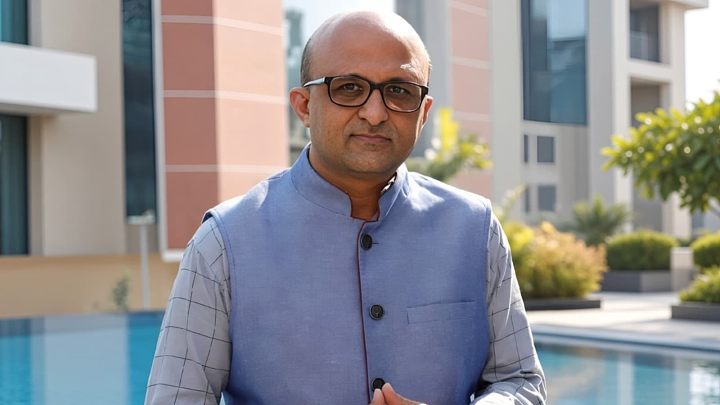
AC, Fridge And Other Home Appliances Are About To Become More Like A Smartphone: Havells India's Dipesh Shah
Your next air conditioner, refrigerator or other home appliance may have much more in common with a smartphone than you expect. The difference will not necessarily be in how the appliance looks, but in what happens behin
লেখক Debashis Sarkar··22K বার পড়া
AC, Fridge And Other Home Appliances Are About To Become More Like A Smartphone: Havells India's Dipesh Shah
Your next air conditioner, refrigerator or other home appliance may have much more in common with a smartphone than you expect. The difference will not necessarily be in how the appliance looks, but in what happens behind the scenes.
Dipesh Shah, Executive President and CTO of Havells India in an interaction with News18 said that the boundaries between hardware, software, connectivity, data and artificial intelligence are rapidly disappearing. That shift could change how consumer appliances are designed, developed and experienced in the coming years.
Shah says modern products are no longer simply pieces of physical hardware. Instead, they are increasingly becoming a combination of hardware, embedded software, connectivity, data and intelligence. As a result, the teams building these products also need to work differently.
For consumers, however, the interesting part is that this increasing technical complexity should actually make appliances feel simpler.
Why Your AC Or Fridge Could Work More Like A Smart Device
Shah believes hardware and software can no longer be developed as completely separate parts of a product. Hardware engineers, software teams, AI specialists and designers need to work together much earlier in the development process.
This is similar to the evolution of smartphones. A smartphone is not defined only by its processor, display or camera hardware. Software, connectivity, sensors, data and AI all contribute to the experience.
Home appliances are moving in a similar direction.
An air conditioner, for example, could increasingly use data about how it is being used to optimise its performance. A refrigerator could potentially learn usage patterns and adjust its operation accordingly. More broadly, connected appliances can generate information about how products perform in real-world conditions, which can then help manufacturers improve future models.
Shah says this could create a continuous learning loop, where information from connected products feeds back into product development and helps shape subsequent generations of appliances.
That means the product-development cycle could become less about launching a device and moving on to the next one, and more about continuously improving the experience based on real-world usage.
AI In Appliances Should Solve A Real Problem
While almost every major consumer electronics company is now talking about AI, Shah believes manufacturers need to be careful about adding artificial intelligence simply because it is fashionable.
For appliances, he sees the strongest opportunities in areas such as energy optimisation, predictive diagnostics, adaptive performance and convenience.
For example, an appliance that understands how it is being used could adjust its operation to improve performance while potentially using energy more efficiently. Similarly, if a product detects an abnormal operating condition early, it could help improve reliability and make servicing more proactive.
The key point, according to Shah, is that consumers should not need to understand the AI running inside their appliances.
Instead, they should simply notice that the appliance works better, consumes energy more intelligently, requires less intervention and is easier to use.
In other words, the technology should largely disappear into the experience.
The More Complicated Appliances Become, The Simpler They Should Feel
This may sound contradictory, but Shah believes increasing technical complexity should ultimately result in simpler products for consumers.
As appliances gain more sensors, connectivity, embedded software and AI capabilities, users should not necessarily be presented with more complicated controls and settings.
Instead, AI could increasingly handle some of that complexity in the background.
A connected appliance could understand usage patterns, optimise performance and personalise the experience without requiring the consumer to know what is happening inside the product.
This is where the smartphone comparison becomes particularly relevant. Modern smartphones perform an enormous amount of processing and optimisation without users having to understand the underlying technology. The same principle could eventually apply to appliances.
The refrigerator, AC or other connected device may become technically more sophisticated while becoming easier to operate.
Havells Is Building Its R&D Around This Shift
The move towards smarter and more connected appliances is also reflected in Havells’ R&D strategy.
The company invested ₹317 crore in R&D during FY26 and currently has four dedicated R&D centres. Havells is also developing a 7.3-acre integrated R&D campus in Noida that will be capable of accommodating nearly 2,000 engineers, researchers and product specialists.
According to Shah, Havells is strengthening capabilities in electronics, embedded systems, AI and connected technologies. The company says 46% of its R&D spending was directed towards sustainable technologies and product development during FY26.
The company’s Customer Experience & Design Studio is another part of this approach, bringing consumer behaviour and user experience closer to the engineering process.
Shah also pointed to Havells’ work on connected products and technologies such as the MotrON EV charger and Residential Solar Grid-Tie Inverter as examples of the company’s broader focus on smarter and more energy-efficient technology.
AI Could Also Change How Appliances Are Developed
The smartphone-like evolution is not limited to the finished product. AI is also changing how appliances are designed and developed.
Shah says AI is making product development more iterative and data-driven. It is being explored across areas including consumer insights, product conceptualisation, engineering, simulation, testing and validation.
Digital engineering and simulation can allow engineers to test more possibilities before committing to physical prototypes. Simulation can also help identify potential failure points and refine designs earlier in the development cycle.
However, Shah stresses that digital simulation should complement physical testing rather than replace it, particularly for electrical and consumer products where safety and reliability are critical.
India’s Appliances Will Need More Than Just AI
There is another important part of the equation: Indian consumers do not all live in the same conditions.
Shah says product requirements can vary significantly depending on region, climate, income and lifestyle. This means companies cannot simply take a technology developed for one market and assume that it will work equally well across India.
Havells’ new refrigerator plant at Ghiloth in Rajasthan, commissioned in March 2026 with a capacity of 12 lakh units per year, is cited by Shah as an example of manufacturing and engineering capabilities being developed around local requirements.
The company also reported broader FY26 manufacturing capex of ₹1,484 crore.
For the next generation of appliances, therefore, AI will only be one part of the story. Hardware engineering, embedded software, connectivity, industrial design, manufacturing and an understanding of consumer behaviour will all need to come together.
Shah’s broader message is that the industry should start with the consumer problem rather than the technology. If AI can solve that problem and deliver a measurable improvement, it has a purpose. If it is simply added as another feature, it may not provide much value.
That could ultimately define the next phase of smart appliances. Your AC or refrigerator may become far more sophisticated internally, with software, sensors, connectivity and AI working together much like they do in modern smartphones. But the goal, according to Havells’ CTO, is for all of that complexity to result in something much simpler: an appliance that understands how it is being used and quietly works better.