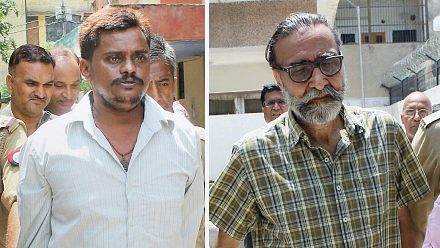
Surendra Koli, Who Survived 13 Death Sentences In Nithari Killings, Found Dead: Why Was It Called ‘House Of Horrors’ Case?
Surendra Koli, a former domestic worker, who was initially labeled the prime suspect and face of the 2006 Nithari serial killings, colloquially known as the ‘House of Horrors’ case, only to be acquitted later, was found
লেখক Manjiri Joshi··70K বার পড়া
Surendra Koli, Who Survived 13 Death Sentences In Nithari Killings, Found Dead: Why Was It Called ‘House Of Horrors’ Case?
Surendra Koli, a former domestic worker, who was initially labeled the prime suspect and face of the 2006 Nithari serial killings, colloquially known as the ‘House of Horrors’ case, only to be acquitted later, was found dead at a tea shop in Haridwar.
Who was he? What was his connection to bungalow D-5 in Sector 31, Noida, Uttar Pradesh — a wealthy residence owned by businessman Moninder Singh Pandher?
THE NITHARI ‘HOUSE OF HORRORS’ CASE RECAP
The case, one of India’s most infamous and chilling true-crime sagas, shocked the nation with accusations of child sexual assault, ritualistic murder, dismemberment, necrophilia, and cannibalism. However, it ultimately became a symbol of monumental failures within the Indian criminal justice system, culminating in the complete legal acquittal of both Koli and Pandher due to a severely botched investigation.
Between 2005 and 2006, at least 19 young women and children mysteriously vanished from Nithari village, a poor slum area immediately adjacent to Pandher’s affluent bungalow. Despite desperate and repeated complaints by impoverished parents, local Noida police largely ignored the disappearances.
The horror finally came to light in December 2006 when two residents discovered a decomposing human hand in a drain behind the bungalow. A subsequently ordered search of the property uncovered skulls, human skeletal remains, and clothing packed into plastic bags buried in the backyard and blocking the nearby municipal sewers.
Following their immediate arrests, the police produced a recorded video confession where Koli allegedly admitted to luring children inside the house with sweets, strangling them, sexually abusing the bodies, and dismembering them. The case triggered massive national outrage over extreme police negligence and systemic class bias.
However, the narrative heavily fractured over the next two decades as accusations surfaced that Koli’s confession was violently coerced, while critical alternate investigative angles—such as a potential illicit human organ trafficking ring connected to local clinics—were completely ignored by the authorities.
WHAT WAS KOLI’S ROLE? WHY WAS HE IN JAIL FOR 19 YEARS?
Surendra Koli was initially projected as the primary operational executioner who orchestrated the gruesome abductions, rapes, murders, and dismemberment of at least 19 women and children. However, following a series of dramatic legal turnarounds, the Indian judiciary acquitted him of all charges, heavily criticizing the investigation for framing him based on a coerced confession.
The Prosecution’s Case
According to the original police and Central Bureau of Investigation (CBI) narrative, Koli allegedly targeted women and children from the neighboring Nithari slum by offering them sweets, chocolates, or false promises of employment.He was accused of dragging them inside the house, strangling them, and sexually assaulting them (including acts of necrophilia).
The prosecution claimed Koli chopped up the bodies, threw the skeletal remains into a municipal drain behind the house, and allegedly cannibalized parts of the victims.
Koli initially gave a video-recorded confession accepting sole responsibility for the horrors, which temporarily exonerated his employer from major murder charges. He quickly retracted the confession, proving it was extracted under severe torture during an illegal 60-day police detention without legal representation.
Despite being sentenced to death 13 times by lower courts, upper courts completely dismantled the prosecution’s case. The High Court acquitted Koli in 12 cases, lambasting the police for a “botched-up” investigation. The court stated that the authorities opted for the “easy course of implicating a poor servant by demonizing him” to protect a potential organized organ-trading ring.
The Supreme Court allowed Koli’s final curative petition, acquitting him in his last remaining case. The apex court ruled that his convictions relied purely on “conjecture” and inadmissible evidence, ordering his immediate release from jail after nearly 20 years.
SURENDRA KOLI: THE MAN WHO SURVIVED 13 DEATH SENTENCES
Koli was sentenced to death multiple times—specifically 13 times by the lower special CBI trial courts between 2009 and 2022 for separate victim cases.
The Allahabad High Court handled a cluster of 12 cases together in October 2023. It completely overturned the convictions and cancelled the death sentences in all 12 of those cases due to a lack of reliable evidence and an extremely flawed investigation.
Koli had one separate, final conviction (the Rimpa Haldar case) where his death sentence had earlier been commuted to life imprisonment because of extensive delays in processing his mercy petition.
The Supreme Court of India systematically cleared him of that final 13th case as well, ruling that it would be a “travesty of justice” to keep him convicted on the exact same tainted evidence that failed in the other 12 cases.
DEATH ROW TO ACQUITTAL: THE NITHARI CASE TIMELINE
2005 – 2006: Dozens of children and young adults vanish from the Nithari slum area. Local police refuse to register missing person reports, dismissively telling some parents that their children had simply eloped.
December 2006: Human remains are discovered in the drains. Further excavations unearth 19 skeletal remains. Businessman Moninder Singh Pandher and his domestic helper Surinder Koli are arrested.
January 2007: Amid massive public outrage and the suspension of negligent local police officers, the Central Bureau of Investigation (CBI) takes over the probe, registering 16 to 19 distinct cases.
2009: A special CBI court hands out the first death sentences to both Koli and Pandher. Over the next few years, individual trials for the separate victims conclude with Koli receiving multiple death sentences and life terms.
September 2014 – January 2015: The Supreme Court commutes one of Koli’s death sentences to life imprisonment due to extensive procedural delays in executing his death warrant.
December 2017: In the highly publicised murder trial of victim Pinky Sarkar, the special CBI court again sentences both Pandher and Koli to death.
October 2023: The Allahabad High Court completely acquits both Pandher and Koli in the majority of their cases. The court harshly reprimands the prosecution, noting a severe “lack of evidence” and pointing out that the state failed to prove guilt beyond a reasonable doubt due to a perfunctory investigation. Moninder Singh Pandher is released from prison.
November 2025: The Supreme Court of India rules on Koli’s final remaining conviction. Overturning its own past orders, the apex court accepts Koli’s plea that his horrific confessions were extracted entirely under illegal police torture and rules the recovery of evidence legally unreliable. Fully cleared of all charges, Surinder Koli walks out of jail as a free man after nearly 20 years of incarceration.
September 2026: Following his release, Koli opens a small tea shop in Haridwar, Uttarakhand. Roughly ten months later, Surendra Koli is found dead, having hanged himself inside his shop.