Properties adapting to changing nature of storms in South West
Extreme weather events including named storms are forcing organisations to adapt their sites to protect themselves and visitors.
مصنف George Thorpe··20K بار پڑھا
Properties adapting to changing nature of storms in South West
Extreme weather events including named storms are forcing organisations to adapt their sites to protect themselves and visitors.
Storms Austen and Boelo wreaked havoc and caused disruption across the UK at the end of last week as they brought wind gusts of 85mph (137km/h) and heavy downpours of rain.
In south-west England, tourism and council bosses said they were having to battle with the "unpredictability" of the weather as the severity of storms appears to increase.
Several National Trust properties across Devon and Cornwall were forced to close during Storm Austen due to safety concerns.
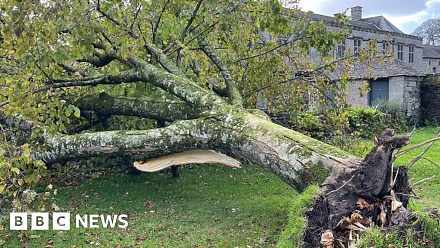
The charity said the stormy conditions caused widespread disruption at its properties including trees falling at Godolphin and Trengwainton Garden in Cornwall and Lydford Gorge in Devon.
It added part of the roof of the boiler room at Levant Mine near St Just in Cornwall suffered damaged while power cuts and fires were also reported across some sites.
Gareth Lay, general manager for Heart of Cornwall portfolio group at the National Trust which looks after properties including Trelissick and Trerice, said the damage from Austen had compounded issues caused earlier this year by Storm Goretti.
He said his team was trying to learn from what had happened during the storms in order to future proof the historic buildings, but there was only so much they could do.
"What we are seeing is an increase in the number of storms and an increase in severity of these storms," Lay said.
"It's really giving us a significant challenge in terms of how we can better plant or manage our properties to protect us from those storms.
"It's quite tricky to find new ways and different ways in how we can adapt the physical parts of our building to be more resilient to these storms."
Bosses at the Eden Project have also been considering how to keep their site safe for staff and visitors during stormy weather.
Phil Young, a horticultural manager at the site, said while the garden was relatively well protected from the elements, they did have to consider how to make it safer.
He said this included looking at the resilience of its tree stock and planting species with deeper roots.
"What I think we consider is unpredictability," Young said.
"That is where I'd say we're looking way, way, way into the future to make sure our plant collections and our site are adaptable."
He added wintry conditions could be just as problematic.
"I used to live 16 miles away from the site and one year a particularly hard snow storm came out of the blue and it took me four hours to get home," Young said.
East Devon District Council said it had a number of issues reported during Austen including debris such as sand and pebbles being blown on to seafront promenades.
Councillor Geoff Jung, portfolio holder for environment operations, said the authority had to deal with the "double whammy" of preparing for climate change and rising sea levels at the same time.