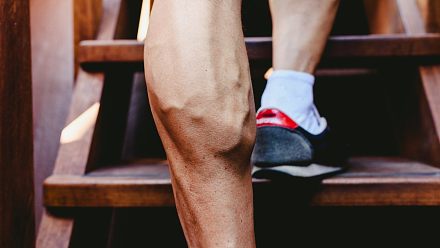
Your ‘Second Heart’ Is In Your Legs: Cardiologists Explains How To Activate It
You may not think much about your calf muscles when you are sitting at your desk, travelling in a car or binge-watching a series. But picture this: you’re halfway through a long desk day or a delayed flight, legs still,
مصنف Tanya Dutt··11K بار پڑھا
Your ‘Second Heart’ Is In Your Legs: Cardiologists Explains How To Activate It
You may not think much about your calf muscles when you are sitting at your desk, travelling in a car or binge-watching a series. But picture this: you’re halfway through a long desk day or a delayed flight, legs still, ankles crossed. Blood that left your heart hours ago is now fighting gravity to get back up from your feet. Your actual heart can’t do that job alone. That’s where the muscles in the back of your lower legs step in.
Because every time you walk, flex your ankles or simply rise onto your toes, your calves are helping move blood back towards your heart.
That is why calf muscles are popularly called the body’s second heart. The phrase is catchy, but it needs a little context. Your calves are not a second heart, nor can a few calf raises replace cardiovascular exercise. What they do have is an important mechanical role in venous circulation, particularly in helping blood travel upwards from the legs.
So, how does this work and can a few simple movements really make a difference? We spoke to cardiologists to understand how the calf help push blood from the lower legs back towards the heart through what doctors call the calf-muscle pump.
Why Are The Calf Muscles Called The Body’s Second Heart?
The heart pumps oxygen-rich blood throughout the body, while veins have to return blood from the lower limbs against gravity. This is where the calf muscles help.
“When we move or move our calf muscles, the muscles contract thereby pushing the venous blood in the lower legs upwards,” explains Dr Sameer Gupta, Sr Interventional Cardiologist, Group Head – Cath Labs, Director – Metro Group of Hospitals.
The veins contain one-way valves that prevent blood from flowing backwards. When the calf muscles contract, they compress nearby veins and help propel blood upwards. When the muscles relax, the veins refill.
Dr Gupta explains that this mechanism is known as the calf-muscle pump, helping maintain normal venous circulation and reduce blood pooling in the lower legs. However, he stresses that the phrase second heart should not be taken literally because the calf muscles do not perform the heart’s function.
What Happens In Your Legs When You Walk?
Think about what happens when you take a few steps after sitting for an hour.
Each contraction of the calf muscles squeezes the veins running through the lower leg. This increases pressure within the veins and encourages blood to move upwards. The venous valves then open to allow the blood through and close to prevent it from travelling backwards.
Dr Gupta walks through the sequence, “Movement results in the contractions of calf muscles, which also compress adjacent veins. This causes pressure build-up in veins, which enables upward blood flow to the heart. The venous valves then open to allow for blood movement up the veins and close after blood has flowed to prevent it from going back down. After the calf muscles have relaxed, veins are able to refill with blood from the lower leg. This process is essential, since legs are far from the heart and are usually below the heart level.”
In 2024, the World Health Organization reported that 31% of adults worldwide, approximately 1.8 billion people, were not meeting recommended levels of physical activity in 2022. WHO recommends that adults get at least 150 minutes of moderate-intensity physical activity or 75 minutes of vigorous activity each week.
When Does Sitting Become A ‘Heart’ Circulation Concern?
For someone working at a desk, eight or nine hours can disappear between emails, meetings and deadlines. The problem is not simply that you are not exercising. Staying stationary for long periods also means the calf-muscle pump is being used less frequently.
“Remaining seated or stationary for extended periods can lead to reduced activity of the calf muscle pump, resulting in accumulation of blood in the legs,” Dr Gupta notes. “This risk increases drastically in the case of individuals who sit for many hours continuously, for example, during frequent traveling or prolonged desk work. Simple movement of the legs and taking occasional walks can assist in the maintenance of normal blood circulation in the legs. One should not ignore any signs such as prolonged or unknown swelling, especially if it affects only one leg, pain or tenderness in the leg, as well as excessive warmth, redness, or change of skin colour. Since they might indicate the formation of blood clots or development of some complications.”
The concern can become more relevant during long-distance travel. The US Centers for Disease Control and Prevention notes that people travelling for more than four hours by air, car, bus or train can be at risk of blood clots because of prolonged sitting. It advises travellers to move their legs frequently, exercise their calf muscles and take breaks to stretch their legs.
What Warning Signs In The Legs Should You Not Ignore?
A little heaviness after sitting all day is one thing. Persistent or unexplained symptoms are another.
Dr Gupta advises people not to ignore prolonged or unexplained swelling, particularly when it affects only one leg, as well as leg pain or tenderness, unusual warmth, redness or changes in skin colour.
These symptoms can sometimes be associated with a blood clot or another circulatory problem and warrant medical assessment rather than being dismissed as ordinary tiredness.
If leg swelling is accompanied by sudden breathlessness, chest pain, coughing up blood, fainting or other signs of a possible pulmonary embolism, urgent medical attention is needed.
How Can You Activate Your Calf Muscles At Your Desk?
You do not necessarily need to turn your office break into a workout. Dr Rohit Goel, Associate Director of Cardiology at Max Hospital Gurugram, keeps the advice realistic: “The calf muscle pump can be engaged by the desk-bound workers through small actions that can continue from the same position without moving away from the seat. You can start by practicing raising the heels with the toes firmly placed on the ground and then advancing to raising the toes while keeping the heels down. You could try out ankle circles and alternating flexing and extending motions as well. This exercise does not require continuous standing, so anytime it is possible, you can get off your chair. You can walk around your office to gain some more benefit during the phone calls or short breaks.”
Dr Goel recommends to try this right now: feet flat, lift both heels 20 times, then rock onto the toes 20 times. Draw slow circles with each ankle. Stand and take a two-minute walk while on a call. These micro-moves restore the pump without turning the workday into a workout.
He also recommends ankle circles and alternating flexing and extending movements. Contract the calf muscles, release them and repeat. And when there is an opportunity to stand up, walking around the office during a phone call or taking a short movement break can provide additional activity.
What’s True About Your ‘Second Heart’ And What’s Not on Social Media?
Dr Goel draws the line carefully, “The helpful part of the second heart recommendation is to prompt you to move your legs every now and then, particularly if you’re seated for extended periods. While activities such as walking, ankle movements, heel lifts and regular standing may help activating the calf-muscle pump and normal venous circulation, social media can sometimes exaggerate the science by saying that calf-muscle activation can help strengthen the heart itself, get rid of toxins and improve the entire body’s circulation. There is not a separate heart in your legs, and calf exercises cannot replace cardio exercises, medical treatment and dealing with circulatory diseases.”
Does Activating Your ‘Second Heart’ Strengthen Your Actual Heart?
This is where social-media advice can go too far. The claims that calf exercises can strengthen the heart itself, flush toxins from the body or dramatically improve circulation throughout the body is not supported by the basic physiology described here.
“The helpful part of the second heart recommendation is to prompt you to move your legs every now and then, particularly if you’re seated for extended periods,” says Dr Goel.
Walking, ankle movements, heel raises and standing can help activate the calf-muscle pump and support normal venous circulation. But, as Dr Goel points out, “There is not a separate heart in your legs, and calf exercises cannot replace cardio exercises, medical treatment and dealing with circulatory diseases.”
That distinction matters. WHO’s 2024 physical-activity data reinforces the broader message that regular movement matters for cardiovascular health, with physical inactivity associated with a higher risk of cardiovascular disease and other chronic conditions.
So the next time you have been sitting for hours, you do not need a complicated workout. Stand up, walk for a few minutes, roll your ankles. raise your heels, move your toes.