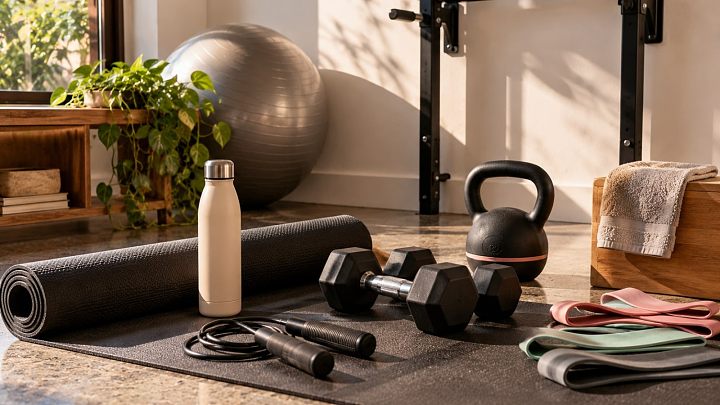
Your First Home Gym Doesn't Need 12 Machines: Start With These 6 Things
There is a particular kind of optimism that comes with deciding to get fit. Suddenly, the exercise bike looks tempting, the treadmill seems essential, and the elaborate multi-gym machine you spotted online starts to feel
مصنف Consumer Trends Desk··27K بار پڑھا
Your First Home Gym Doesn't Need 12 Machines: Start With These 6 Things
There is a particular kind of optimism that comes with deciding to get fit. Suddenly, the exercise bike looks tempting, the treadmill seems essential, and the elaborate multi-gym machine you spotted online starts to feel like a perfectly reasonable purchase. Before long, your shopping cart resembles the equipment list of a commercial fitness studio.
But a good home gym doesn’t need to begin that way.
Whether you have a spare room, a quiet corner of your bedroom or just enough floor space to roll out a mat, you can build a useful workout setup without investing in a dozen machines. The secret is to choose equipment that serves more than one purpose, works with your fitness goals and doesn’t turn your home into a storage facility.
The best home gym equipment is not necessarily the most expensive. It is the equipment that makes it easier to show up, train consistently and gradually challenge yourself.
Start with your space, not your shopping cart
Before buying anything, consider where you will exercise. Can you comfortably lie down on a mat, extend your arms and move through a squat without knocking into furniture? Is there somewhere to store weights safely? If you live in an apartment, can your equipment be packed away after a session?
These practical questions should come before the shopping.
It also helps to decide what you want from your workouts. Strength training, general fitness, mobility and cardio do not require identical setups. A few versatile pieces can support a broad range of exercises, but you should choose equipment that suits your actual routine rather than an imagined one.
Start small. Once working out becomes a habit, you can add equipment to meet specific needs.
The six things worth buying first
1. Adjustable dumbbells: your strength-training foundation
If strength training is part of your plan, dumbbells are among the most versatile pieces of equipment you can own. They can be used for squats, lunges, rows, presses, curls and a variety of other exercises.
Adjustable dumbbells are particularly useful when space is limited because one set can replace several pairs of fixed weights. Start with a manageable resistance, learn the movements correctly and increase the load as your strength improves.
Look for secure locking mechanisms, comfortable handles and a weight range that suits your current ability as well as your future progress.
2. Resistance bands: small equipment, plenty of possibilities
Resistance bands take up very little space, making them especially useful for compact home gyms and travel workouts.
Depending on the type and resistance level, they can be used for rows, glute exercises, shoulder work, mobility routines and assisted movements. They also provide an alternative to dumbbells for certain exercises.
Choose a set with different resistance levels rather than assuming one band will suit every movement. Inspect bands regularly for tears or damage, and follow the manufacturer’s guidance for safe use.
3. An exercise mat: the foundation of your workout corner
A mat may not be the most exciting purchase, but it can make a home workout more comfortable. It provides a designated surface for floor exercises, stretching, core work and mobility sessions.
Look for a mat that stays in place, offers enough cushioning for your routine and is easy to clean and store. If your workouts include standing exercises or dynamic movements, grip matters as much as thickness.
It also creates a useful psychological cue: once the mat is out, it is time to move.
4. A skipping rope: simple cardio without a bulky machine
Not every cardio workout requires a treadmill or stationary bicycle. A skipping rope is portable, easy to store and can be used for short bursts of cardiovascular exercise.
It is best suited to people who are comfortable with the impact involved. Beginners can start with short intervals and build gradually, while anyone with joint concerns, balance difficulties or relevant medical restrictions should consider a more suitable low-impact alternative.
Check that you have enough overhead clearance and a safe, non-slip surface before starting.
5. A kettlebell: one weight, multiple movement patterns
A kettlebell adds variety to strength and conditioning sessions. Depending on your experience, it can be used for goblet squats, deadlift variations, carries and other controlled movements.
The weight matters. A kettlebell that is too heavy can compromise technique, while one that is too light may not provide enough resistance for certain exercises. Start with a load you can control comfortably and learn the correct technique before progressing to more demanding movements.
You do not need a full rack of kettlebells to begin. One suitable weight can be enough to explore whether this style of training works for you.
6. A pull-up bar: an optional upgrade for upper-body training
A pull-up bar can expand your options for upper-body and grip training, particularly if you want to work towards pull-ups or chin-ups.
However, it is not essential for every beginner. Doorway and wall-mounted models have different installation requirements, and not every doorframe or wall is suitable. Check the manufacturer’s installation instructions and load limits carefully before use.
If installation is impractical, dumbbell rows and resistance-band exercises can provide alternatives for training the back.
What you can skip for now
The temptation to buy a treadmill, exercise bike, weight bench and multi-gym station at the same time is understandable. They look impressive, and each can serve a purpose. But none is automatically necessary for a beginner.
Large machines take up space, cost more and often serve a narrower set of purposes than a small collection of versatile equipment. Before investing, consider whether you have established a consistent routine and identified a specific gap that a new machine would fill.
If you enjoy walking, outdoor walks may be enough to meet your initial cardio goals. If you want to build strength, dumbbells and bands may be a sensible place to begin. And if you discover that you genuinely love cycling or running indoors, you can consider a dedicated cardio machine later.
The point is not to avoid buying equipment. It is to buy it in the right order.
How to build a home gym without overspending
A practical first setup can be built in stages:
Start with the basics: an exercise mat, resistance bands and a suitable pair of dumbbells.
Add variety: consider a skipping rope or kettlebell if it fits your goals and preferred style of training.
Upgrade with purpose: add a pull-up bar, bench or cardio machine only when you know why you need it.
Compare quality, weight options, storage requirements, warranty terms and safety features before buying. The cheapest item is not always the best value, especially if it is uncomfortable to use or difficult to store.
Most importantly, remember that equipment does not create a workout by itself. A realistic routine, correct technique, appropriate progression and enough recovery matter far more than the number of products lined up against a wall.
The takeaway
Your first home gym should make exercise easier to begin, not more complicated to maintain. Six carefully chosen essentials can offer plenty of variety without taking over your living space or your budget.
Start with what you need, learn what you enjoy and let your equipment evolve alongside your routine. The most impressive home gym is not the one with the most machines. It is the one you actually use.
Shop the six home gym essentials
If you are putting together your first workout corner, these are six types of equipment worth exploring. Choose the weight, resistance and dimensions that suit your needs, and compare the specifications before buying.
1. Rubber Coated Hexa Dumbbell Set for Men & Women Professional Exercise Hex Dumbbells for Full Body Workout, Upper & Lower Body Strength Training, Home Gym Exercise
A conventional dumbbell set for readers who want to start building a strength-training routine.
2. Cult Resistance Band for Workout (7–15 kg) – Fitness Band for Stretching, Pull-Ups, Yoga, Pilates & Strength Training (Red)
Compact resistance bands for a range of floor-based and accessory exercises.
3. CULT Yoga Mat EVA Strap
Floor exercises and stretching
A simple mat for creating a dedicated exercise space at home.
4. Adjustable skipping rope
Cardio
A compact option for short skipping intervals and conditioning. Look for adjustable length and comfortable handles.
5. Anti-Slip Grip Kettlebell for Home Workout
Strength and conditioning
A kettlebell option for controlled strength exercises. Choose a suitable weight for your experience.
6. Wall Mount Pull Up Bar for Home Gym
Upper-body training
A wall-mounted dip station for people with a suitable installation area. Check the mounting requirements before purchase.
Prices and availability may change. Verify current listings, specifications and seller details before publication.