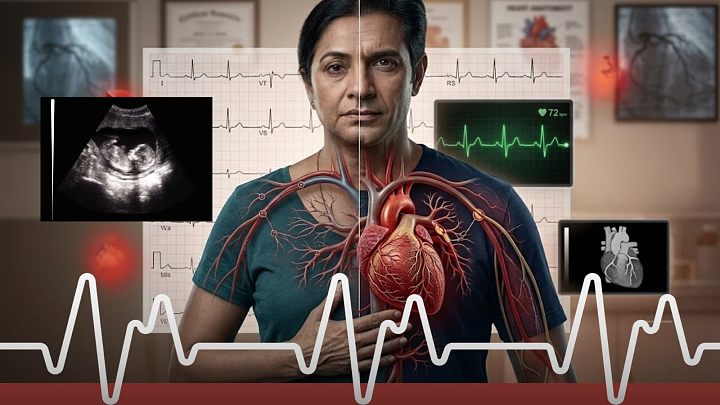
World Heart Day: What Makes Heart Disease Different In Women Than Men? Cardiologists Explain
Heart disease is often spoken about as though it follows one familiar script: crushing chest pain, pain spreading to the left arm and an urgent trip to the hospital. But women do not always experience cardiovascular dise
مصنف Tanya Dutt··23K بار پڑھا
World Heart Day: What Makes Heart Disease Different In Women Than Men? Cardiologists Explain
Heart disease is often spoken about as though it follows one familiar script: crushing chest pain, pain spreading to the left arm and an urgent trip to the hospital. But women do not always experience cardiovascular disease in that textbook pattern. The difference is not simply about symptoms. Biology, reproductive health, hormonal changes, patterns of blood-vessel disease and even gaps in medical research can influence how heart disease is recognised and managed in women.
Cardiovascular disease remains the leading cause of death globally, accounting for an estimated 19.8 million deaths in 2022, according to the World Health Organization. That makes understanding sex-specific differences in heart health more than a matter of awareness. It can affect how quickly symptoms are recognised and how risk is assessed.
On World Heart Day it feels worth slowing down and asking: what actually changes when the patient is a woman? How do the symptoms shift, which conditions show up more often, and why do so many women still walk into clinics later than they should?
To unpack these questions we spoke with two experienced cardiologists — Dr. Ajeet Bana, Chairman, Cardiac Sciences, EHCC Hospital, and Dr. Rohit Goel, Associate Director, Department of Cardiology, Max Hospital Gurugram. Both see these patterns every week in their practice.
Why Can The Same Heart Problem Look Different In A Woman Vs A Man?
A heart attack happens when blood flow to part of the heart muscle is suddenly reduced or cut off. While chest pain or pressure remains an important warning sign in women, they may also experience symptoms such as breathlessness, unusual tiredness, nausea, indigestion, sweating, dizziness or discomfort in the back, shoulder, jaw or upper abdomen. These symptoms can occur with or without chest pain.
Dr Ajeet Bana, says, “Men are more commonly associated with chest pressure or pain that may spread to the arm or jaw. Women can experience these symptoms too, alongside breathlessness, unusual fatigue, nausea, sweating, dizziness or discomfort in the back, shoulder or upper abdomen.”
Dr Rohit Goel, adds, “Because women’s symptoms often skip the textbook script. Men typically experience classic heart attack symptoms such as pressure or pain in the centre of the chest radiating to the left arm. Women are more likely to report non-classical symptoms such as breathlessness, nausea, indigestion, fatigue persisting for several days, discomfort in the jaw, back or upper abdomen and these are often dismissed as being due to stress or indigestion.”
That last part is particularly important. Breathlessness after climbing stairs or unusual exhaustion after a normal day can easily be attributed to lack of sleep, stress or household responsibilities. But a new, persistent or unexplained symptom deserves attention, particularly when a woman has risk factors such as diabetes, high blood pressure, high cholesterol, smoking, obesity or a family history of heart disease.
Dr Bana advises that women experiencing sudden, persistent or unusual symptoms, particularly when accompanied by breathlessness or sweating, should seek medical attention promptly. An ECG, cardiac biomarkers and other investigations can help determine whether the heart is involved.
What Heart Conditions Do Women Develop Differently?
Women have historically been underrepresented in several areas of cardiovascular research, although representation has improved over time.
One important difference involves the smaller blood vessels of the heart. Coronary microvascular dysfunction affects the tiny blood vessels that supply the heart. These vessels can malfunction even when the larger coronary arteries do not show a major blockage. The American Heart Association notes that coronary microvascular disease is more common in women and can cause chest pain, breathlessness, fatigue and low energy.
Dr Bana explains, “Coronary microvascular dysfunction is one example. It involves impaired function of the smaller blood vessels supplying the heart and may occur even when the major coronary arteries show little or no significant blockage.”
Another condition is spontaneous coronary artery dissection, or SCAD. This occurs when a tear develops in the wall of a coronary artery, potentially restricting blood flow and causing a heart attack. Most people affected by SCAD are women, and it can occur in women who do not have the conventional risk factors associated with coronary artery disease.
Dr Bana says women are also more likely to experience SCAD and adds that pregnancy-related cardiovascular complications and the hormonal and metabolic changes associated with menopause can influence cardiovascular risk across a woman’s lifetime.
Dr Goel also points out that “women more often have blockages in smaller vessels rather than one obvious clogged artery, which changes how the pain presents.” However, this should not be interpreted as meaning that women generally have smaller-vessel disease instead of conventional coronary artery disease. Women can develop the same major cardiovascular conditions as men, including coronary artery disease and heart attacks.
The key is not to wait for the stereotypical picture of an older patient with severe chest pain. Reduced exercise tolerance, breathlessness, fatigue, nausea or jaw and back discomfort can also be part of the clinical picture.
Can Pregnancy Affect a Woman’s Heart?
Pregnancy is an important cardiovascular window because some complications can signal a higher risk later in life.
Preeclampsia, gestational hypertension, gestational diabetes, preterm delivery and other adverse pregnancy outcomes have been associated with increased cardiovascular risk later in life. The American Heart Association recommends that a history of these complications be considered when assessing cardiovascular risk.
Dr Goel describes pregnancy as a potential “checkpoint” in cardiovascular health. He says, “Pregnancy can unmask risk early — gestational diabetes or preeclampsia are now known red flags for heart disease decades later, not just pregnancy complications.”
This does not mean every woman who develops a pregnancy complication will go on to develop heart disease. Rather, such a history can help doctors identify women who may benefit from closer monitoring of blood pressure, blood sugar, cholesterol and other cardiovascular risk factors after pregnancy.
Why Does Menopause Matter for Women’s Heart Health?
The menopause transition is another major point at which cardiovascular risk factors can change.
As women move through perimenopause, the period leading up to menopause, hormonal fluctuations are accompanied by changes in several cardiometabolic factors. Research cited by the American Heart Association shows increases in LDL cholesterol, metabolic risk and blood pressure during the menopause transition.
Dr Goel says, “Oestrogen offers women some protection before menopause, which is part of why heart disease shows up later in women than men on average. But every hormonal shift is a checkpoint.”
He adds, “As oestrogen drops, LDL cholesterol and blood pressure both start climbing, and this is usually when a woman’s heart risk starts catching up to a man’s.”
Recent AHA research also found that cardiovascular health scores decline across the transition from premenopause to perimenopause and postmenopause, with cholesterol and blood sugar among the factors contributing to the decline.
This is why menopause should not be viewed only through the lens of hot flushes, sleep changes or menstrual symptoms. It is also an opportunity to review cardiovascular health.
How Has The Historical Underrepresentation Of Women In Medical Research Affected Heart Care?
There has been a longstanding problem with the representation of women in cardiovascular clinical trials. A 2024 review found that women were underrepresented relative to the disease population in 62% of the cardiovascular trials it examined. A broader systematic review of cardiovascular trials registered between 2017 and 2023 found that women accounted for 41% of participants, with representation varying considerably by disease and type of intervention.
Dr Bana says, “Women have historically been underrepresented in several areas of cardiovascular research, although their representation has improved over time.”
Dr Goel adds, “Trials for decades enrolled mostly men, so dosing and even the symptom checklists doctors are trained on lean male by default.”
The research gap does not mean that women should automatically receive completely different treatments. The fundamental principles of cardiac diagnosis and treatment remain evidence-based. Instead, doctors need to account for differences in presentation, risk factors, anatomy and disease mechanisms when assessing an individual patient.
Dr Bana says, “The important consideration is to assess the individual rather than rely on a conventional picture of heart disease.”
He notes that depending on the clinical presentation, evaluation may include an ECG, cardiac biomarkers, imaging or coronary assessment. Treatment with medicines, procedures and cardiac rehabilitation should similarly reflect the patient’s condition, cardiovascular risk and available clinical evidence.
Why is Cardiac Rehabilitation Particularly Important for Women?
Recovering from a heart attack does not end when a patient leaves hospital. Cardiac rehabilitation combines supervised physical activity with education and management of cardiovascular risk factors.
Yet women are less likely than men to be referred to cardiac rehabilitation. The American Heart Association notes that women remain underrepresented in these programmes, with lower referral rates and barriers that can include social roles, medical conditions and financial constraints.
Dr Goel says, “Women also get referred to cardiac rehab less often after a heart attack, and even when they go, they’re less likely to finish the program — usually because they’re the ones running the household and caring for everyone else.”
Research has also identified family responsibilities, transport and other practical barriers as factors affecting participation.
Dr Goel calls rehabilitation “a core part of actually recovering”, rather than an optional addition to treatment. Dr Bana similarly says medicines, procedures and rehabilitation should be tailored to the patient’s clinical condition and risk.
What Heart-health Assumption about Women Needs to Change?
Perhaps the most persistent assumption is that being young, active or apparently healthy puts a woman outside the usual heart-risk conversation.
Dr Bana says, “The assumption I would most like women to move away from is that being young, active or otherwise healthy places them outside the possibility of heart disease.”
Dr Goel puts it more directly: “That heart disease is ‘a man’s problem’ and something to worry about later.”
The evidence does not support treating cardiovascular disease as an exclusively male concern. Women can develop conventional coronary artery disease, while also facing sex-specific conditions and risk factors involving the smaller coronary vessels, SCAD, pregnancy complications and the menopause transition.
For women, heart-health awareness therefore needs to extend beyond recognising dramatic chest pain. Knowing blood pressure, blood sugar and cholesterol levels, understanding family history, paying attention to changes in exercise tolerance and discussing pregnancy or menopause-related risk with a doctor can all form part of cardiovascular prevention.
As Dr Bana puts it, “Early evaluation creates an opportunity to identify cardiovascular risk and intervene before a major cardiac event occurs.”