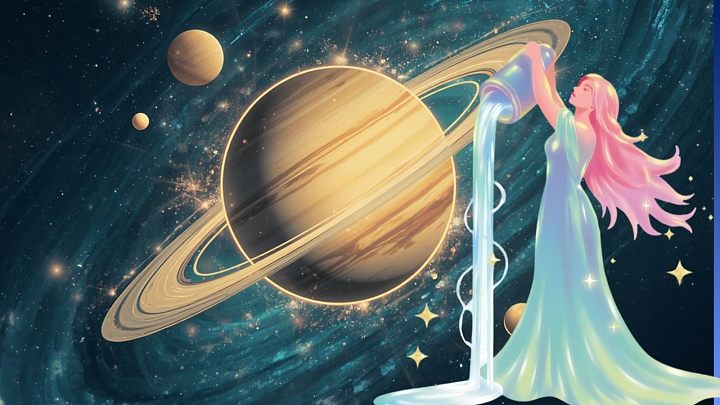
Saturn At Opposition: October Brings Saturn Closest To Earth: How You Can See It? Is It Visible In India?
Skywatchers have another reason to look up this October. Saturn will reach opposition on October 4, 2026, putting the ringed planet in one of the best positions for observation this year. At opposition, Saturn lies almos
مصنف Abigail Banerji··28K بار پڑھا
Saturn At Opposition: October Brings Saturn Closest To Earth: How You Can See It? Is It Visible In India?
Skywatchers have another reason to look up this October. Saturn will reach opposition on October 4, 2026, putting the ringed planet in one of the best positions for observation this year. At opposition, Saturn lies almost directly opposite the Sun from Earth’s perspective, meaning the planet is visible for most of the night, from around sunset until sunrise. It is also close to its brightest appearance of the year.
For anyone who has wanted to spot Saturn from Earth, October 4 is an excellent opportunity. Here’s everything to know about Saturn at opposition, including whether it will be visible from India, when to look up and whether you need a telescope.
Saturn is the sixth planet from the Sun and the second-largest planet in the solar system. It is a gas giant made primarily of hydrogen and helium and does not have a solid surface like Earth. NASA describes Saturn as the farthest planet from Earth that can be seen with the unaided human eye.
It is about nine times wider than Earth and takes approximately 29.4 Earth years to complete one orbit around the Sun. Despite its enormous size, Saturn rotates remarkably quickly, completing a day in only about 10.7 hours.
What Makes Saturn Unique?
The first thing that sets Saturn apart is, of course, its spectacular ring system. The rings are not a solid disc. They are made up of billions of pieces of ice and rock, ranging from tiny grains to much larger chunks. The main ring system stretches hundreds of thousands of kilometres across while remaining remarkably thin vertically.
Saturn also has an extraordinary collection of moons. NASA says Saturn has 293 confirmed moons as of August 2026, more than any other planet in the solar system. Among them are Titan, which is larger than Mercury, and Enceladus, an icy moon with a subsurface ocean and plumes that spray water ice and vapour into space.
What Is Saturn At Opposition?
In astronomy, opposition occurs when Earth comes between the Sun and an outer planet, placing that planet on the opposite side of the sky from the Sun. This makes the planet visible throughout much of the night and, because it is relatively close to Earth and fully illuminated by sunlight from our viewpoint, it appears particularly bright.
Saturn reaches opposition on October 4, 2026. The planet will rise around sunset and remain above the horizon through the night before setting around sunrise.
Will Saturn Be Visible In India?
Yes. Saturn will be visible from India during the night of October 4 and into the early morning of October 5, weather and local conditions permitting.
The exact timings depend on where you are located. Across India, the best strategy is to start looking after sunset once the sky has become sufficiently dark. Saturn will climb higher in the sky as the evening progresses, reaching its highest point around the middle of the night. Current sky charts for India show Saturn remaining visible for most of the night around this period.
How to view Saturn in Opposition?
For the clearest view of Saturn and its rings, choose a location away from bright city lights, with an unobstructed view of the sky and, ideally, stable weather. Urban observers can still spot Saturn because it is bright enough to be seen from many light-polluted locations, although darker skies make it easier to identify surrounding stars.
What Equipment Do You Need To See Saturn?
You don’t need expensive astronomy equipment simply to spot Saturn. Under reasonably dark skies, Saturn is visible to the unaided eye as a bright, steady-looking point of light.
For beginners, a few options can make the experience more rewarding:
Naked eye: Enough to locate Saturn in the night sky.
Binoculars: Useful for getting a closer look at the surrounding star field, although they generally won’t give you a clear view of Saturn’s rings.
Small telescope: The better choice if you actually want to see Saturn’s rings. Timeanddate notes that a small telescope is needed to resolve the rings.
Smartphone astronomy app: A sky-map app can help beginners identify Saturn and understand which direction to look.
If you’re buying or borrowing a telescope specifically for this event, a basic beginner telescope with a stable mount is more useful than investing in extremely high magnification. Atmospheric conditions and a shaky mount can make a bigger difference to what you see than simply having the highest magnification.