Rashmika Mandanna’s ‘MS Blue’ Sari Is a Fitting Tribute to M S Subbulakshmi, the Woman Behind India’s Most Iconic Voice
Rashmika Mandanna’s latest sari moment was less about a red-carpet fashion statement and more about stepping into character. At the launch of M.S. – A Legacy On Screen, the upcoming biographical film on legendary Carnati
مصنف Swati Chaturvedi··21K بار پڑھا
Rashmika Mandanna’s ‘MS Blue’ Sari Is a Fitting Tribute to M S Subbulakshmi, the Woman Behind India’s Most Iconic Voice
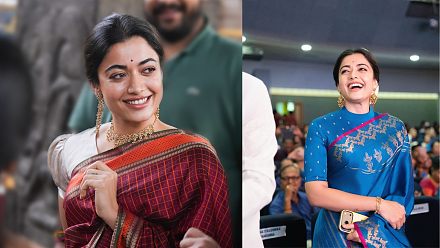
Rashmika Mandanna’s latest sari moment was less about a red-carpet fashion statement and more about stepping into character. At the launch of M.S. – A Legacy On Screen, the upcoming biographical film on legendary Carnatic vocalist and Bharat Ratna recipient M. S. Subbulakshmi, Mandanna paid homage to the woman she will portray on screen through two distinctly traditional sari looks. The most striking was a deep blue Kanjivaram silk sari in the shade that has become inseparable from Subbulakshmi’s legacy: MS Blue.
The choice was especially fitting. The film was launched at Chennai’s Music Academy on September 16, 2026, Subbulakshmi’s 110th birth anniversary with Kamal Haasan giving the ceremonial first clap. Directed by Gowtam Tinnanuri and featuring music by Anirudh Ravichander, the pan-India project will see Mandanna take on one of the most revered figures in Indian classical music.
Rashmika Mandanna’s ‘MS Blue’ Kanjivaram sari
For her first look, Mandanna wore the Shankarabharanam Kanjivaram silk sari from Aikyatha’s Suswaram Raga Edition. The sari is particularly interesting because its design is not merely inspired by Subbulakshmi’s colour palette; it has been conceived around classical music itself.
The handwoven silk begins in a deep MS Blue and gradually deepens into royal purple. Fine gold zari and temple-inspired motifs frame the border and pallu, giving the six yards the visual richness associated with traditional South Indian ceremonial silk. Aikyatha lists the sari at ₹49,999 and describes it as part of its numbered, Silk Mark-certified Suswaram collection.
The connection to Shankarabharanam is equally deliberate. The Raga Edition translates classical ragas into colour, texture and motif; in this particular sari, the raga is interpreted through the movement from blue to purple, gold zari and temple imagery. The result feels almost like a musical composition rendered in silk. And that makes the sari particularly appropriate for Subbulakshmi.
Why ‘MS Blue’ matters
Long before “celebrity style” became a modern phenomenon, M. S. Subbulakshmi had a visual signature of her own.
Her performances were associated with richly woven Kanchipuram silks, traditional gold jewellery, flowers in her hair and an understated, dignified beauty. But it was blue that eventually became particularly synonymous with her.
The shade now popularly called MS Blue is generally described as a distinctive, deep blue associated with the saris Subbulakshmi wore on stage. Nalli’s own account traces the story to 1951, when Subbulakshmi brought a blue thread into its store and asked for a sari in that particular colour; the weavers experimented with dyes to recreate it in Kanchipuram silk.
Another account from Tamil Nadu textile history credits Kanchipuram weaver Muthu Chettiyar with creating the distinctive shade that became associated with the singer. That association has endured so strongly that decades after Subbulakshmi’s death, simply wearing an MS Blue Kanjivaram can evoke her instantly.
And Mandanna clearly understands that visual vocabulary. The jewellery and makeup details complete the transformation Mandanna kept the styling rooted firmly in South Indian tradition.
For the blue sari, she wore gold jhumkas, traditional bangles, a delicate nath and a gold hair ornament, while her hair was pulled into a neat bun decorated with a generous wreath of fresh white jasmine flowers.
The jasmine is an especially effective detail. Rather than overwhelming the sari with contemporary accessories, the gajra reinforces the old-world concert aesthetic associated with Subbulakshmi.
Her makeup followed the same philosophy: a small red bindi, defined eyes, natural-looking skin and a restrained lip. There is no attempt to make the look overtly glamorous. Instead, the styling allows the sari, flowers and jewellery to carry the visual narrative.
It is a remarkably different approach from the heavily accessorised celebrity sari look. Everything has a reason.
Rashmika wore a second Kanjivaram sari too
Mandanna did not stop with MS Blue. She also appeared in a wine, purple and burnt-orange Kanchipuram silk sari from Sutrani, paired with an ivory Banarasi mashru blouse featuring delicate gold motifs. The sari has a geometric checked pattern, a richly coloured orange border and gold zari detailing.
This second look was styled with another set of traditional gold jewellery, including long earrings connected to kaan chains, a floral necklace, bracelets and gold hair accessories. Her hair was worn in a braid rather than the jasmine-adorned bun of the blue look. The makeup remained deliberately understated, with the red bindi and kohl-rimmed eyes keeping the focus on the sari.
The two outfits therefore tell the same story in different colours. The first is immediately recognisable as Subbulakshmi through MS Blue; the second draws from the broader visual vocabulary of the Kanchipuram silks she was known to wear.
More than a fashion reference: Rashmika is stepping into M. S. Subbulakshmi’s world
The sartorial choices also take on greater meaning because of the film itself. M.S. – A Legacy On Screen was unveiled on Subbulakshmi’s 110th birth anniversary, making the launch an intentional celebration of her cultural legacy rather than a conventional film announcement. The event featured performances of her music, while MS Blue was reportedly selected as the dress code, further establishing the colour as the visual thread connecting the evening to the legendary singer.
Rashmika is also approaching the role with a significant degree of preparation. Recent reports say she has begun training in Carnatic vocals for the part, while director Gowtam Tinnanuri has spoken about wanting to explore not just Subbulakshmi’s achievements but the human being behind the icon, her sacrifices, dreams and personal life.
That distinction is important. Subbulakshmi’s legacy is enormous: she was the first musician to receive the Bharat Ratna, India’s highest civilian honour, and the first Indian musician to perform at the United Nations General Assembly. She also received the Ramon Magsaysay Award and the Sangeetha Kalanidhi, among numerous other honours.
Her influence extended well beyond the concert stage. She appeared in films including Sevasadanam, Sakuntalai, Savitri and Meera, with the latter becoming her most famous cinematic role. After Meera, she largely withdrew from cinema and devoted herself to music.
View this post on Instagram
A post shared by Rashmika Mandanna (@rashmika_mandanna)
Her devotional recordings including Venkateswara Suprabhatam, Bhaja Govindam and Vishnu Sahasranamam became part of the everyday soundscape of generations of Indian households. She also gave extensively to charity, using her music to raise funds for numerous causes.
The symbolism of Rashmika’s sari moment
Seen in that context, Mandanna’s blue sari feels almost like a visual introduction to the role. The MS Blue silk, jasmine flowers, gold jewellery, traditional drape and red bindi aren’t random elements assembled to create a “South Indian” look. Together, they reference the visual identity through which generations of audiences remember Subbulakshmi.
And the Aikyatha sari takes that idea one step further: music itself has been translated into the weave. Its Shankarabharanam inspiration, temple motifs, gold zari and MS Blue-to-purple palette turn the sari into a tribute not only to the singer, but to the classical tradition she represented.
For an actor about to portray a woman whose voice became inseparable from India’s cultural memory, it is an unusually thoughtful way to begin.
Rashmika Mandanna isn’t simply wearing M. S. Subbulakshmi’s favourite colour. She is using the sari to introduce audiences to the visual world of the woman she is preparing to become on screen.