Prada Wants The Ultra-Rich. What It’s Really Selling Is Access
What does a luxury brand sell when its richest customers can already buy almost anything?Prada appears to have an answer: access. The Italian fashion house is increasingly courting its wealthiest customers with something
مصنف Swati Chaturvedi··6K بار پڑھا
Prada Wants The Ultra-Rich. What It’s Really Selling Is Access
What does a luxury brand sell when its richest customers can already buy almost anything?Prada appears to have an answer: access. The Italian fashion house is increasingly courting its wealthiest customers with something that goes well beyond the product itself, private cultural experiences, intimate dinners, exclusive access and pieces that exist at price points far removed from ordinary luxury shopping.
The strategy was on display during Milan Fashion Week, when Prada brought more than 100 of its top customers to the city and arranged private access to Leonardo da Vinci’s The Last Supper, along with dinners at restaurants reserved exclusively for the group.
It is a revealing shift in the way luxury is being sold.
Prada’s New Luxury Currency: Access
For decades, the traditional luxury proposition was relatively straightforward: craftsmanship, heritage, exclusivity and a product that most people could not easily afford. But the ultra-rich have moved beyond simply wanting expensive things.
They want things that are difficult to access. A handbag that costs $20,000 can be bought if you have the money. A private viewing of one of the world’s most famous works of art, followed by an intimate dinner arranged specifically for a select group of Prada’s biggest clients, is a different proposition.
The product becomes only one part of the relationship. Prada is effectively building a world around the customer.
And Then There Are the $100,000 Skirts
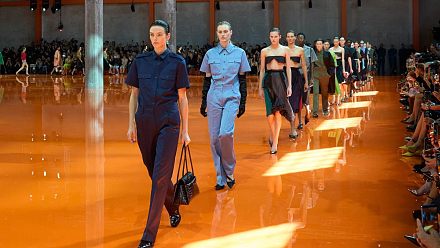
The other side of the strategy is, naturally, the product. At its Spring/Summer 2027 womenswear show in Milan, Prada put skirts at the centre of the collection, presenting 63 looks built around the garment rather than trousers or dresses. Miuccia Prada and Raf Simons used the skirt as a canvas for contrasting materials, proportions and styling.
But at the very top of the pricing pyramid, Prada is playing an entirely different game.
The Wall Street Journal reports that some of the brand’s most rarefied offerings can reach extraordinary prices, including a skirt around the $100,000 mark. Meanwhile, Prada showed crocodile handbags based on a revived 1920s design, with onyx clasps, that were offered exclusively to top clients for a little over $20,000. These aren’t products designed to compete on value. They’re designed to communicate rarity.
The Ultra-Luxury Customer Is Becoming More Important
The timing matters. Luxury fashion is navigating a difficult period, with spending from more aspirational and middle-income luxury shoppers under pressure. Major fashion houses are therefore paying greater attention to customers at the very top of the pyramid, people for whom a luxury purchase is less about affordability and more about distinction. Reuters has reported that luxury brands are investing heavily in stores, experiences and fashion shows as they attempt to justify premium prices and strengthen relationships with high-value customers.
That changes the equation for a company like Prada. The question is no longer simply: How many handbags can we sell? It is: How valuable can our relationship with our best customers become?
From Product to Private Club
This is where Prada’s approach becomes particularly interesting. The richest customer may not need another handbag. They may, however, want to be invited somewhere others cannot go.
They may want to meet the designer, see a collection before anyone else, access a historic site privately or attend a dinner where every guest has been carefully selected.
Luxury, in this world, starts looking less like retail and more like a membership business.
The product remains essential. But the experience around the product becomes part of what the customer is actually buying.
This isn’t unique to Prada. Luxury hotels, private clubs, jewellery houses, watchmakers and fashion brands have increasingly blurred the line between product and lifestyle. The most ambitious luxury companies are no longer simply selling objects; they’re constructing ecosystems around their customers.
Prada’s advantage is that it can combine fashion with culture, architecture, art and Milan itself.
Why This Matters for the Future of Luxury
The irony is that a $100,000 skirt may have less to do with selling skirts than it appears. At that level, price becomes a communication tool. It tells the customer that the item is rare, the production is limited and the brand is operating in a world that isn’t designed for mass consumption.
But the more interesting signal may be what Prada is doing around that product. Private access. Cultural experiences. Personal relationships. Invitation-only events. In other words, Prada isn’t simply asking the ultra-rich to buy more. It is giving them more reasons to belong.
And that could be where luxury’s next battle is fought: not over who makes the most expensive object, but over who can create the most desirable world to enter.