Karwa Chauth 2026: Why Women Use A Chalni (Sieve) To See Their Husband’s Face
Every Karwa Chauth evening, as families wait for the moon to appear, a familiar ritual unfolds in many Indian households. Women observing the fast offer prayers to the moon, look at it through a chalni (sieve) and then t
مصنف Lifestyle Desk··25K بار پڑھا
Karwa Chauth 2026: Why Women Use A Chalni (Sieve) To See Their Husband’s Face
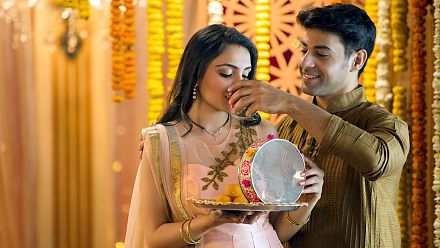
Every Karwa Chauth evening, as families wait for the moon to appear, a familiar ritual unfolds in many Indian households. Women observing the fast offer prayers to the moon, look at it through a chalni (sieve) and then turn the sieve towards their husbands before breaking their fast. It is a moment often captured in Bollywood films, but the custom has a significance that extends beyond its cinematic appeal.
Karwa Chauth is observed by many married Hindu women who fast and pray for their husbands’ well-being and longevity. The day is associated with devotion, faith and marital companionship, with the evening moon-sighting ritual marking an important moment before the fast ends. But why a sieve? And is there a particular order in which the ritual should be performed?
When Is Karwa Chauth 2026?
Karwa Chauth in 2026 falls on Thursday, October 29. According to the timings provided for the festival, the Karwa Chauth puja muhurat is from 05:38 PM to 06:56 PM, while the fast is from 06:31 AM to 08:17 PM, subject to local timings.
Women observing the traditional nirjala vrat abstain from both food and water until the moon is sighted and the customary rituals are completed. Although the fast is traditionally associated with married women, observances and participation can vary across families and communities.
Why Do Women Use A Chalni To See The Moon And Their Husband?
The chalni is one of the most recognisable objects associated with Karwa Chauth. Traditionally used to sift grain, the sieve takes on a symbolic role during the festival’s evening rituals.
The sieve represents clarity and focus. Symbolically, it is important because the sieve’s mesh filters out coarse things from fine grain, and impurities too. Similarly, the mesh during karwa Chauth filters out distractions and impurities, showing only what truly matters. Turning the sieve towards the husband is, in turn, understood by some families as a symbolic gesture of devotion and the bond between spouses.
The custom is also linked in popular explanations to the ghoonghat, or veil, traditionally worn by women in some communities. The sieve can function as a light, symbolic covering through which the moon and the husband’s face are viewed. Practices and explanations, however, differ across regions and households; there is no single interpretation shared by every community. In some families, a lit diya is also placed on or near the sieve during the ritual.
What Is The Correct Order Of The Karwa Chauth Chalni Ritual?
While the exact procedure varies, the moon-sighting ritual is commonly performed in the following sequence:
1. Offer prayers to the moon: Once the moon is visible, devotees perform the customary moon worship. In many traditions, this includes offering arghya, or water, to Chandra Dev.
2. Look at the moon through the chalni: The woman observes the moon through the sieve as part of the ritual.
3. Look at the husband through the same sieve: She then turns the sieve towards her husband and looks at his face through it. The gesture is associated with prayers for his well-being and the couple’s marital bond.
4. Break the fast: After completing the customary prayers, she breaks her fast. In many households, the husband offers her water or a morsel of food, although the exact practice varies.
The sequence is traditionally followed as part of the observance, but customs are not identical across all communities. Those observing Karwa Chauth often follow the instructions and practices passed down through their families.
What Should You Avoid During The Chalni Ritual?
There is no universally applicable rule that looking directly at the moon before using the sieve invalidates the fast. However, those following a particular family or regional tradition may be expected to observe the customary sequence.
If you are observing the ritual, keep these points in mind:
Follow your family’s customary sequence: If your tradition calls for offering arghya before moon-sighting through the sieve, complete the steps in that order.
Keep the ritual items ready: Have the chalni, water and other items used in your family’s puja prepared before moonrise.
Do not assume every household follows identical customs: Details of the ritual, including the use of a diya, vary by region and family.
Prioritise your health: A fast should not come at the expense of your well-being. If you feel unwell during a fast, seek appropriate medical advice rather than pushing through symptoms.