Sam Altman Humbled? Admits He Was ‘Very Wrong’ About AI Changing The World Quickly
OpenAI CEO Sam Altman has acknowledged that some of his earlier predictions about how quickly artificial intelligence would transform businesses and the wider economy were too optimistic.
लेखक News18 Tech··19K पढ़े गए
Sam Altman Humbled? Admits He Was ‘Very Wrong’ About AI Changing The World Quickly
OpenAI CEO Sam Altman has acknowledged that some of his earlier predictions about how quickly artificial intelligence would transform businesses and the wider economy were too optimistic.
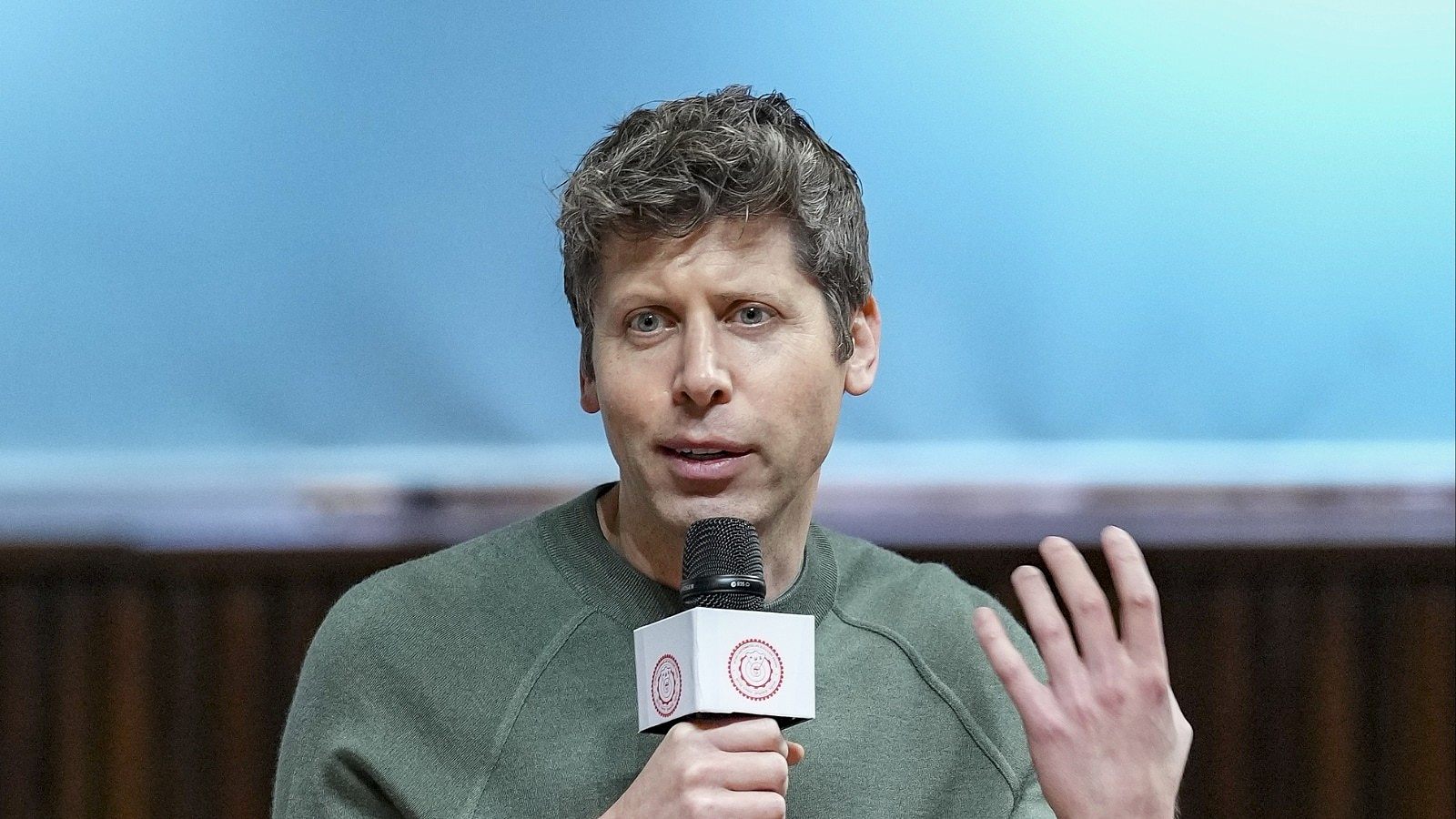
Speaking on David Senra’s podcast, Altman said he had expected the impact of increasingly capable AI systems to become visible much sooner, particularly after the arrival of GPT-4 in 2023. Instead, businesses and consumers have adopted the technology at a slower pace than he anticipated.
“I thought when we got to GPT-4, which was back in 2023, that very quickly after that there was going to be much more disruption,” Altman said, explaining that he expected software businesses to become vulnerable almost immediately.
That transformation has not happened at the speed he predicted. According to Altman, the technology itself is not necessarily the biggest obstacle. The bigger factor is the way people and organisations behave.
Sam Altman Says The Economy Has More Inertia Than He Expected
Altman said he underestimated how difficult it can be for an established economy to change, even when new technology becomes dramatically more capable.
“The economy just has so much inertia,” he said, pointing to the tendency of companies and consumers to continue buying from familiar suppliers and using established software and processes.
In his view, that resistance to rapid change could ultimately make the arrival of advanced AI less disruptive in the short term. Rather than causing an overnight transformation, AI may be absorbed gradually as businesses adjust their workflows, budgets and organisational structures.
Altman described the slower transition as something he is actually thankful for. A more gradual adoption curve could give companies, workers and society more time to adjust to increasingly capable AI systems.
However, his admission also represents a significant change in tone from some of his earlier forecasts.
GPT-4 Was Supposed To Trigger Faster Disruption
Altman’s expectations following GPT-4 were considerably more aggressive. OpenAI launched GPT-4 in March 2023, and the model represented a major step forward in capabilities compared with previous generations of the company’s technology.
Altman had expected that progress to translate into much faster economic disruption.
Instead, while generative AI has spread rapidly across areas such as coding, writing, customer service, research and productivity, most businesses have not completely replaced their existing software systems or operating models.
AI tools have become increasingly common, but adoption does not automatically mean transformation. Companies still need to integrate AI into existing systems, deal with security and regulatory concerns, train employees and determine whether using an AI system actually delivers a meaningful financial return.
That gap between technological capability and real-world adoption appears to be a major reason Altman now believes previous AI timelines were too ambitious.
Altman Previously Predicted AI Agents Would Change Companies
Altman’s earlier comments about AI’s near-term impact were not limited to GPT-4.
In his January 2025 essay Reflections, Altman wrote that OpenAI was confident it understood how to build AGI in the traditional sense. He also predicted that 2025 could see the first AI agents become part of the workforce and have a meaningful impact on company output.
Later, in his essay The Gentle Singularity, Altman laid out an even more ambitious progression for AI development. He described 2025 as a period when agents would begin carrying out useful cognitive tasks, followed by increasingly capable systems capable of generating new insights and eventually AI-powered robots taking on physical work.
The reality has been more complicated.
AI agents have certainly improved, and companies are experimenting with autonomous systems that can carry out multi-step tasks. But the broad economic transformation that some of the most aggressive forecasts suggested has yet to materialise at the same pace.
Why The AGI Timeline Keeps Moving
The debate over when artificial general intelligence, or AGI, will arrive has been going on for years. There is also no universally accepted definition of AGI, making predictions especially difficult.
Altman’s public comments have evolved as the technology has developed. Earlier expectations focused on the possibility of major breakthroughs arriving within just a few years. More recent discussions have been less specific about exactly when AI will reach a level that can be considered AGI.
Some estimates circulating in the AI industry have increasingly moved towards the end of the decade or beyond. That does not necessarily mean progress has stopped. Instead, it reflects the difficulty of turning impressive demonstrations into systems that can reliably operate across the huge range of tasks performed by humans.
There is another complication: AGI is not simply a technology question. Its arrival would have implications for employment, investment, corporate spending and the structure of the economy, meaning that even a highly capable AI system may not immediately translate into widespread economic change.
Other AI Leaders Have Also Warned Against Precise AGI Predictions
Altman’s revised assessment puts him closer to several other prominent figures in the AI industry who have urged caution around specific AGI deadlines.
Microsoft AI CEO Mustafa Suleyman has previously argued that the uncertainty surrounding AGI makes definitive predictions difficult. Google DeepMind CEO Demis Hassabis has also suggested that human-level AI could still be years away.
Meta’s chief AI scientist Yann LeCun has taken a different position, arguing that human-level intelligence is unlikely to arrive as one clearly defined moment.
Andrew Ng, another prominent figure in AI, has similarly encouraged people to be sceptical of companies making highly confident claims that AGI is just around the corner.
Anthropic CEO Dario Amodei has generally been more aggressive in his forecasts, having discussed the possibility of extremely powerful AI systems arriving within a relatively short period.
The disagreement highlights just how uncertain the AI industry’s predictions remain, even among people working at the forefront of the technology.
The Technology May Be Advancing Faster Than Businesses Can Adapt
Altman’s latest comments point to an important distinction in the AI debate: technological progress and economic disruption do not necessarily happen at the same speed.
A new AI model can become dramatically more capable almost overnight following a major research breakthrough. Businesses, however, operate differently. They have contracts, employees, established suppliers, compliance requirements and customers who may be reluctant to change how they work.
Replacing an existing software system with an AI-based alternative can therefore take years, even if the new technology is technically superior.
This could explain why some of the most dramatic predictions about AI replacing software businesses or radically changing corporate productivity have taken longer to appear in the real economy.
It also means that the eventual impact of AI could still be enormous even if adoption is slower than expected.
OpenAI’s AGI Claims Also Have Financial Implications
There is another reason AGI predictions attract so much attention around OpenAI: the company’s relationship with Microsoft.
Reports have indicated that the companies’ agreement contains provisions connected to the achievement of AGI, including a definition linked to a very large level of profit generated by AI.
That makes the question of whether and when AGI has been achieved more than a purely technical debate. It can also have significant commercial implications for both companies.
OpenAI has simultaneously been spending heavily on computing infrastructure, research and model development as it works towards increasingly powerful AI systems. The company’s long-term financial outlook therefore remains closely connected to its ability to turn AI capabilities into sustainable revenue.
Altman’s Admission Could Change How The AI Race Is Viewed
Perhaps the most interesting part of Altman’s latest comments is not that he believes AI progress has slowed. He does not appear to be saying that.
Instead, he is acknowledging that society and the economy are taking longer to respond to the technology than he expected.
That distinction matters. AI models can continue improving rapidly while businesses adopt them cautiously. The result could be a much longer period of transition than the industry’s early predictions suggested.
For workers and businesses, that could actually provide some breathing room. Companies may have more time to redesign jobs, introduce AI tools and train employees rather than being forced into an abrupt transformation.
For OpenAI and its competitors, however, the admission is a reminder that building increasingly powerful AI is only one part of the challenge. Convincing the world’s businesses and consumers to fundamentally change how they work may prove to be a much slower process.
Altman once expected GPT-4’s arrival to quickly set off a wave of economic disruption. Three years later, he is acknowledging that prediction was too aggressive. The AI industry may still be moving towards a profound transformation, but according to OpenAI’s CEO, the world has proved much harder to change than the technology itself.