He Bought A ₹1.5 Lakh Sony Bravia TV. But It Got 'Green Lines' Within Warranty Period, Then Sony Sent A ₹5 Crore Legal Notice For 'Protesting'
Sony Bravia TV: A warranty dispute involving a Sony Bravia television has taken an extraordinary turn after a consumer says he received a ₹5 crore legal notice from Sony India following a public campaign over his failed
लेखक News18 Tech··41K पढ़े गए
He Bought A ₹1.5 Lakh Sony Bravia TV. But It Got 'Green Lines' Within Warranty Period, Then Sony Sent A ₹5 Crore Legal Notice For 'Protesting'
Sony Bravia TV: A warranty dispute involving a Sony Bravia television has taken an extraordinary turn after a consumer says he received a ₹5 crore legal notice from Sony India following a public campaign over his failed TV.
The consumer, identified publicly as Laxmi Kant Tiwari, says his ₹1,50,031 Sony Bravia television developed vertical lines around 22 months after purchase, despite being covered by Sony’s three-year warranty. According to his account, Sony’s service process classified the problem as “external damage” and rejected the warranty claim.
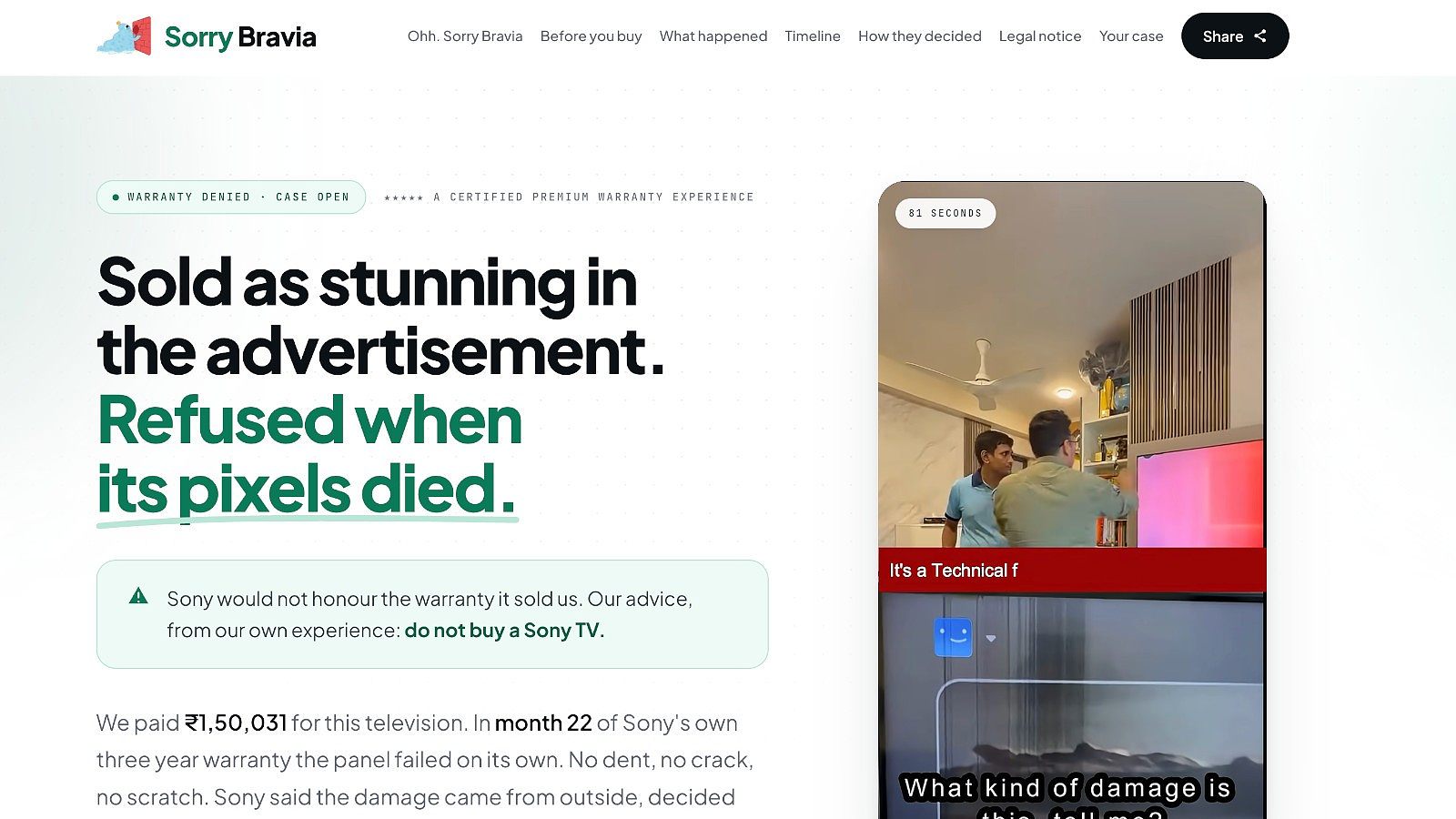
What happened next has now attracted significant attention online. Tiwari bought the domain SonyBravia.com and published what he describes as a complete record of the dispute, including his timeline, service correspondence and photographs. On September 1, 2026, he says lawyers representing Sony India sent him a six-page legal notice demanding that he remove the website and related posts, issue an unconditional apology and face possible civil and criminal action involving damages of ₹5 crore.
The website now carries the title “Sorry Bravia” and says the consumer’s complaint has already been filed and is pending.
How The Sony Bravia Warranty Dispute Started
According to the account published on SonyBravia.com, the television in question is a 55-inch Sony Bravia K-55XR70 Mini LED TV, purchased on September 20, 2024, for ₹1,50,031.
The consumer says the television was covered by Sony’s own three-year warranty, while he also purchased a two-year extended warranty from Croma for ₹20,789.
The problem reportedly appeared on July 2, 2026, when vertical lines started appearing on the display. The website says the television was wall-mounted and had not been dropped, moved or knocked.
“No dent, no crack, no scratch,” the website says while describing the condition of the television.
A technician subsequently visited the consumer’s home and photographed the display. According to the consumer’s account, those photographs were sent to another team through WhatsApp. Sony’s service decision was then communicated as damage caused by an “external cause”.
The consumer says he was subsequently given a repair estimate of ₹29,130. That is where the dispute intensified.
“I Asked Sony For Two Months To Show Me The Proof”
The central argument made by Tiwari is not simply that the television developed lines. He says his repeated request to Sony was to explain exactly what physical damage had caused the panel failure.
On his public profile, Tiwari wrote: “I asked Sony for two months to show me the proof behind ‘external damage’.”
His website similarly says that he repeatedly asked what test had been performed and what specific damage had been identified.
“What test did you do? What damage do you mean?” reads the account of the questions he says he put to Sony.
According to the website, he says he received several responses but did not receive the technical report or evidence he was requesting.
The website states that Sony’s written rejection referred to the display panel being “damage[d] due to external cause” and attached a photograph of the failing screen.
Tiwari argues that a photograph showing a malfunctioning display does not, by itself, establish what caused the failure. “A photo of a dead screen proves the screen is dead. It does not prove who broke it, or what broke it.”
That statement is presented on the website as the central question behind the dispute.
The Website Also Records A ₹10,000 Cash Allegation
The consumer’s website makes another serious allegation concerning the July 3 service visit. It claims that the technician offered to get the television covered under warranty for ₹10,000 in cash.
The website reproduces the consumer’s recollection of the alleged conversation in Hindi:
“Agar aap 10k do, to warranty me cover karwa dunga, turant. Nahi to humne photo upload kar di hai. Sony wale aapko batayenge ki warranty milegi ki nahi.”
The website translates this as an offer to get the television covered under warranty immediately in exchange for ₹10,000, otherwise Sony would decide whether the warranty applied.
Importantly, the website itself makes clear that this is the consumer’s account of the conversation, rather than a documented finding. It says the alleged cash offer was reported to Sony in writing, but that no finding had been made on the allegation.
That distinction is important because neither the cash-offer allegation nor the consumer’s wider accusations should be treated as established facts unless independently proven.
Then Came The ₹5 Crore Legal Notice
The dispute took a much more dramatic turn on September 1.
According to the legal-notice page published by Tiwari, a six-page notice arrived by email from Rise Legal, New Delhi, on behalf of Sony India Private Limited.
The website says the notice demanded three major things.
The YouTube video, X posts and SonyBravia.com website should be removed and permanently deleted.
An unconditional apology should be issued within seven days.
If those demands were not met, Sony would pursue civil and criminal legal action, including damages “to the tune of Rs. 5 crores”.
The website quotes the notice as demanding that the content be “Immediately remove and permanently delete” the material and that the consumer “Tender an unconditional apology”.
These are descriptions and quotations published by the consumer from the legal notice; Sony’s legal position should not be confused with a court ruling.
The consumer says the notice itself did not contain the technical report he had been asking for.
His website lists what he says was missing from the notice: a technical report, the name of any test performed on the panel, and a photograph showing the alleged dent, crack or other physical mark that caused the failure.
Why Did He Buy SonyBravia.com?
Instead of simply posting about the dispute on social media, Tiwari created a dedicated website at SonyBravia.com.
The site contains a detailed timeline beginning with the purchase of the television and continuing through the warranty dispute, service visits, correspondence and the legal notice.
It also includes photographs of the television, details of the claimed warranty coverage and copies or descriptions of correspondence.
The website repeatedly states that it is not affiliated with Sony, sells nothing and carries no advertising. It also describes itself as a personal consumer-awareness account based on the owner’s correspondence, service records and photographs.
At the bottom of the site, the consumer says Sony, its service partner or anyone featured who believes something is incorrect can contact him. He says any correction or reply will be published unedited.
The site also has a section inviting other Sony customers to submit their own warranty experiences.
“Show Us The Evidence And We Will Publish It”
Following the legal notice, Tiwari has said he does not intend to remove the material.
His website states: “Show us the evidence and we publish it here, unedited, within 72 hours.”
He has also said that his consumer complaint remains pending.
The consumer’s position is therefore relatively straightforward: he wants Sony to establish why the television was classified as having external damage, while Sony’s lawyers have reportedly challenged the online material and demanded its removal.
At this stage, it is important to distinguish between the two sides. The consumer’s website documents his version of events and publishes material he says supports his account. The legal notice represents the position of Sony India and its lawyers. A legal notice is a demand or warning and is not itself a court judgment establishing that either side is right or wrong.
The consumer says he has already filed a complaint before a consumer commission and that the matter is pending.
His public response to the legal notice is that he will not apologise or remove the material, while continuing to invite Sony to provide the evidence behind the external-damage diagnosis.
The case could therefore develop on two separate tracks: the consumer dispute over the television warranty and the legal dispute surrounding the website, social-media posts and alleged defamation.
For consumers, the episode also highlights why keeping purchase invoices, warranty documents, photographs and service correspondence can be important when an expensive electronic product develops a fault.
For now, the most striking question at the centre of this particular dispute remains the one Tiwari has repeated throughout his website: “Where is the physical damage?”
Whether Sony ultimately provides further technical evidence, whether the consumer complaint results in a ruling, and how the legal dispute over the website develops remain to be seen.