US Midterms 2026: Trump’s Big Test As Democrats Launch Bid To Wrest Congress From Republicans
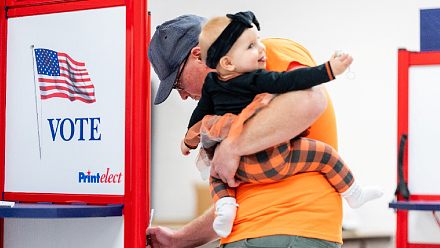
More than 53 million Americans have already voted, setting a new record for early participation in a US midterm. Democrats are increasingly optimistic about reclaiming the House and Senate, with Trump’s approval ratings,
লেখক Shankhyaneel Sarkar··87K বার পড়া
US Midterms 2026: Trump’s Big Test As Democrats Launch Bid To Wrest Congress From Republicans
More than 53 million Americans have already voted, setting a new record for early participation in a US midterm. Democrats are increasingly optimistic about reclaiming the House and Senate, with Trump’s approval ratings, the cost-of-living squeeze and a deeply contested electoral map putting Republicans on the defensive.
Donald Trump may not be on the ballot, but Tuesday’s US midterm elections could still turn into a referendum on his presidency.
With all 435 seats in the House of Representatives and 35 of the Senate’s 100 seats up for grabs, Democrats are hoping to turn voter dissatisfaction with the economy and the president into control of Congress. Republicans, meanwhile, are fighting to retain their majorities and prevent the final two years of Trump’s second term from becoming a prolonged battle with a Democratic-controlled legislature.
The latest projections suggest the party has reason to worry. Decision Desk HQ (DDHQ), in its November 2 forecast, gives Democrats an 84% chance of winning the House and a 65% probability of taking the Senate. Its model projects Democrats could emerge with 241 House seats and a 52-48 advantage in the upper chamber.
The Senate forecast is particularly significant. Republicans currently hold a 53-47 majority, meaning Democrats need a net gain of four seats to take control. DDHQ gives Democrat James Talarico a 62% chance of winning in Texas, Mary Peltola a 61% chance in Alaska and Troy Jackson a 65% chance of defeating Republican Senator Susan Collins in Maine.
These are forecasts, not predictions of certain victories. Several contests remain close, and the final outcome could hinge on turnout among independents and voters who supported Trump in 2024 but are now unhappy with his administration.
The stakes are considerable. A Democratic takeover of either chamber would complicate Trump’s legislative agenda, while control of both would give the opposition party a powerful platform to investigate the administration, block appointments and challenge the president’s priorities.
The record participation has added another layer of uncertainty to an election in which both parties are trying to turn enthusiasm into votes.
Here are five storylines to watch as the United States votes:
1. Can Trump inspire his voters and win over independents?
Trump has repeatedly urged supporters to treat the midterms as if he himself were on the ballot. He has travelled across the country campaigning for Republican candidates, holding rallies in states such as Iowa and Kansas over the final weekend.
But mobilising the president’s core supporters may not be enough. Republicans are facing a difficult political environment, with Trump’s approval ratings under pressure and voters increasingly concerned about the cost of living.
The Iran war and the administration’s tariff battles have added to the squeeze on fuel, fertiliser and other goods. The impact is particularly sensitive in agricultural states, where higher input costs can hit farmers directly.
The administration has promised $15 billion in assistance to agricultural producers, including payments to offset higher diesel costs. Trump’s campaign appearances in Iowa and Kansas also underline how seriously Republicans are taking the threat in states that have traditionally leaned towards the party.
The problem for Republicans is that a strong turnout among committed Trump voters may not compensate for discontent among independents and swing voters. As the Associated Press reported on the eve of the election, even vulnerable Republicans have acknowledged that the Iran war is making it harder for the party to defend its congressional majorities.
2. Will the polls get it right this time?
The final polls have given Democrats reason to be optimistic, but the margins are narrow enough to leave room for surprises.
A New York Times/Siena University survey released on November 1 showed Democrats leading in all seven closely watched Senate races it examined — Alaska, Iowa, Kansas, Maine, Michigan, Ohio and Texas.
In Texas, Talarico led Republican Ken Paxton 50% to 43%. In Alaska, Peltola was ahead of Republican incumbent Dan Sullivan 48% to 46%. Maine Democrat Jackson led Collins 51% to 45%.
The other contests were also encouraging for Democrats: Josh Turek led Ashley Hinson 48% to 47% in Iowa; Adam Hamilton led Roger Marshall 49% to 44% in Kansas; Abdul El-Sayed led Mike Rogers 53% to 42% in Michigan; and Sherrod Brown led Jon Husted 49% to 44% in Ohio.
But the polling institute cautioned that several races remained within the margin of error. Iowa, in particular, was described as virtually tied, while the institute said a Senate majority for either party remained possible.
The polling industry is also under scrutiny after allegations that two purported polling firms falsified data during the campaign. Any major miss on Election Day could revive questions about whether surveys are adequately capturing the political mood, particularly in states where polling has struggled in recent election cycles.
For Democrats, the challenge is converting a favourable national environment into victories in individual states. For Republicans, the hope is that the polls have underestimated their support.
3. Are Latino voters moving back towards Democrats?
One of the biggest questions in the election is whether the Republican gains among Latino voters in 2024 will hold. Trump made significant inroads with the community during his presidential comeback. According to a 2025 Pew Research Center analysis, Latino voters shifted 22 percentage points towards Republicans between 2020 and 2024. Joe Biden had won the group by 25 points in 2020; Kamala Harris lost it by three points in 2024.
But the political mood may be changing again. Surveys released in October by NBC News/Telemundo and Pew Research Center put Trump’s approval rating among Latino voters at just 27% and 24%, respectively.
The economy and immigration remain important factors, but the cost of living could prove decisive. If Latino voters who backed Trump over economic concerns in 2024 return to the Democrats, it could have consequences well beyond the Senate races — particularly in competitive House districts and states such as Texas.
4. Will Republican spending overcome Democratic momentum?
Republicans have enjoyed a substantial financial advantage in the campaign, spending heavily on television advertising and mobilisation efforts. The party has also benefited from outside spending by groups such as MAGA Inc., Trump’s political action committee, and America PAC, backed by billionaire Elon Musk.
Yet money does not automatically translate into votes. Democrats in several competitive Senate contests have reported stronger fundraising performances than their Republican opponents, and the latest polling has suggested that the political momentum may be moving against the governing party.
The final days of the campaign have also exposed divisions among Democrats. In Michigan, Congresswoman Haley Stevens, who lost the Democratic Senate primary to El-Sayed, endorsed Republican candidate Mike Rogers instead.
The move angered party leaders, including Senate Minority Leader Chuck Schumer, who called it a “despicable betrayal”. Stevens said El-Sayed’s campaign had made her unwelcome, while the Democratic nominee sought to play down the fallout and focus on issues such as the cost of living.
The endorsement could complicate Democratic efforts in a state where the Senate race is central to the party’s hopes of taking control of the chamber. Whether it changes the outcome, however, will only become clear when votes are counted.
5. Could old swing states become competitive again?
Perhaps the most striking feature of this election is the number of traditionally Republican states that Democrats now believe they can contest.
Texas, Alaska and Kansas are all part of the Senate battleground, while Iowa and Ohio have also emerged as important tests of the political environment. These are not states Democrats would normally expect to sweep in a midterm.
Ohio is particularly significant. Brown, a former senator seeking a comeback after losing in 2024, is challenging Republican incumbent Husted. The state is also hosting a closely watched gubernatorial contest between Democrat Amy Acton and Republican Vivek Ramaswamy.
In Texas, Talarico is attempting to turn a competitive race against Paxton into a historic Democratic breakthrough. In Alaska, former congresswoman Peltola is challenging Sullivan, while Maine’s Jackson is seeking to unseat Collins, one of the most closely watched Republican incumbents.
The final New York Times/Siena polling has put Democrats ahead in all three contests, but none is a guaranteed victory. Even a small shift in turnout could change the result.
For Republicans, losing ground in states that Trump carried in 2024 would be a warning that the coalition which returned him to the White House may not be holding together. For Democrats, victories in these states would signal that the party’s recovery extends beyond traditionally Democratic territory.
What is at stake?
The US Congress has two chambers, and control of each carries different political consequences. The House has 435 voting members, all elected every two years. The Senate has 100 members, with roughly one-third facing voters every two years.
A party needs 218 seats for a majority in the House and 51 in the Senate, with the vice-president able to break a 50-50 tie. Democrats therefore need to win four net Senate seats from the current 53-47 Republican split.
A Democratic victory in either chamber would constrain Trump’s ability to push legislation through Congress. If Democrats win both, the president could face a legislature controlled by his political opponents for the final two years of his term. The election is also a test of whether Trump’s influence can still deliver victories for Republicans when he is not personally seeking office.