Mann Misses It, Saini Attends It: Punjab Vs Centre Continues Even At Chief Justice’s Swearing-In
Justice Ashwani Kumar Mishra was on Monday sworn in as the full-time Chief Justice of the Punjab and Haryana High Court, triggering a political standoff between the Punjab government and the Central government.
লেখক Manjiri Joshi··191K বার পড়া
Mann Misses It, Saini Attends It: Punjab Vs Centre Continues Even At Chief Justice’s Swearing-In
Justice Ashwani Kumar Mishra was on Monday sworn in as the full-time Chief Justice of the Punjab and Haryana High Court, triggering a political standoff between the Punjab government and the Central government.
The drama stems from the Punjab government’s strict opposition to his appointment, which culminated in Punjab Chief Minister Bhagwant Mann skipping the swearing-in ceremony altogether.
PUNJAB VS CENTRE
The Punjab Cabinet held an emergency meeting on Sunday, passing a formal resolution objecting to the appointment. They alleged that the Central government cleared and notified the appointment on September 5 “without awaiting” or considering the Punjab government’s response regarding his suitability.
The Punjab government claimed that by pushing the appointment through without their inputs, the Centre violated the established Memorandum of Procedure (MoP) for appointing High Court judges.
The state cabinet formally requested Punjab Governor Gulab Chand Kataria to put the administration of the oath on hold until their concerns were adequately addressed.
THE SWEARING-IN CEREMONY
Despite the Punjab government’s formal objections, the ceremony moved forward on Monday morning at Lok Bhawan in Chandigarh.
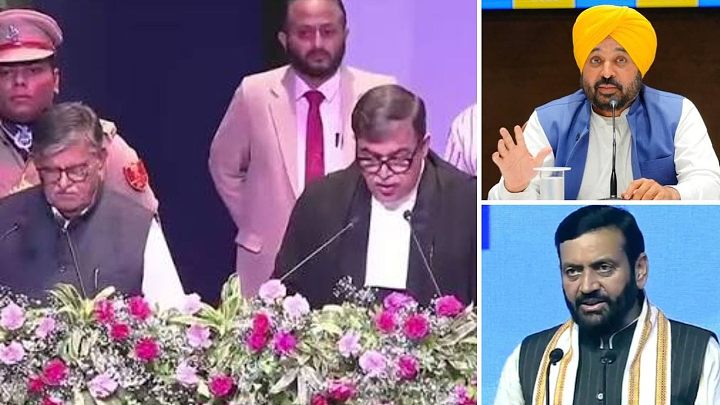
Governor Gulab Chand Kataria administered the oath of office to Justice Mishra, who had already been functioning as the court’s Acting Chief Justice since June 2026.
While Punjab CM Bhagwant Mann skipped the event to travel to New Delhi, his Haryana counterpart, Haryana CM Nayab Singh Saini, attended the ceremony alongside Haryana Governor Prof. Ashim Kumar Ghosh. Traditionally, chief ministers from both shared states attend the ceremony.
#WATCH | Chandigarh: Punjab Govt’s objections regarding the appointment of Justice Ashwani Kumar Mishra as the Chief Justice of the Punjab and Haryana High Court, Additional Solicitor General of India Satya Pal Jain says, “The resolution passed by the Punjab Cabinet yesterday,… pic.twitter.com/xosoO521di
— ANI (@ANI) September 7, 2026
WHAT DOES THE LAW SAY
The legal framework governing the appointment of a High Court Chief Justice (HC CJ) is centered on the principle of “consultation,” not “concurrence” or “consent.” Under Indian law, the state government holds a consultative role but does not possess veto power over judicial appointments made by the Central Government and the Supreme Court Collegium.
Under Article 217(1) of the Indian Constitution, every High Court Judge (including the Chief Justice) is appointed by the President of India. The Constitution mandates that the President must consult:
The Chief Justice of India (CJI)
The Governor of the State concerned
Because the Governor acts on the “aid and advice” of the State Council of Ministers, the Chief Minister and the state executive are systematically brought into this consultative loop.
The definitive legal meaning of “consultation” was shaped by the Supreme Court through the landmark Judges’ Cases (specifically S.P. Gupta v. Union of India, 1981, the Second Judges’ Case, 1993, and the Third Judges’ Case, 1998). The apex court ruled that “consultation” with the judiciary means the binding opinion of the Supreme Court Collegium. Legal experts and former law ministers emphasize that while the state’s views are entitled to weight, they are not binding on the Central Government or the President. The law explicitly requires the state to be consulted, but it does not require the state’s concurrence (agreement).
The Union Ministry of Law and Justice follows a set of guidelines called the Memorandum of Procedure (MoP). Under Para 6 of the MoP, once the SC Collegium recommends a name, the Union Law Minister forwards it to the state government to obtain its views before sending the final proposal to the Prime Minister and President. The MoP does not prescribe a clear, strict time limit for the state government or the Governor to send their recommendations.
HOW IT APPLIES TO PUNJAB DISPUTE
The state received the Centre’s letter on August 12, 2026. Because the MoP sets no fixed deadline, the state argues the Centre “hurriedly” notified the appointment on September 5 without waiting for their response. The Centre says the SC Collegium made the recommendation on August 6, 2026. All other states responded within a week, but Punjab did not send its views for an extended period.
Punjab argues that proceeding without their inputs violates federal principles and established constitutional norms. The Centre says allowing a state to sit on a judicial file indefinitely would freeze the judicial process, disrupt the inter-se seniority of judges across batches, and trigger institutional anomalies.
Ultimately, because the state’s feedback is consultative rather than a mandatory sign-off, the Centre acted within legal bounds to push the file forward. Justice Mishra officially took his oath of office as Chief Justice on September 7, 2026, bypassing the state’s protests.