20-Foot-Deep Well Under UP’s Saharanpur Collectorate Mosque? ASI To Probe
A 20-foot-deep, 1.5-metre-wide well discovered beneath a demolished mosque inside the Saharanpur Collectorate complex has opened a new chapter in the controversy surrounding the site, with the Archaeological Survey of In
লেখক Oliver Fredrick··96K বার পড়া
20-Foot-Deep Well Under UP’s Saharanpur Collectorate Mosque? ASI To Probe
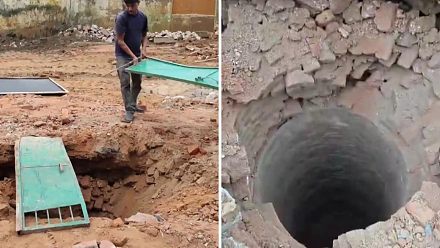
A 20-foot-deep, 1.5-metre-wide well discovered beneath a demolished mosque inside the Saharanpur Collectorate complex has opened a new chapter in the controversy surrounding the site, with the Archaeological Survey of India (ASI) expected to examine the structure to determine its age, origin and possible historical significance.
The well was discovered on Sunday while workers were clearing the rubble of the mosque, which was demolished by the district administration on Saturday. The unexpected discovery has attracted considerable attention because the structure was lying hidden beneath the mosque and covered by a heavy slab.
The most striking question now confronting officials and residents is – How old is the well, who built it and why was it covered? There is no official answer yet.
According to details emerging from the site, workers encountered a heavy slab while removing the debris. The slab reportedly proved difficult to remove, following which cutting equipment was used. Once it was opened, the shaft of the well was found underneath. The well is estimated to be around 20 feet deep and 1.5 metres wide. Its construction and exact age have not yet been established.
The administration is expected to seek an expert assessment, including an examination by the ASI, before drawing any conclusions about the structure.
A BURIED STRUCTURE RAISES A BIGGER QUESTION
The discovery has transformed what was primarily a dispute over the legality of the mosque into a question about what existed at the site before the mosque was constructed.
Was the well already present when the mosque came up?
Was it an old source of water associated with an earlier settlement or building?
Or was it constructed at a later stage and subsequently covered?
At present, none of these possibilities has been established.
The ASI examination could potentially look at the masonry, construction technique, materials and other physical characteristics of the well. If material remains are found around or inside it, they could also help experts establish a possible chronology.
The discovery has generated curiosity among people in the area, particularly because the well was hidden beneath a structure that had stood inside the Collectorate premises for decades.
The sudden appearance of a deep shaft beneath the demolished structure has prompted residents and onlookers to ask why such a substantial structure was not known to the public and when it was sealed.
However, the mosque’s management has claimed that the structure was several decades old, with some accounts putting its age at more than a century. The administration, however, treated it as an unauthorised structure on government land.
The newly discovered well could now become an important physical feature in understanding the history of the site — but only if experts are able to establish its chronology.
WHAT THE ADMINISTRATION, OPPOSITION SAY
The administration’s position remains that the mosque was an unauthorised structure constructed on government land. The demolition followed a legal dispute in which a district court upheld the earlier eviction order.
Saharanpur DIG Abhishek Singh said the City Magistrate’s court had found the mosque to have been illegally constructed on government land and that the mosque committee’s appeal had subsequently been dismissed.
The demolition itself has triggered a political controversy, with opposition leaders questioning the manner and timing of the action. SP MP Iqra Hasan alleged that she was placed under house arrest when she sought to travel to Saharanpur, while Akhilesh Yadav criticised the action and stressed the need to respect different faiths.
BJP ally and Uttar Pradesh minister Om Prakash Rajbhar has defended the administration’s action, saying the government was implementing the court’s decision. He has also taken a political swipe at Akhilesh Yadav over the controversy, asking whether the SP chief would visit the site and offer fatiha.
Opposition leaders, meanwhile, have questioned the demolition and the government’s handling of the dispute.
For now, the 20-foot well remains the biggest unanswered question at the Saharanpur Collectorate site. Its depth and substantial construction suggest that it was not merely a shallow pit, but its age cannot be determined from its appearance alone.
An archaeological examination could establish whether its construction predates the mosque, whether it belongs to an older phase of the site and whether anything inside it can help establish its history.
Until that investigation is complete, the well remains exactly what it appears to be — a mysterious structure that lay hidden beneath the mosque and surfaced only after its demolition.
And for locals watching the developments, the question is likely to remain the same — What was there before the mosque and what can this buried well tell us about it?