BRICS FM Joint Statement: IMF-World Bank Reforms, AI, Local-Currency Payments, GIFT City Risk Lab In Focus
The BRICS Finance Ministers and Central Bank Governors have backed measures to deepen financial and economic cooperation among member countries, with a focus on development financing, cross-border payments, local-currenc
লেখক Mohammad Haris··28K বার পড়া
BRICS FM Joint Statement: IMF-World Bank Reforms, AI, Local-Currency Payments, GIFT City Risk Lab In Focus
The BRICS Finance Ministers and Central Bank Governors have backed measures to deepen financial and economic cooperation among member countries, with a focus on development financing, cross-border payments, local-currency settlements, trade facilitation, infrastructure and emerging technologies.
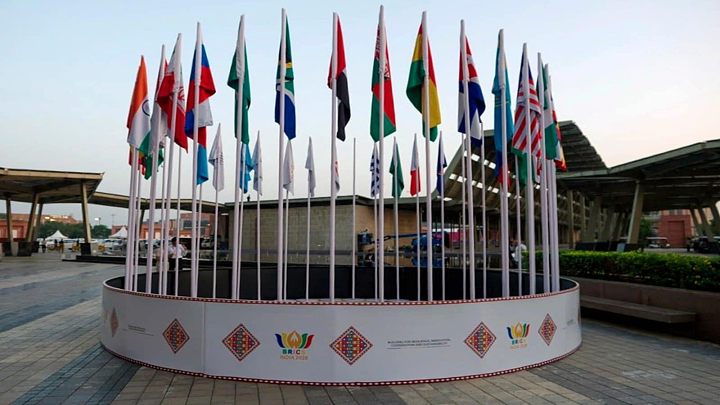
The decisions were outlined in the Joint Statement issued after the BRICS Finance Ministers and Central Bank Governors met in Mumbai on September 10. The meeting was held under India’s 2026 BRICS theme of ‘Building for Resilience, Innovation, Cooperation and Sustainability’.
BRICS Payment Task Force on cross-border interoperability of payments
One of the key areas highlighted in the statement was the development of more efficient cross-border payment mechanisms among BRICS countries. The BRICS Payment Task Force has been examining the interoperability of payment and messaging channels and the use of local currencies for trade settlements and investments.
“We acknowledge the work done to study the cross-border interoperability of payment and messaging channels, and the discussions on promoting trade settlements and investments using BRICS local currencies, while respecting national priorities and acknowledging that there is no one-size-fits-all approach. We encourage the BPTF to continue discussions, building on the ongoing work, to facilitate practical solutions for cross-border payments among BRICS countries, which are fast, low-cost, more accessible, efficient, transparent, and safe,” according to the statement.
It said discussions on local-currency trade settlements would continue.
“We encourage the BPTF to continue discussions, building on the ongoing work, to facilitate practical solutions for cross-border payments among BRICS countries, which are fast, low-cost, more accessible, efficient, transparent, and safe,” the statement said.
Greater role for New Development Bank
The BRICS countries also backed a larger role for the New Development Bank (NDB) in financing development and infrastructure projects across member countries and the wider Global South.
The finance ministers and central bank governors encouraged the NDB to mobilise more resources, expand local-currency financing, strengthen project-preparation facilities, diversify funding sources and support high-impact projects aimed at inclusive and sustainable growth.
“As it embarks on its second golden decade of high-quality development, we recognise and support the growing role of the New Development Bank (NDB) as a robust and strategic agent of development and modernisation in BRICS and the Global South,” according to the joint statement.
BRICS Multilateral Guarantees to help mobilise private capital
The group also welcomed progress on the BRICS Multilateral Guarantees (BMG) initiative, being prepared by the NDB.
“We welcome the progress made in advancing the BRICS Multilateral Guarantees (BMG) initiative in line with the guidance provided by BRICS Leaders in 2025. We note the preparatory work undertaken by the NDB for the pilot phase of the initiative under its existing Policy on Guarantees aimed at supporting sustainable development, and resilient infrastructure projects,” according to the statement.
The initiative is aimed at supporting sustainable development and resilient infrastructure projects. According to the statement, it could help mobilise private capital, improve creditworthiness and reduce financing costs for development projects in BRICS countries and the Global South.
The members called for continued technical work and the development of pilot transactions, which could provide a basis for expanding the initiative in the future.
Investment platform gets further push
The statement also noted progress on discussions around a proposed New Investment Platform (NIP). BRICS members supported continuing technical discussions on the platform through a dedicated Study Group under the Finance Track. The approach will be consensus-based, phased and member-driven, while respecting national sovereignty and different regulatory frameworks.
“Pursuant to Leaders’ encouragement to continue technical-level efforts on the New Investment Platform (NIP) and building on the guidelines finalised under the Brazilian Chairship, we welcome the progress achieved under the Indian Chairship in advancing discussions on the NIP,” it said.
For businesses and investors, the initiative could eventually provide another mechanism for cooperation around investment, although the statement indicates that technical work on its structure and operating modalities is still continuing.
BRICS backs reform of global financial institutions
The statement also called for changes to global economic governance, particularly greater representation for emerging markets and developing economies in institutions such as the IMF and World Bank.
BRICS members reiterated the need to reform the Bretton Woods Institutions to make them more representative and responsive to the changing global economy. They said the voice and representation of EMDEs should better reflect their position in the global economy.
“We also reiterate our call for improved management procedures, including through a merit-based, inclusive and transparent selection process that would increase regional diversity and representation of EMDEs in the leadership of the IMF and the World Bank,” according to the statement.
On IMF reforms, the group called for the implementation of quota increases agreed under the 16th General Review of Quotas and for approaches to meaningful quota realignment under the 17th review.
“We urge entry into effect of the quota increases agreed under the 16th General Review of Quotas (GRQ) with no further delay and call for the development of approaches to meaningful quota realignment under the 17th GRQ at the earliest,” it said.
Customs cooperation to support trade
Trade facilitation also emerged as an important part of the Finance Track discussions. India’s BRICS chairship saw the commencement of the first BRICS Joint Customs Enforcement Operation, while member countries also worked towards a Customs Mutual Administrative Assistance Agreement.
The agreement is intended to enable timely information sharing, cooperation and mutual assistance between customs administrations, supporting both trade facilitation and enforcement.
The members also agreed to work towards stronger cooperation on Authorised Economic Operator (AEO) programmes, including information exchange, capacity building, sharing of best practices and mutual recognition, taking into account national frameworks and priorities.
For exporters and importers, stronger customs coordination could help improve information flows and make cross-border trade processes more predictable over time.
“Customs cooperation among BRICS countries has continued to deepen since its inception in 2012, establishing a strong institutional framework for collaboration in areas such as Authorised Economic Operators (AEO), Digitalisation and intellectualisation, customs enforcement, and Capacity building,” according to the statement.
GIFT City could get BRICS risk lab
Another India-specific initiative in the statement is a proposal to host a BRICS Risk Lab at the GIFT City International Financial Services Centre (IFSC) in Gujarat.
BRICS members expressed interest in taking forward discussions on India’s proposal. The proposed platform would support work around risk models, insurance and reinsurance capabilities and exchange of best practices among participating members.
The statement said, “We recognise the need for harnessing the collective potential of BRICS to build a more self-reliant BRICS insurance ecosystem to support trade among members, and further discussion on enhancing reinsurance capacities.”
It added, “Members expressed interest in taking forward the discussions on India’s proposal to host a BRICS Risk Lab, open to participation by interested members, at the GIFT City International Financial Services Centre (IFSC) in Gujarat. We look forward to further discussions regarding enhancing BRICS members’ (re)insurance capacity, with the voluntary participation of relevant stakeholders, comprising regulators, and reinsurance companies from BRICS countries.”
AI, quantum computing and fintech enter financial cooperation agenda
The Finance Track also placed emerging technologies on its agenda, with BRICS countries examining the opportunities and risks posed by artificial intelligence and quantum computing in the financial sector.
The group adopted an EMDE-centric approach to assess these technologies and welcomed an ‘Approach Paper on AI in Finance’, an ‘AI Governance and Enablement Toolkit’ and a study on opportunities and risks from quantum computing for the financial sector.
The members said the BRICS Fintech Working Group should continue policy dialogue and knowledge sharing while ensuring appropriate regulatory oversight and the ethical and responsible deployment of emerging technologies.
“Recognising the transformative potential of Artificial Intelligence (AI) and emerging technologies such as quantum computing for the financial sector, we have adopted an EMDE-centric approach to assess the opportunities and risks posed by these technologies,” it added.
Infrastructure and PPP financing
Infrastructure financing was another major focus. The BRICS Task Force on Public-Private Partnerships and Infrastructure advanced discussions on PPP models, de-risking frameworks and ways to strengthen disaster resilience in infrastructure projects.
The statement said the work could help member countries strengthen their PPP ecosystems and improve risk-allocation frameworks. It also stressed the importance of building a robust project pipeline and actively involving the private sector.
Tax cooperation and financial transparency
The BRICS countries also reaffirmed their commitment to strengthening cooperation among tax authorities, including efforts to combat tax evasion, tax avoidance and illicit financial flows.
India’s chairship saw the establishment of working groups on international taxation and transfer pricing and revenue statistics, along with initiatives including a BRICS Tax Support Network and Tax Cross-Learning Lab.
BRICS emerged as an influential grouping as it brings together 11 major emerging economies of the world, representing around 49.5 per cent of the global population, around 40 per cent of the global GDP and around 26 per cent of the global trade.
BRICS, originally comprising Brazil, Russia, India, China and South Africa, expanded in 2024 to include Egypt, Ethiopia, Iran, the United Arab Emirates and Saudi Arabia, with Indonesia joining in 2025.
Belarus, Bolivia, Kazakhstan, Cuba, Malaysia, Nigeria, Thailand, Uganda, Uzbekistan and Vietnam became BRICS partner countries last year.