There’s A Bar Inside That Bar. And It’s Probably More Interesting
Little in Delhi surprises the cocktail aficionado anymore. Among its more famous bars is Barbet & Pals, located in the upscale and peppy GK-II market. Walk in on a busy night, and you’re ushered into a room that is
লেখক Mallika Bhagat··15K বার পড়া
There’s A Bar Inside That Bar. And It’s Probably More Interesting
Little in Delhi surprises the cocktail aficionado anymore. Among its more famous bars is Barbet & Pals, located in the upscale and peppy GK-II market. Walk in on a busy night, and you’re ushered into a room that is cacophonous and infectiously energetic. The bartenders here certainly know how to rouse up a room, and before the night is over, everyone is on their feet, dancing away to the roars of ‘birds of the same feather, sit together!’
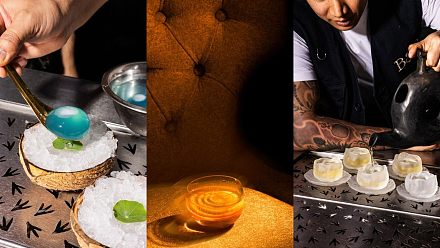
Then someone opens a door. You step through, and the noise falls away so completely that, for a moment, you forget there is a full-blown celebration still happening just outside. A flight of stairs takes you down to Cavity, a small, hushed room located underneath the buzzing bar, where you’re taken on a journey with cocktails by a bartender duo that treats the room to jokes and witty quips. It’s their equivalent of a chef’s table, and you sit in rapture.
For drinkers who’re craving an experience beyond the crowded main bar, one table and a night out is no longer enough. This is why bartenders are carving out smaller rooms inside existing spaces to give India’s new breed of experiential diners a taste of something new. Inside these nested bars, cocktail is treated as the centrepiece of a longer, more educational evening.
Cavity puts India’s GI-tagged ingredients at the forefront.
The Case For Smaller Rooms
For most drinkers, this might read like a new trend, but Minakshi Singh, co-founder of award-winning bars like Sidecar, has been watching the trend for years. She is clear that the idea itself is not brand new. “It’s not necessarily new,” she says. “We have seen a version of this for a little bit. There’s a bar called Hoots that has been at Perch for more than ten years now. Only a handful of us earlier knew about it. It was novel and really fun, but it didn’t pick up as a trend then. Now you can see a lot more people opening bars inside bars.”
What has changed, she believes, is consumer appetite. After years of large, high-energy rooms, people are looking for something more personal. “It’s a different experience—far more customised, far more intimate. It gives the bartender a place to showcase their talent and creative output. In a busy bar, there often isn’t time to chat. This is the opposite. The experience is more fun, more exciting, more conversational. It’s almost like going to someone’s living room while still being in a commercial bar.”
That intimacy is precisely what Cavity is designed around. Built on the back of founder bartenders Chirag Pal and Jeet Rana’s experience, the nine-seater puts India’s GI-tagged ingredients at the forefront. But is the space a ‘speakeasy’, given Delhi’s obsession with Prohibition-era bars? Rana is careful about the terminology. “It isn’t a speakeasy in the traditional sense,” he says. “It’s just a bar within a bar.”
At Cavity, the experience includes nine courses, with Jeet and Chirag’s cocktails paired with food by Chef Amninder Sandhu
And it’s important not to confuse the two. The new generation of these spaces is not necessarily asking guests to find a secret entrance or pretend they are part of an underground drinking society. The exclusivity comes from the experience itself. At Cavity, that experience comes in nine courses, with cocktails paired with food by Chef Amninder Sandhu and ingredients sourced from across India. The courses move from lighter and brighter flavours towards richer, more complex ones, taking in places such as Assam, Tripura, Ladakh and Karnataka.
For instance, Amazake is a creamy cocktail made with Assamese Joha rice and pearl millet, with the spirit fermented with passionfruit and the cocktail served with a prawn balchao. Later, Sandhu’s take on Nihari, the slow-braised Kareli, arrives with a cocktail called Black Cardamom, made with mezcal, single malt and, as expected, cardamom for a smoky flavour.
That bartender-to-drinker conversation is central to the appeal of these smaller rooms. And at ZLB23 inside The Leela Palace Bengaluru, Naval Kukreti has taken that idea a step further with The Theatre, a seven-seat room where the bartender is quite literally part of the performance.
At ZLB23 inside The Leela Palace Bengaluru, Naval Kukreti has taken that idea a step further with The Theatre, a seven-seat room where the bartender is quite literally part of the performance.
“The bartender becomes the performer, the bar becomes the stage, and each cocktail has a role to play within the larger narrative. We wanted the guest to feel that they were watching something unfold rather than simply being served a drink.”
The room draws from classic private lounges and historic opera houses: rich wood panelling, deep burgundy and oxblood velvet, antique brass, low light, and a statement chandelier. An exposed stainless-steel bar keeps the craft fully in view. The first menu follows a clear sequence of taste—bitter to sour, savoury, and finally sweet. “Bitter has a very significant place in the sequence. We wanted the opening course to awaken and prepare the palate… The sweet cocktail comes at the end. In the same way that a dessert course traditionally closes a meal, sweetness provides a sense of completion,” he shares.
A sitting lasts 90 minutes to two hours, with three sessions each evening (7 pm, 9 pm and 11 pm). Popcorn and small bites appear alongside the drinks, but the cocktail, like Aperitivo (with Japanese whisky, strawberry and makrut lime vermouth), remains the star.
Why Sharing A Table With The Bartender Pays Off
Kukreti agrees that the intimacy has become a playground for the team. “One of the things the team has enjoyed most is looking at ingredients that we would generally eat and asking how we can put them into a glass. Taking something familiar and approaching it differently is a big part of what we call the Art of Mixology.”
That freedom to experiment is something Minakshi sees as one of the biggest advantages of the format. In a busy main bar, there are limits to how much a bartender can explain, experiment or engage. In a smaller room, provenance, sustainability, ingredients and technique can become part of the evening rather than footnotes to it.
A sitting at Theatre lasts 90 minutes to two hours, with three sessions each evening (7 pm, 9 pm and 11 pm)
But can we expect to see more iterations of these nested Russian-doll bars? Minakshi notes the practical constraint that still shapes the Indian version of the trend. “In India, unfortunately, just a small bar does not work on its own. You have to have a bigger bar to support the smaller bar. That’s the reality of the commercial side of it. But from a bartender’s point of view, these spaces are far more fun, far more interesting, really exciting to work in.”
That may explain why the bar-within-a-bar makes particular sense here. Seven or nine seats on their own can be a difficult proposition. Seven or nine seats within a larger establishment can offer a more specialised experience supported by the infrastructure, staff and footfall of the main bar.
And if she were designing one herself, she already knows the direction she would take. “I would love to keep it a single-spirit bar and have a lot of fun with that spirit. It would be a very unique idea. Unfortunately, availability is always a concern in India, especially with spirits like agave.”
At Rana’s Cavity, the experience currently costs ₹5,500 plus taxes per person and is strictly reservation-led. But the man is unfazed by the prospect of imitators. “Delhi has always been very good at picking up trends, so I’m sure we’ll see more people experimenting with smaller, experience-led formats. But trends can be copied; consistency and quality can’t. In the long run, talent, execution and hospitality always win.” That is the real test for these rooms. Once the novelty of the door wears off, what remains is the drink and the person making it.