Rimple And Harpreet On Ramayana Costumes, The Backlash And Their Return To The Runway After A Decade | EXCLUSIVE
In 2018, Sanjay Leela Bhansali’s Padmaavat swept audiences into a world of palaces drenched in grandeur, jewel-laden costumes, lavish textiles and silhouettes that seemed designed for the sheer pleasure of being looked a
লেখক Labani Mahanandy··18K বার পড়া
Rimple And Harpreet On Ramayana Costumes, The Backlash And Their Return To The Runway After A Decade | EXCLUSIVE
In 2018, Sanjay Leela Bhansali’s Padmaavat swept audiences into a world of palaces drenched in grandeur, jewel-laden costumes, lavish textiles and silhouettes that seemed designed for the sheer pleasure of being looked at. But behind all that visual splendour was a fashion story of its own, crafted by none other than designer duo Rimple and Harpreet.
With their exquisite eye for Indian textiles and an instinct for making clothes feel inseparable from character, the designers helped shape the sartorial world that made Padmaavat so unforgettable. And kept casting the same spell over and over again.
Now, they have stepped into a story that carries an entirely different weight. Ramayana brings with it centuries of visual references, cultural memory and deeply familiar characters, making the question of how these figures should look on screen a particularly delicate one.
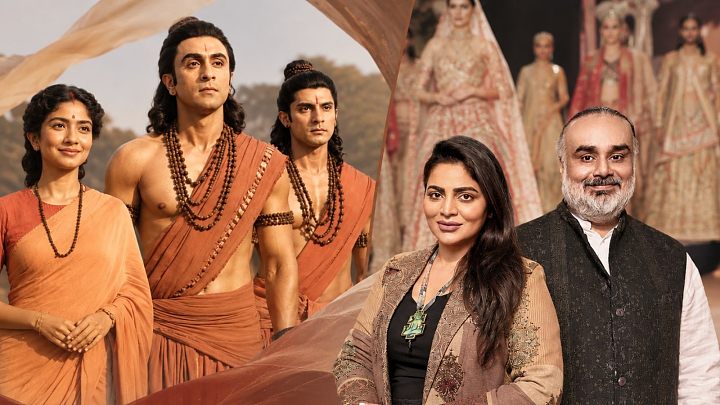
So when the first looks from the film dropped, the response was bound to be complicated. The costumes of Sita, Kaikeyi and Surpanakha sparked major conversations online. After all, these are characters who have been part of our visual vocabulary for generations.
And as the duo returns to the runway after nearly a decade with Bagh, a collection inspired by Punjab, folklore and memory, there could not be a more interesting time to look at what drives their work.
In an exclusive conversation with CNN-News18, Rimple and Harpreet take us inside the making of Ramayana, their new collection Bagh and much more.
Inside The World Of Ramayana
For Rimple and Harpreet, the starting point for Ramayana was not a particular garment or a particular period. It was the world itself.
The idea was to build a visual language that felt rooted without making the film look like a recreation of a history textbook.
“Our starting point is always the world of the story. For Ramayana, the research drew from ancient sculptures, temple architecture, traditional jewellery, indigenous textiles, historic drapes, craft traditions and natural materials. We have always believed that costume design is not about recreating history as a museum exhibit, but about interpreting the emotional truth of a story and building a believable world that honours its spirit.”
The designers did not want to follow one historical reference either. Instead, they focused on bringing different elements together to create a world that felt cohesive on screen.
“It was not about following a single historical reference, but about creating a cohesive visual universe where every silhouette, textile, ornament and texture contributes to the storytelling,” they further added.
If the story moves between kingdoms and landscapes, the costumes have to move with it. For the designers, that meant giving different worlds within Ramayana their own visual identities.
“Each kingdom, landscape and character has a distinct design language,” the designer duo reveal.
Dressing Ram, Sita, Lakshman And Ravana
Few costumes come with more expectation attached to them than those of Ram, Sita, Lakshman and Ravana. These are characters whose appearances have been interpreted countless times across paintings, sculpture, television, theatre and cinema.
For Rimple and Harpreet, that came with an enormous sense of responsibility.
“These characters carry extraordinary cultural and emotional significance, and we approached them with a deep sense of respect and responsibility,” they say.
The designers were equally clear that their process began with character rather than costume. They explain, “Our starting point was always the emotional truth of the character before the garment itself. Ram is defined by a sense of calm strength, while Sita carries grace, dignity and quiet resilience.”
Those qualities then informed the physical elements of the costumes.
“Every silhouette, textile, ornament and texture was chosen to express that inner world, rather than simply replicate a historical garment,” Rimple and Harpreet said, adding, “The challenge was to find a fresh cinematic language while remaining respectful of the deeply rooted cultural associations these characters carry.”
Ramayana First Looks Debate
The first looks from Ramayana did not arrive quietly. While some viewers welcomed the scale and detailing, costumes associated with Sita, Kaikeyi and Surpanakha also drew mixed reactions from a section of netizens.
For designers working on characters so deeply familiar to Indian audiences, such reactions are hardly surprising.
“We understand that the Ramayana holds a very deep cultural and emotional significance, and audiences naturally bring their own visual associations to these characters,” the duo says.
But for the designer duo, authenticity was never about sticking to one historical reference or making the costumes look like archaeological recreations. Their approach focused on understanding the heritage behind the world they were creating, while allowing textiles, craftsmanship and texture to become part of the storytelling.
They also point out that a trailer can only offer a glimpse of the work.
“A trailer cannot fully reveal how a textile moves, how it responds to light, or how a costume relates to a character’s journey.”
That becomes particularly relevant when discussing film costumes. A still can capture one moment, but the costume has to exist within movement, performance, lighting and the larger arc of the character.
Their Return To The Runway After A Decade With ‘Bagh’
While Ramayana finds the designers working on one of cinema’s most ambitious visual stories, another important chapter has unfolded in their own fashion journey.
After nearly a decade away from the runway, Rimple and Harpreet recently returned with Bagh, a collection rooted in Punjab, memory and folklore.
The collection draws from the stories of Heer-Ranjha and Sohni-Mahiwal, but its emotional starting point was broader than romance. “Bagh began with a feeling of longing and a desire to return to a Punjab that exists through memory, folklore and craft,” they say.
Those legendary love stories offered a way into something more personal: distance, defiance and the ache of reaching for something that remains just out of grasp. “These stories resonate because they speak to something much larger than romance: defiance, distance, the ache of reaching for something that is forever just out of grasp,” the duo added.
After almost a decade away from the runway, Bagh also became a way of returning to the reason they create in the first place. “It felt like the right moment to return because Bagh brought us back to the essence of why we create: storytelling through craft, textiles and silhouette.”
On Global Fashion Controversies
That conversation naturally extends beyond Indian fashion. Global fashion houses have increasingly drawn from Indian crafts, techniques and traditional silhouettes, from Ralph Lauren’s recent aari-inspired piece to Prada’s use of Kolhapuri chappals.
For Rimple and Harpreet, the question is less about whether cultures can inspire one another and more about how that exchange happens.
“The line lies in understanding and acknowledging the cultural knowledge, generations of skill, tradition and lived experience behind a craft.”
For them, inspiration becomes meaningful when it goes beyond simply borrowing an aesthetic. It also requires recognising the artisans, communities and generations of knowledge that have kept these traditions alive.
Whether translating the timeless lore of the Ramayana into elaborate costumes or returning to their Punjabi roots through craft and narrative, Rimple and Harpreet view fashion as a medium of preservation. In their hands, textiles do more than capture the eye, they breathe new life into heritage