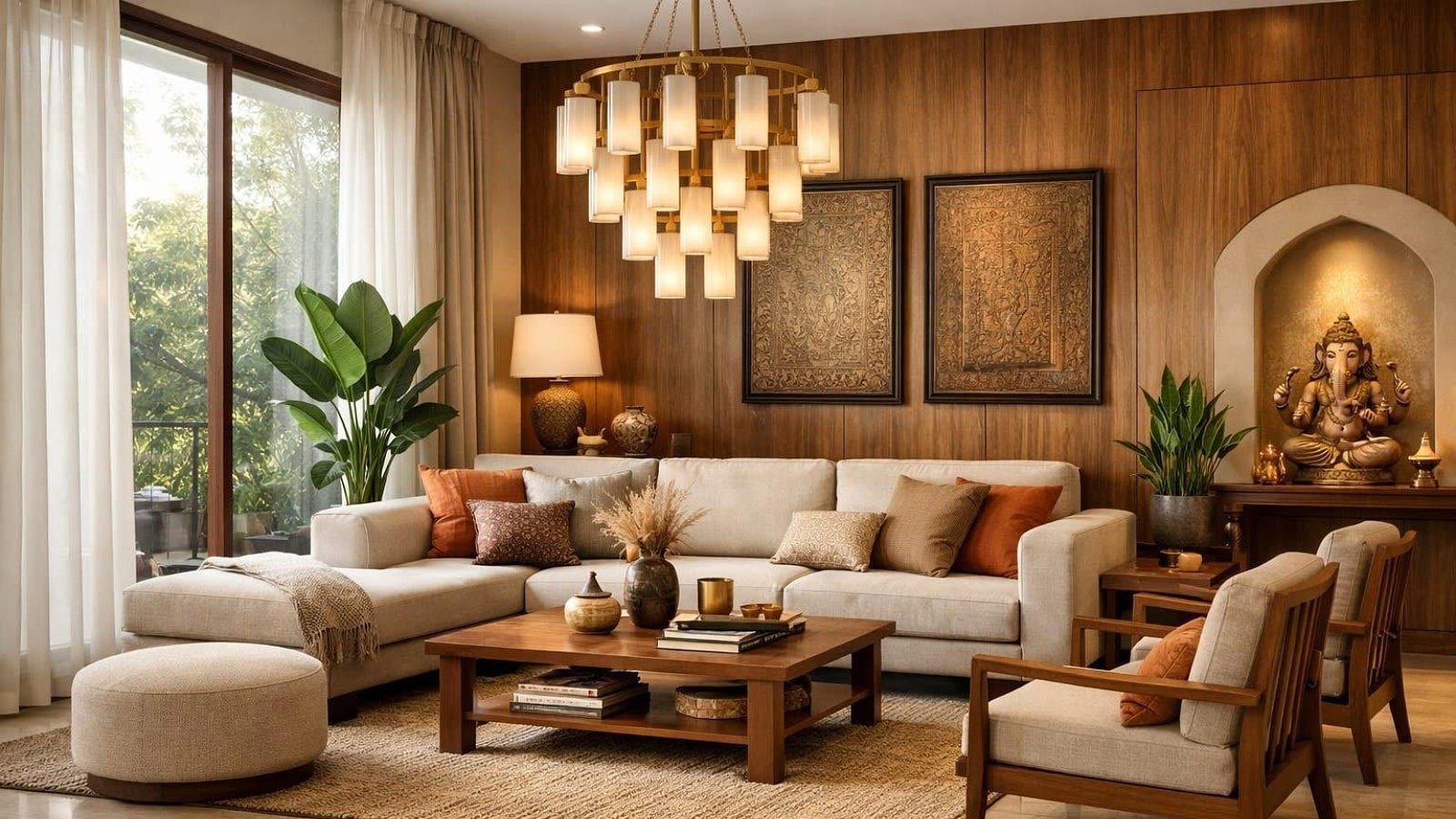
From Cluttered To Curated: How Indian Homes Are Embracing A New Era Of Minimalist Luxury
For decades, the Indian home has been defined by a certain abundance, colour layered over colour, heirlooms passed down through generations, handcrafted objects collected over time, and rooms designed as much to tell a s
লেখক Swati Chaturvedi··6K বার পড়া
From Cluttered To Curated: How Indian Homes Are Embracing A New Era Of Minimalist Luxury
For decades, the Indian home has been defined by a certain abundance, colour layered over colour, heirlooms passed down through generations, handcrafted objects collected over time, and rooms designed as much to tell a story as to serve a function. But the contemporary Indian home is beginning to speak a different visual language.
Minimalism has entered the conversation, but it is far removed from the stark, impersonal interiors the word once conjured. Today, particularly in urban and luxury homes, minimalism is less about having less and more about making every element count. As lifestyles become increasingly fluid, homes are being asked to accommodate work, entertaining, wellness, family time and solitude, often within the same square footage.
Ganesen Viswanathan, Vice President, MagickHome India, believes this shift has made functionality an essential part of contemporary residential design. “As urban living becomes more dynamic and homes are expected to accommodate work, leisure, wellness, and family life simultaneously, functionality has become just as important as aesthetics.”
When One Room Has Many Lives
The idea of a room having one fixed purpose is gradually disappearing. The dining table can become a workstation in the morning; the guest bedroom can transform into a home office; and the living room might host a family gathering one evening and become a quiet retreat the next.
“Spaces are expected to seamlessly transition throughout the day,” says Viswanathan. This has led homeowners towards flexible layouts and modular furniture that can respond to changing needs, an approach in which adaptability itself becomes a form of luxury.
In this new paradigm, luxury is not necessarily about the size of a home or the number of objects within it. It is about how effortlessly the space works.
Storage, But Make It Invisible
Perhaps one of the most significant changes in modern Indian interiors is happening behind closed doors. Storage is no longer an afterthought; it is becoming part of the architecture itself.
Built-in wardrobes, concealed cabinets, under-bed storage, modular kitchens and multifunctional furniture are helping homeowners keep everyday clutter out of sight while maintaining a sense of visual calm.
The result is a home that feels lighter without necessarily owning fewer things. Storage-led design, in many ways, has become the quiet infrastructure behind the minimalist aesthetic.
The Luxury of Fewer, Better Things
For Abhaye Gupta, founder, Rabyana Design, the evolution of minimalism is closely tied to a fundamental change in how homeowners approach luxury.
“Minimalism is no longer simply about keeping spaces white, simple and free of clutter,” says Gupta. “Today, especially in luxury homes, minimalism is about creating spaces that feel calm, elegant and personal, while ensuring that every element has a purpose.”
That philosophy has shifted attention from quantity to quality. Rather than filling a room with decorative objects, homeowners are increasingly choosing fewer, more distinctive pieces, a sculptural chair, a statement light, an artwork or a handcrafted object and allowing each one room to breathe.
It is a more considered interpretation of luxury: less visual noise, more visual impact.
Materials That Age With The Home
Minimalism can sometimes risk feeling cold, particularly when reduced to hard surfaces and a monochromatic palette. The answer, designers increasingly suggest, lies in texture.
Natural wood, marble, stone, metal, linen and other tactile materials can introduce warmth and depth without compromising the simplicity of a space.
“Materials have also become an important part of minimalist design,” explains Gupta. Thoughtfully chosen materials, he adds, can make a simple room feel luxurious without relying on heavy ornamentation.
This is also where practicality enters the picture. Viswanathan points to the growing preference for scratch-resistant finishes, moisture-resistant surfaces, child-friendly materials and low-maintenance solutions. The modern homeowner is increasingly looking for finishes that can withstand everyday life while retaining their aesthetic appeal.
The idea is simple: a beautiful home should also be a home that can actually be lived in.
Technology That Knows When To Disappear
Technology, meanwhile, is becoming less visible even as it becomes more integral to the home. Intelligent lighting, integrated appliances and precision-engineered modular systems are being incorporated into interiors without necessarily announcing their presence. The technology works quietly in the background, allowing the architecture and design to remain the focus.
This is perhaps one of the more interesting contradictions of the contemporary home: the smarter it becomes, the less technology needs to look like technology.
Minimalism With An Indian Soul
Yet the most compelling modern Indian interiors are not necessarily those that imitate international minimalism. Instead, they are finding ways to combine contemporary restraint with the country’s rich design vocabulary.
For Gupta, personalisation is essential to making minimalism feel authentic. Indian art, craftsmanship, heirloom furniture and handcrafted décor can coexist with contemporary pieces, creating spaces that feel modern without becoming culturally anonymous.
The result might be a pared-back room anchored by an antique wooden chair, a contemporary living space punctuated by Indian art, or a restrained palette warmed by handcrafted textiles.
Minimalism, in this context, does not erase history. It edits it.
Designing For The Life Inside
Personalisation is ultimately what prevents minimalist homes from becoming generic. A young professional may need a highly functional home office; a growing family may prioritise child-safe materials and abundant storage; someone who entertains frequently may want a living space that can transition effortlessly from everyday life to large gatherings.
“Every family has different requirements, and modern interiors are increasingly being tailored to individual lifestyles,” says Viswanathan.
That may be the defining characteristic of the new Indian home: it is no longer designed simply to be looked at. It is designed to work.
And perhaps that is where the evolution of minimalism becomes most interesting. The goal is not to strip a home of personality, colour or history. It is to create enough space, physically and visually, for those things to matter.
As Gupta puts it, modern minimalism is ultimately about “doing more with less, without compromising on beauty.”
In the Indian home, that philosophy is taking on a character of its own: warmer, more personal, more technologically considered and, above all, designed around the lives of the people who inhabit it.