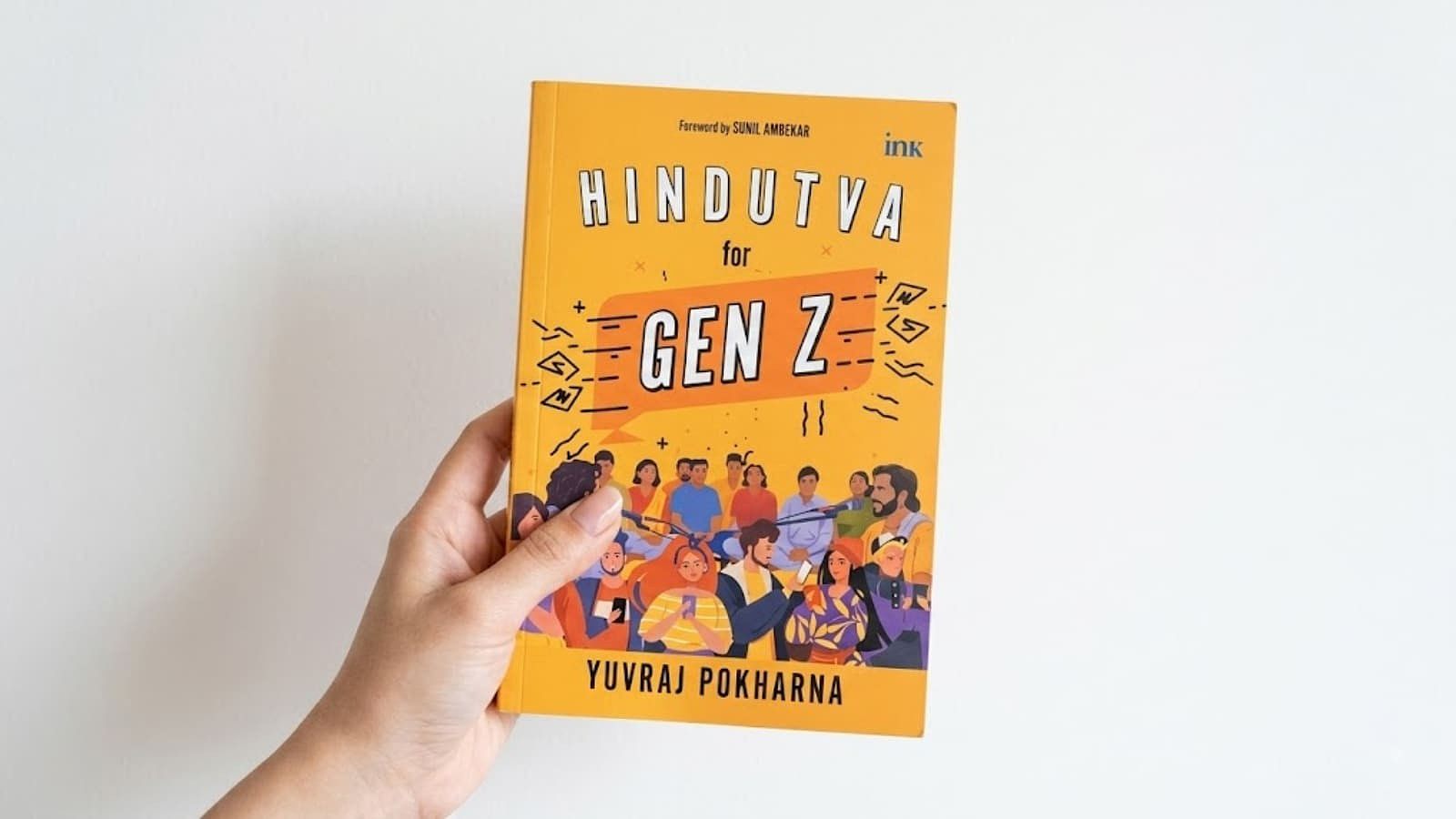
Beyond The Binaries: Why Hindutva Is An Open Framework, Not A Rigid Dogma
When entering the public discourse surrounding Hindutva, one quickly encounters a fierce tug-of-war. Yet, according to author Yuvraj Pokharna, both prominent sides of the modern debate are fundamentally getting it wrong.
লেখক Lifestyle Desk··15K বার পড়া
Beyond The Binaries: Why Hindutva Is An Open Framework, Not A Rigid Dogma
When entering the public discourse surrounding Hindutva, one quickly encounters a fierce tug-of-war. Yet, according to author Yuvraj Pokharna, both prominent sides of the modern debate are fundamentally getting it wrong.
On one end stands the traditionalist, fringe right-wing, often self-prescribed on digital platforms as “Trads”, who attempt to enforce a narrow, dogmatic, and reactionary set of rules. From threatening film directors over cinematic portrayals to imposing cancel-culture-style rigidity, these elements try to lock an ancient worldview into a strict cage. On the other end lies what remains of the modern political Left, which attempts to critique the phenomenon through a purely Western lens, mislabelling it as inherently divisive or extremist.
“If we define Hindutva as an ideology, it is obvious that like any ideology, it will be ascribed to a set of rules and dogmas,” Pokharna explains. “Hindutva and Bharat are about ideas, not about narrow structures. We have always been a land of ideas, debates, and discourse. We are not confined or stuck upon one thing.”
To illustrate this civilizational openness, Pokharna points to historical figures revered with equal weight in Indian tradition: Charaka, an ancient physician known for his agnostic and empirical outlook, stands on the same revered pedestal as Adi Shankara, the titan of Advaita philosophy. Bharat is a land that holds over 300 documented variants and versions of the Ramayana. It is a culture where a Bengali Brahmin eating fish along coastal traditions doesn’t violate a rigid “framework”, because no such artificial framework ever existed.
Crucially, Pokharna draws a sharp distinction between Western tolerance and Indian acceptance. Western discourse sermonises tolerance, a concept that implies grudgingly enduring someone you dislike. Indian civilisation, by contrast, was built on genuine acceptance. Trying to play by the Western playbook, Pokharna argues, means losing the plot entirely.
The Post-2014 Watershed
While Hindutva represents an ancient civilizational identity, its presence in mainstream political discourse underwent a monumental paradigm shift in 2014.
Prior to 2014, Hindutva was often dismissed in elite public spheres, caricatured by critics with reductive stereotypes, or confined to specific political cliques. The arrival of Prime Minister Narendra Modi at the centre stage catapulted the idea into global newsrooms and daily conversations.
For Pokharna, 2014 acts as a historical marker, akin to a “BC and AD” transition in public discourse. The concept gained a bold, unequivocal voice, elevating civilizational identity to the forefront of national consciousness. However, Pokharna emphasises the need to “separate the chaff from the wheat.” Isolated incidents or fringe actions cannot be used to invalidate an entire civilizational movement, just as mainstream figures cannot be held accountable for radical elements on the margins.
Deconstructing the Jati-Varna Conundrum
One of the most critical re-examinations in ‘Hindutva for Gen Z’ centres on the origin of social stratification in India and the confusion surrounding caste.
Contrary to popular misconceptions, the ancient Vedic Varna system was never a birth-based hierarchy; it was a classification based on Guna (inherent qualities), Karma (actions), and the channelisation of human energy. Citing the Bhagavad Gita, where Bhagavan Krishna states that the four Varnas were created based on aptitude and work, Pokharna offers a modern, candid example: a person working on the payroll of a company, bound to execute directives from above without total intellectual independence, is functionally performing a Shudra (service/executor) role by Karma. In its original sense, Shudra was a functional classification, not a class-based pejorative.
So, where did the division originate?
According to Pokharna, “Over 1,200 to 1,300 years of continuous foreign invasions and rules, stretching from 712 AD through colonial rule, the fluid occupational system (Jati) slowly corrupted and merged with class status. The British administration then formalised and “crystallised” this confusion into a rigid, weaponised structure. Imposing Western sociological concepts like the Portuguese Casta and Latin Castrum, colonial administrators documented, categorised, and divided the populace (creating administrative listings like “Scheduled” Tribes).”
The Gen Z Dilemma and the “Third Way”
Generation Z, the first digitally native generation of independent India did not build this rigid caste system; they merely inherited the remnants of historical corruption. Pokharna expresses strong optimism for this generation, rejecting the dismissive or patronising attitude held by some traditionalists.
He critiques the very term “Gen Z” as a Western sociological import derived from Critical Race Theory (CRT), a framework that seeks to divide societies into binary struggles between the “oppressor” and the “oppressed.” While Western Gen Z grew up in shrinking, polarised economies, Indian Gen Z has grown up witnessing their country’s economic and cultural resurgence. Surveys consistently show that over 60% of Indian youth feel spiritual, composed, and connected to prayer.
Rather than viewing youth through political binaries, Pokharna advocates for a “Third Way”, a middle path that avoids both rigid right-wing traditionalism and left-wing cynicism.
“They are our progenies, our children,” Pokharna asserts. “It is upon us to treat them with love, care, warmth, and patience. The book is not here to pontificate or preach. It is a collection of 26 standalone essays, thought-starters or ‘pokes’, to encourage young people to read, absorb, and think for themselves.”
In stark contrast, Indian civilizational thought offers an open architecture. It does not demand allegiance to a single text or dogma. Whether one finds faith in a temple, practices devotion through Bhakti, or explores agnostic inquiry like the ancient Rishis, all paths remain valid within this shared heritage.
Ultimately, ‘Hindutva for Gen Z’ serves not as an ideological manifesto, but as an invitation. It invites the younger generation to strip away Western prisms, look past centuries of historical distortion, and claim an agency rooted in a 5,000-year-old tradition of open debate, cultural adaptation, and unconditional acceptance.