Christine Lagarde Resigns As ECB Chief Early, Could Lead WEF, Weigh In On French Politics
European Central Bank (ECB) President Christine Lagarde on Thursday resigned ahead of the end of her term, bringing months of speculation about her future to a head as Europe grapples with economic uncertainty, rising bo
مصنف Shankhyaneel Sarkar··85K بار پڑھا
Christine Lagarde Resigns As ECB Chief Early, Could Lead WEF, Weigh In On French Politics
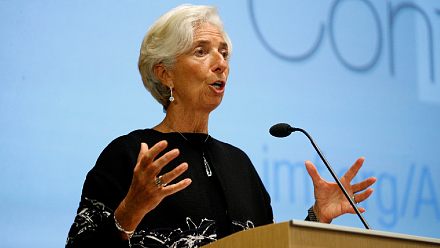
European Central Bank (ECB) President Christine Lagarde on Thursday resigned ahead of the end of her term, bringing months of speculation about her future to a head as Europe grapples with economic uncertainty, rising borrowing costs and an increasingly divisive political climate in France.
Lagarde, 70, will step down on February 7, giving European Union leaders time to appoint her successor before France’s presidential election, Reuters reported on Thursday. Her term was originally scheduled to end in October 2027.
A source with direct knowledge of the matter told Reuters that Lagarde had resigned to allow herself to weigh in on political issues in France and globally. As ECB president, she was expected to maintain political neutrality to protect the independence of the central bank.
The early departure has also fuelled speculation that Lagarde could take up a role at the World Economic Forum (WEF), which Reuters said had emerged as a possible destination. The WEF declined to comment.
“I leave this institution with a sense of good work done and an ECB that is fit for the future,” Lagarde said in a short video shared on social media.
Her resignation comes at a consequential moment for Europe. The ECB is confronting inflation risks from an oil-price shock linked to the Iran war, while rising government bond yields, particularly in France, threaten to weigh on economic growth and increase borrowing costs for households and businesses.
Lagarde’s exit raises questions over timing
Lagarde’s decision has drawn contrasting reactions, with some questioning the timing of her departure and others arguing that it would give European institutions time to prepare for a transition.
Markus Ferber, a German member of the European Parliament from the centre-right European People’s Party, said the early resignation sent “the wrong signal” at a time of elevated inflation, nervous bond markets and looming elections.
“If the impression arises that such a departure is timed around national elections, it damages trust in an institution that must stand above any domestic political calculation,” Ferber told Reuters. He sits on the parliamentary committee involved in confirming Lagarde’s successor.
Marcel Fratzscher, president of German economic think tank DIW, took a different view, describing the move as “a strong sense of responsibility towards Europe”.
“By leaving office early, Christine Lagarde gives European governments and institutions an opportunity to appoint a successor who will safeguard European values and protect the ECB’s independence,” Fratzscher told Reuters.
Lagarde has previously said she would not run for the French presidency. However, she has indicated that she would advocate for pro-European values in her home country “in whichever capacity” she considered most effective.
European Council President Antonio Costa said the process to find her successor would begin immediately, Reuters reported. The appointment could form part of a broader reshuffle of senior ECB positions, with executive board member Isabel Schnabel due to leave in early January and chief economist Philip Lane scheduled to depart in May.
Who could succeed Lagarde?
Klaas Knot, the former head of the Dutch central bank, and Pablo Hernandez de Cos, the former governor of the Bank of Spain, are widely viewed as leading contenders to replace Lagarde, according to Reuters.
Markets appeared relatively unmoved by the announcement, with analysts suggesting that the ECB’s institutional credibility would limit the impact of a leadership change.
“The rumoured successors are both very competent, well established central bankers, so for markets, it won’t matter too much,” Piet Haines Christiansen, an economist at Danske Bank, told Reuters.
Simon Dangoor, Goldman Sachs’ head of Fixed Income Macro Investing, said the ECB had established a reputation that extended beyond individual leaders.
“The ECB is now quite well established, the market is familiar with the way it operates,” Dangoor said. He added that the institution’s behaviour was likely to remain broadly similar regardless of who took over.
Oil shock and bond turmoil complicate ECB’s task
Lagarde’s departure comes as the ECB seeks to prevent higher energy prices, driven by the Iran war, from feeding into broader inflation and wage growth.
At the same time, rising sovereign bond yields — particularly in heavily indebted France — have pushed up financing costs and threatened to constrain economic activity.
The ECB was widely expected to keep its deposit rate at 2.5% on Thursday while signalling that another increase, potentially as early as December, remained possible, Reuters reported ahead of the decision.
“There is likely a low bar to another hike in December, given the likelihood of another upward revision of the ECB’s inflation forecast due to higher energy prices,” Oliver Rakau of Oxford Economics said.
The ECB was scheduled to announce its interest rate decision at 1315 GMT on Thursday, followed by Lagarde’s press conference at 1345 GMT. Money markets were pricing in three further rate increases by the end of next year, which would take the deposit rate to 3.25%.
The leadership transition therefore comes as the ECB faces a delicate balancing act: containing an energy-driven inflation shock without deepening the economic slowdown caused by tighter financial conditions.