Bangladesh 'Regime Change': How An AFP Journalist Became A Link Between Student Leaders And Yunus
At a time when the phrase ‘regime change’ has stirred political debate in India following activist Prashant Bhushan’s advocacy of the idea, an intriguing account from Bangladesh has brought a journalist into the story of
مصنف Anindya Banerjee··51K بار پڑھا
Bangladesh 'Regime Change': How An AFP Journalist Became A Link Between Student Leaders And Yunus
At a time when the phrase ‘regime change’ has stirred political debate in India following activist Prashant Bhushan’s advocacy of the idea, an intriguing account from Bangladesh has brought a journalist into the story of the political upheaval that led to Sheikh Hasina’s ouster.
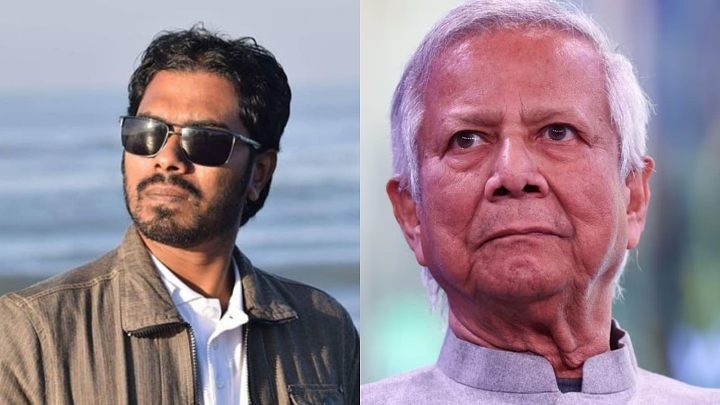
Shafiqul Alam, former press secretary to Muhammad Yunus, has revealed in a social media post that student leaders reached out to the Nobel laureate through Qadaruddin Shishir, who was then the editor of Agence France-Presse’s (AFP) Dhaka fact-check team.
According to Alam’s account, Shishir facilitated the initial talks between the student leaders and Yunus just two days before Hasina’s government fell in August 2024.
“When student leaders wanted to reach out to Nobel Laureate Professor Muhammad Yunus and invite him to head the interim government in a post-Hasina scenario, they needed a trusted bridge-builder. Qadaruddin Shishir stepped up to fulfil that critical role,” he wrote.
The revelation offers a glimpse into the behind-the-scenes conversations that preceded one of Bangladesh’s most consequential political transitions in recent history. It also raises questions about the informal networks and intermediaries that may have helped bring key players together during the final days of Hasina’s rule.
The Two Days Before Hasina’s Fall
The timing is significant. Bangladesh was witnessing an escalating student-led uprising against Hasina’s government. Protests that had begun over quotas in public-sector jobs had transformed into a wider movement demanding her resignation in 2024.
As the political crisis intensified, Yunus emerged as a potential figure in the country’s post-Hasina transition, even before Hasina’s ouster.
Alam’s account suggests that student leaders had established a channel of communication with Yunus before the government collapsed, with Shishir playing a facilitating role.
“Hasina would remain in power for two more days, yet her brutal security machine—notorious for mass killings and abductions—never caught a whisper of it. Had they discovered what was happening, Shishir and our entire AFP team would likely have ended up in an Aynaghar (house of mirrors secret prison),” he wrote.
That detail adds a new dimension to the story of the days leading up to August 5, 2024, when Hasina left Bangladesh amid mass protests.
Alam’s post does not, by itself, establish the full extent of Shishir’s involvement or demonstrate that he was part of a coordinated regime-change operation. However, it places the AFP journalist in the chain of communication between student leaders and the man who would subsequently head Bangladesh’s interim government.
The precise nature of those conversations, who initiated them and what was discussed remain important questions.
Why The Revelation Matters Beyond Bangladesh
The account comes at a time when the phrase ‘regime change’ has entered India’s domestic political discourse following Prashant Bhushan’s remarks on the subject. Bangladesh’s experience has consequently acquired renewed relevance in debates about political protests, popular movements and the forces that shape transitions of power.
STATEMENT OF SOLIDARITY WITH THE YOUTH OF INDIA
Dhaka, Bangladesh | 10 October 2026
To the youth and democratic forces of India,
We stand in firm solidarity with the young people of India demanding electoral accountability and defending their democratic rights. Recent detentions of peaceful protesters, organizers, and journalists in New Delhi, alongside internet suspensions and restrictions at Jantar Mantar, directly threaten fundamental freedoms. Concerns regarding electoral integrity and institutional independence require transparent answers, not barricades and censorship.
This struggle is not yours alone. From Dhaka, we stand with you as friends bound by a common demand for accountable power, democratic institutions, and human dignity.
We know this struggle intimately, because we have lived it. In July 2024, our student led movement against recruitment quotas transformed into a nationwide uprising against 15 years of authoritarian rule. The state responded with live ammunition. The United Nations later estimated that as many as 1,400 people were killed during the uprising and its suppression. We deeply remember and honor the solidarity shown by Indian students, writers, and independent voices during our uprising.
We recognize India’s rich traditions of democratic resistance. The women of Shaheen Bagh defended equal citizenship through a Delhi winter, while generations of students at JNU and Jadavpur University have sustained organised dissent. These remain invaluable democratic inheritances. Today, we once again see the courage of young Indian women on the streets. In Bangladesh, women were also at the forefront of the July Revolution; their courage and sacrifices helped secure our victory.
Hindutva majoritarianism, fascism, and every form of religious supremacy must not define the future of South Asia. We reject authoritarianism, communal hatred, and political intolerance in India just as we reject them in Bangladesh. Our shared future must rest on communal harmony and social justice, irrespective of religion, caste, gender, or class. No society is truly democratic while minorities live in fear, dissent is criminalized, and citizenship is conditional on identity.
We call upon Indian authorities to respect the right to peaceful assembly, disclose the whereabouts and legal grounds for detaining protest organizers, immediately release those held for exercising their rights, and ensure journalists can report without intimidation or equipment seizure.
Today, many young leaders have been unjustly detained. Sharjeel Imam and Umar Khalid continue to be kept behind bars for years without trial. We regard all of India’s young protesters and prisoners of conscience as comrades. Their courage inspires young people across South Asia.
Our struggles are interconnected, extending to unresolved issues of border killings, water sharing, environmental protection, and national sovereignty. We seek a South Asia where nations treat each other as equals, governments remain accountable, and sovereignty is never an excuse for domination.
To the democratic people of India: from Dhaka, and from the unfinished democratic aspirations of our July generation, we stand with you. Stand firm, protect one another, reject communal hatred, and refuse to surrender the future of South Asia to fascism and division.
Inqilab Zindabad.
— Nahid Islam (@NahidIslam_24) October 10, 2026
The National Citizen Party (NCP), a political outfit that emerged from the July uprising that ousted Hasina, has extended its solidarity to recent student protests in India. Nahid Islam’s comparison of the protests in Dhaka and Delhi cannot be ignored altogether.
Bangladesh’s experience offers a reminder that the fall of a government cannot be understood through street protests alone. The relationships, conversations and decisions unfolding away from public view can also form an important part of the historical record.
Alam’s account provides a potentially significant piece of that record. For now, the post offers a window into the back-channel contacts that preceded the upheaval.