How Abhishek Nayar Ended Shreyas Iyer's 67-Match Wait For A Maiden T20I Century
There was more to Shreyas Iyer’s maiden T20I century than the 43 balls it took him to get there. After waiting 67 matches for his first hundred in the format, Iyer produced an unbeaten 102 against the West Indies in Luck
مصنف Feroz Khan··72K بار پڑھا
How Abhishek Nayar Ended Shreyas Iyer's 67-Match Wait For A Maiden T20I Century
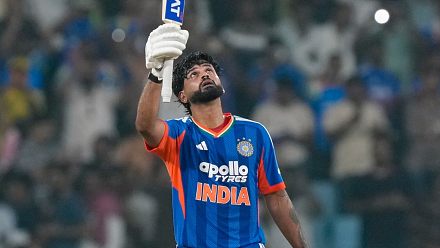
There was more to Shreyas Iyer’s maiden T20I century than the 43 balls it took him to get there. After waiting 67 matches for his first hundred in the format, Iyer produced an unbeaten 102 against the West Indies in Lucknow on Tuesday, striking 10 fours and six sixes as India completed an eight-wicket win in the first T20I.
The innings though had its origins away from the Ekana Cricket Stadium. The foundation was laid in a conversation that lasted nearly two hours at Iyer’s home with former India batting coach Abhishek Nayar.
Iyer felt that something was missing in his batting during India’s gold-winning campaign at the recent Asian Games in Japan, particularly when he tried to hit with power. His bat swing did not feel as clean as it had in the past, and he was increasingly conscious of whether he could generate enough force to clear the boundary.
The work with Nayar was aimed at restoring that feeling rather than chasing a particular result, with the two focusing on Iyer’s grip, his first movement and the tactical ways in which he could deal with different bowlers.
Three days later, the result was impossible to miss as Iyer reached three figures for the first time in his T20I career.
A Technical Issue
Nayar, who has known Iyer through his domestic career in Mumbai, his time with Kolkata Knight Riders in the IPL and the national team setup, understood that the issue was not about a lack of ability.
“One of the things he was feeling at the end of the Asian Games was something to do with his technique, where he felt he wouldn’t generate as much force while hitting and just the thought process of not being able to clear the boundary,” Nayar was quoted as saying by news agency PTI.
The conversation therefore moved away from the outcome and towards the mechanics that came before it, with Nayar and Iyer examining how the batter could create the momentum and rhythm required to feel ready to hit the ball before the delivery was even bowled.
“He just felt it was certain – because we have worked and been together for so long – it was more a very technical and a tactical thing. We did a bit of work on his grip and his movements that he speaks about getting flow and momentum into his batting. And then obviously a bit of tactical nuances as to how he can overcome certain bowlers and stuff.
“So it was more just a couple of hours of sitting and talking and making sure he feels really good of his initial movement and before the ball is bowled, the feel of being able to hit the ball,” Nayar added.
There was also a practical reason the session took place at Iyer’s home rather than at a training facility. Iyer had just returned from Japan and was due to catch another flight, leaving little time for a conventional intervention.
“… because he had just travelled (back from Japan) and had to catch a flight after that. So, it only made sense for me to go to his place,” Nayar said.
The pair narrowed their work down to three areas that Nayar believed could make the difference, while also talking through the usual cricket and mindset aspects that form part of their long-standing relationship.
“In a lot of ways, a bit of change in the grip in technical terms, getting his initial movement right and tactically how to overcome bowlers,” he said. “… those are the three things we addressed along with the normal cricket and mindset discussion that you have in general. Obviously, I didn’t expect it to turn out so well, but all credit to him for being able to deliver it and follow through on it.”
Muscle Memory
For a technical change to survive an international game, however, talking about it is only the first step.
Nayar wanted Iyer to physically practise the adjustments during their meeting so that the new movements were not merely ideas he carried into the match.
“You can’t talk and get this right. You obviously have to demo it. So, we did that when we met, just so that he understands the feeling of doing it because you can’t make technical changes without actually practising it,” he said.
That distinction was important to Nayar because Iyer’s concern was fundamentally about feel. The batter knew what he wanted the ball to do, but needed to regain the confidence that his body and bat could produce that result.
Nayar said tactical aspects of batting has been a major point of discussion between them.
“In the recent past, a lot of our discussions have always been very tactical and it’s always been about how we can overcome certain situations,” he said. “But I just felt, it’s been a while since he’s actually had a technical difficulty. To think about it in regards to performance, that’s not how we were trying to address it. It was just about bringing him, bringing that feedback as to how we can actually clear the boundary rope and have the confidence before you play that.”
“It’s not that he doesn’t have the ability. For a cricketer, the important thing is feeling before the ball is bowled that he can tonk it out of the park, and then, whether or not it happens is a completely different story,” Nayar added.
Iyer Acknowledged The Change
The clearest indication that the work had resonated with Iyer came not from the numbers on the scoreboard, but from the way he described his own innings afterwards.
In a video shared by BCCI, Iyer also mentioned about the chat with Nayar.
“I had a brief interaction with Abhishek Nayar in that period where we were talking about cricket. I think that conversation with him helped me a lot in the performance (vs WI),” he said.
Iyer identified the point at which he needed to be ready as being before the ball arrived, making his initial setup and movement central to the way he approached the innings.
“The key that I observed in my batting was setting myself before the delivery of the ball, and that worked perfectly. So, creating that momentum and rhythm was essential at the start of the innings, and it worked out pretty well,” Iyer said.
Asian Games Exposed The Gap
For Nayar, the issue had become visible because Iyer was comparing what he was producing with what he knew he could produce. The batter was not questioning his ability to hit big shots, but was unhappy with the amount of force he was generating and the quality of his bat swing.
Iyer was not happy with the force he was trying to generate with the bat, especially in the Asian Games.
“It was just about giving him that feeling and that’s the kind of cricketer he is. Because we’ve been together for so long, just understanding makes it easier for me to help him and for him to understand what I’m trying to say,” Nayar said.
“A lot of what happened in the Asian Games for him, where he just felt like he couldn’t generate the kind of force he wanted while he was trying to hit the ball, and he felt his bat-swing wasn’t as clean as it has been in the past,” he added.
The challenge for Iyer now is to prevent the hundred itself from becoming the next problem to solve.
Nayar’s preference is for him to carry forward the process that produced the innings rather than immediately attempting to replicate the score.
Iyer will be in action in Ranchi next where the conditions may offer a different challenge.
“He is going to go to Ranchi from Lucknow, which may or may not be a very different pitch. I’m just happy that things turned out the way it did because an international hundred is always special. You just don’t want to follow that up by saying, I want to score another. You want to follow that up by saying, I want to try and focus on the same process and hopefully the results deliver,” Nayar said.