One Leaf, Many Names: How Patra, Alu Vadi and Pathrode Became India's Favourite Rolled-Up Snack
Ask any Indian to name their favourite snack and you’re likely to get a very passionate answer! That’s because we take our snacks seriously, especially the ones we have grown up eating and the ones that remind us of home
مصنف Lubna Khan··6K بار پڑھا
One Leaf, Many Names: How Patra, Alu Vadi and Pathrode Became India's Favourite Rolled-Up Snack
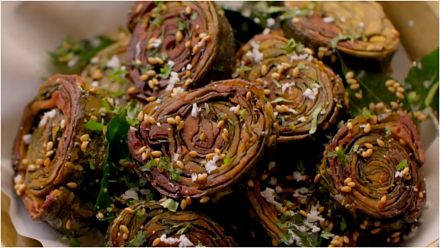
Ask any Indian to name their favourite snack and you’re likely to get a very passionate answer! That’s because we take our snacks seriously, especially the ones we have grown up eating and the ones that remind us of home. One such snack is that delicious spiral-shaped delight made with colocasia (taro or arbi) leaves.
You may know it as ‘patra’ in Gujarat, ‘alu vadi’ in Maharashtra or ‘pathrode’ along the coastal belt of Karnataka, particularly around Udupi and Mangaluru. The names may change as you cross state borders, but the idea of the dish basically remains the same. The colocasia leaves are layered with a spiced mixture, rolled up, steamed and sliced into spirals, before being tempered or fried.
As the monsoon season rolls in, the heart-shaped leaves of Colocasia, known variously as arbi, alu, or chempu, come out in kitchens across the country to be turned into mouth-watering delicacies. Brimming with earthy flavor, Colocasia leaves lend themselves to snacks you can devour while sipping on kadak chai, as breakfast bites. While cooking them requires a fair bit of skill and patience, the result is always delicious!
Gujarat’s Sweet, Sour And Spicy Patra
Every region has its own twist on the recipe, but the arbi leaf remains the star. The well-known Gujarati version of the dish uses a gram flour (besan) paste flavoured heavily with jaggery and tamarind, giving it a delicious, sweet and tangy taste. After steaming and slicing, it is tempered with mustard seeds and sesame seeds, while some add curry leaves too.
While the snack itself looks complicated, it’s actually quite simple once you know how to make it.
Maharashtra Calls It Alu Vadi
Cross the border into Maharashtra and its local version, ‘alu vadi’ gets a spicy twist, with both shallow- and deep-fried versions being popular. Here, ‘alu’ refers strictly to the Colocasia leaf, not potatoes.
The Maharashtrian version also uses a spiced besan mixture, with tamarind and jaggery. The leaves are layered, rolled and cooked before being sliced. While some choose to deep fry it until the edges are crisp, others shallow-fry the slices and finish them with a tempering of mustard seeds and sesame.
Alu Vadi (Image: YouTube/@AnuradhasChannel)
For many Maharashtrian households, alu vadi is the kind of snack that happily finds its way onto the table with tea, chutney or as part of a larger meal.
Karnataka’s Pathrode
Running south along the Konkan coast toward Mangalore and Udupi, the dish undergoes a noticeable transformation. Here, the dish is generally known as ‘pathrode’, and while the leaf-rolling technique remains the same, the filling can take a slightly different route.
Instead of the chickpea flour (besan), the filling here consists of a thick, coarse paste made of rice flour, urad dal, chillies, spices, tamarind and jaggery before being rolled and steamed. This rice base gives Pathrode a dense, grainy bite.
Other Colocasia Leaf Dishes to Know
In Karnataka, leftover steamed rolls (pathrode) are frequently added into a rich coconut curry (Pathrode Gashi).
Meanwhile, in Kerala, the Colacasia leaf rolls are called ‘Chempila Appam’, where Colocasia leaf rolls are layered with spiced rice-and-coconut batter, rolled and then steamed.
In parts of North India, you’ll find ‘rikwach’ or ‘patrodu’, while the Parsi community has ‘patrel’ — all made along similar lines, with colocasia leaves layered with a spiced besan-based mixture, then rolled and cooked.
Then there’s also ‘Saru Patra Tarkari’ from Odisha, which takes the familiar arbi leaf preparation in a slightly different direction. It is a traditional Odia curry made with arbi leaves rolled with a spiced batter, steamed, fried, and then simmered in a tangy mustard gravy.
So, how many of these colocasia-leaf dishes have you tried? And more importantly, which one is your favourite?