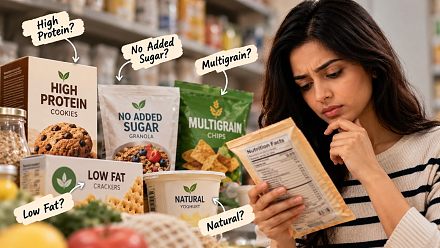
‘High Protein’, ‘No Added Sugar’, ‘Natural’: Are We Falling For Healthy Food Labels?
Scroll through Instagram or browse a quick-commerce app, and healthy eating can start to look like a shopping checklist. Pick up a high-protein snack, swap regular bread for multigrain, avoid added sugar and look for any
مصنف Labani Mahanandy··5K بار پڑھا
‘High Protein’, ‘No Added Sugar’, ‘Natural’: Are We Falling For Healthy Food Labels?
Scroll through Instagram or browse a quick-commerce app, and healthy eating can start to look like a shopping checklist. Pick up a high-protein snack, swap regular bread for multigrain, avoid added sugar and look for anything labelled natural. Sounds simple enough, right?
Except, there’s more to a food product than the words printed on its packaging. A high-protein cookie can still contain refined flour, while a product with no added sugar can contain other sources of carbohydrates. And ‘natural’ doesn’t automatically mean nutritious.
Speaking to CNN-News18, Rahul Kamra, keto coach and founder of Ketorets said he believes consumers are becoming more conscious of what they eat, but brands have learnt to capitalise on that awareness. “The way these terms are marketed creates a certain feeling around the product,” he says.
The problem, he explains, is that shoppers can start treating these claims as a green light to eat without paying attention to portions or the rest of the nutritional information. Kamra describes this as a “get-out-of-jail card”, where people assume a product is healthy simply because it ticks one dietary box.
So, before that wellness-approved packet makes its way into your basket, here’s what those popular claims actually tell you.
‘No Added Sugar’ Is Only Part Of The Story
A ‘no added sugar’ label can sound reassuring, especially if you’re trying to reduce your sugar intake. But it doesn’t tell you everything about a product’s carbohydrate content or overall nutritional value.
Kamra points to ingredients such as maltodextrin and fruit concentrates, along with refined carbohydrate sources, as reasons to look beyond the claim.
“‘No added sugar’ is simply one piece of information about a food,” he says.
He jokingly illustrates the psychological pull of the label, “If tomorrow you started putting a ‘no added sugar’ label on an apple, I’m sure you would see its sales improving.”
The point is that a claim can make a product seem more appealing without changing its actual nutritional composition. Consumers should therefore check total carbohydrates and sugars, read the ingredients and consider the serving size instead of relying on the front-of-pack message.
It’s also worth remembering that ‘no added sugar’ does not mean sugar-free or carbohydrate-free. The claim has a specific meaning, and it shouldn’t be treated as a guarantee that a food won’t affect blood glucose.
The High-Protein Hype Is Real
Protein has become one of the biggest selling points in the wellness market. From breakfast cereals and bread to chips and cookies, brands are finding new ways to put the nutrient front and centre.
Kamra calls ‘high protein’ a “halo word”, arguing that consumers may see the claim and immediately assume the product is a healthier choice.
“You can sell chips which are high protein, or you can sell literally high-protein bread,” he says, highlighting how widely the claim can be used across food categories.
There’s nothing inherently wrong with choosing protein-rich foods. Protein is an essential nutrient, and packaged products can offer convenient ways to increase intake. The catch is assuming that more protein automatically makes a product nutritionally superior.
Kamra points out that a high-protein product “can also be loaded with refined flour and seed oils”. The protein content doesn’t tell you how much sodium, saturated fat, added sugar or other ingredients the product contains.
He believes brands are making the most of the current enthusiasm for protein, describing it as “the protein panic”. His concern is that shoppers may focus so heavily on meeting their protein targets that they overlook the rest of the nutrition label.
The smarter move? Check how much protein the product provides per serving, compare the overall nutritional profile and decide whether it suits your needs. A protein claim is useful information, not a complete health assessment.
Multigrain Doesn’t Always Mean Whole Grain
Multigrain bread, seeded crackers and grain-based breakfast cereals often get a healthy reputation. But the terms ‘multigrain’ and ‘whole grain’ aren’t interchangeable.
Multigrain simply indicates that a product contains more than one type of grain. It doesn’t, by itself, tell you whether those grains are whole or refined, or how much of each the product contains.
Kamra advises shoppers to examine the ingredient list rather than rely on the packaging. If whole wheat or another whole grain isn’t prominent in the ingredients, the product may contain more refined flour than you expect.
He also emphasises the importance of checking fibre content. Fibre can help you assess the nutritional value of grain-based foods. The lesson is straightforward: don’t assume that a brown loaf, a scattering of seeds or the word ‘multigrain’ guarantees a whole-grain product. Read the ingredients and compare the nutrition information.
What Does ‘Natural’ Actually Mean?
Few words make a product sound as reassuring as ‘natural’. It suggests simplicity and a closer connection to the food itself. But the word alone doesn’t tell you whether a product is low in sugar, high in fibre or nutritionally balanced.
“Natural tells you nothing,” says Kamra.
He explains how the word can influence consumers without necessarily giving them meaningful information about nutritional quality. “Sugar is natural. Coconut oil is natural,” he says, pointing out that the term covers ingredients with very different nutritional profiles.
His argument is that the appeal of ‘natural’ often lies in the impression it creates rather than in any specific nutritional information it provides.
The term’s regulatory meaning can also vary by product and jurisdiction, so it shouldn’t be treated as a universal guarantee. Instead, look at the actual ingredients and nutrition panel. Those details are more useful when deciding whether a product fits your dietary needs.
Low-Fat, Low-Carb: Have The Diet Rules Changed Again?
There was a time when low-fat products dominated conversations about healthy eating. Today, social media often focuses on carbohydrates and sugar instead. Kamra recalls how fat was demonised during the low-fat trend of the 1970s and 1980s. He sees a similar pattern in the way online conversations now treat carbohydrates and sugar.
“People have become more aware of their health; they become more aware of their blood sugar levels and inflammation,” he says.
But awareness, he argues, doesn’t necessarily mean people understand how to make informed dietary choices. A low-fat claim doesn’t tell you whether a product contains added sugar, just as a low-carb claim doesn’t automatically make it a healthier option.
Fat, protein and carbohydrates all play roles in the diet. The right balance depends on individual needs, overall eating patterns and the product itself. Rather than demonising a single nutrient, consumers should consider the full nutritional profile.
The Healthy-Looking Snack That Deserves A Second Look
Flavoured protein muesli is one example Kamra highlights. A product may advertise its protein content while also containing dried fruit, honey, fruit concentrates or date paste.
“There are lots of options which you will see where 30 to 40 g of carbohydrate is simply pushed, and it is called a health food,” he says.
That figure needs context, of course: the carbohydrate content depends on the product and serving size. And ingredients such as dried fruit and honey aren’t inherently unhealthy. The point is that a prominent protein claim can distract shoppers from the amount of carbohydrate in the product.
The same principle applies to foods marketed as keto-friendly, low-calorie or sugar-free. Check the nutrition information, compare serving sizes and read the ingredients before deciding whether a product meets your needs.
A useful rule is to compare products on a consistent basis, such as per 100g, as well as looking at the portion you would actually eat. That makes it easier to see past claims designed to grab your attention.
How To Spot The Red Flags
So, how can shoppers separate useful information from wellness marketing? Kamra recommends paying close attention to the claims, serving sizes and ingredient lists.
He specifically warns that a ‘low-calorie’ claim can be based on the stated serving size, which may be smaller than the amount someone actually consumes. Always check the serving information before judging the numbers.
He also urges consumers to question products that pile on buzzwords such as ‘clean’ and ‘immunity-boosting’. Such language can sound convincing, but it doesn’t replace clear nutritional information.
Here are a few checks worth making before you buy:
Read the ingredients: Find out what makes up most of the product, rather than relying on claims printed on the front.
Check the nutrition panel: Look at protein, total carbohydrates, sugars, fibre, sodium and saturated fat where relevant.
Compare serving sizes: A claim may look impressive when the stated portion is much smaller than what you would typically eat.
Question vague language: Words such as ‘natural’ and ‘clean’ don’t provide enough information on their own to judge nutritional quality.
Look at the whole product: More protein or less added sugar doesn’t automatically make a food the best choice for everyone.
So, the next time a ‘high protein’, ‘multigrain’ or ‘no added sugar’ label catches your eye, turn the packet around. The marketing tells you what the brand wants you to notice. The nutrition panel gives you more of the information you need to decide.