Amit Shah To Visit Belur Math: How Swami Vivekananda Built A Spiritual Home On The Banks Of The Ganga
On the western bank of the Ganga, away from the bustle of Kolkata, stands a monastery whose story is rooted in one monk’s extraordinary vision. Belur Math, the headquarters of the Ramakrishna Math and Ramakrishna Mission
مصنف Labani Mahanandy··25K بار پڑھا
Amit Shah To Visit Belur Math: How Swami Vivekananda Built A Spiritual Home On The Banks Of The Ganga
On the western bank of the Ganga, away from the bustle of Kolkata, stands a monastery whose story is rooted in one monk’s extraordinary vision. Belur Math, the headquarters of the Ramakrishna Math and Ramakrishna Mission, is more than a place of worship. It is where Swami Vivekananda sought to give practical shape to the teachings of his spiritual mentor, Sri Ramakrishna, building an institution that would bring together spiritual inquiry and service to humanity.
Union Home Minister Amit Shah is scheduled to visit Belur Math on October 18, during his two-day visit to West Bengal for Durga Puja. His itinerary includes witnessing the festivities at the monastery before visiting several prominent puja pandals across Kolkata and Howrah. The visit brings attention to a landmark whose significance extends beyond its religious identity. To understand Belur Math is to understand Vivekananda’s belief that faith must find expression in the service of others, and that the pursuit of spiritual truth cannot be separated from the realities of human life.
From A Disciple’s Search To A Global Spiritual Movement
Born Narendra Nath Datta in Kolkata on January 12, 1863, Swami Vivekananda grew up questioning the nature of God and the meaning of existence. His search led him to Sri Ramakrishna, the mystic of Dakshineswar whose teachings would transform his understanding of religion. Ramakrishna encouraged him to look beyond intellectual arguments and seek direct spiritual experience. Their relationship became the foundation of a movement that would eventually carry Indian spiritual thought to audiences across the world.
Following Ramakrishna’s death in 1886, Vivekananda and a group of fellow disciples embraced monastic life. They gathered at a modest house in Baranagar, north of Kolkata, where they began laying the foundations of the Ramakrishna monastic order. The early years were marked by austerity and uncertainty, but the group shared a conviction that their spiritual inheritance had a larger purpose. Vivekananda’s travels across India deepened that conviction. Witnessing poverty and social deprivation, he began to see the need for an organised movement that could combine spiritual practice with education, relief work and the uplift of disadvantaged communities.
His address at the World’s Parliament of Religions in Chicago in 1893 brought him international recognition and introduced many Western audiences to Vedanta and the broader Indian spiritual tradition. Yet the acclaim was not the end goal. Vivekananda returned to India determined to build an institution that could translate his ideas into action. On May 1, 1897, he founded the Ramakrishna Mission, giving organisational form to his conviction that serving people was itself a form of worship.
Why Belur Math Became Vivekananda’s Spiritual Home
In 1898, Vivekananda acquired land at Belur, on the western bank of the Ganga, to establish a permanent home for the monastic brotherhood. The setting offered the order a place to practise its spiritual disciplines while building an institution that could engage with the wider world. Belur Math grew into the headquarters of the Ramakrishna Math and Ramakrishna Mission, anchoring a movement that would eventually establish centres across India and abroad.
What Vivekananda envisioned was not a monastery sealed off from society. He wanted a place where meditation and contemplation could inspire meaningful work beyond its gates. The Ramakrishna Math nurtures monastic life and spiritual practice, while the Ramakrishna Mission undertakes organised humanitarian and social service. The two institutions are closely connected in their ideals, with work spanning education, healthcare and disaster relief. Their guiding philosophy rests on the belief that service to humanity can be a path to realising the divine.
This idea gave Belur Math a distinctive place in India’s religious landscape. Its monks do not regard social service as separate from their spiritual calling. Instead, the act of helping another person becomes an extension of their faith. For Vivekananda, the divine was not to be sought only in sacred spaces or through ritual; it could also be served through the needs of the people around us.
A Temple That Speaks The Language Of Religious Harmony
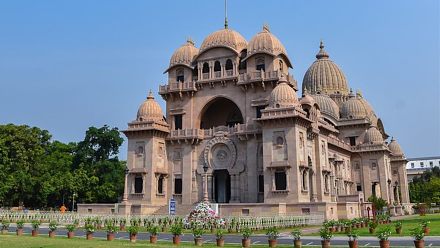
The Sri Ramakrishna Temple is among Belur Math’s most recognisable landmarks, not least for its unusual architectural design. Conceived in keeping with Vivekananda’s vision of universalism, the temple incorporates features associated with different religious and architectural traditions. Its design reflects the idea that diverse paths of worship can lead towards a shared spiritual truth.
Vivekananda did not live to see the temple completed. The design was prepared by Swami Vijnanananda, one of his brother disciples and a civil engineer, and construction was completed in 1938. The result gives physical expression to the Ramakrishna tradition’s emphasis on religious harmony, a principle that runs through the institution’s teachings and work.
The temple is only one part of the monastery’s historical landscape. The Swami Vivekananda Temple marks the site where his mortal remains were cremated after his death on July 4, 1902. Other shrines and buildings across the grounds preserve the memory of Sri Ramakrishna and the people who helped shape the movement. Together, they make Belur Math a place where the institution’s present-day work remains closely tied to the lives and ideals of its founders.
Belur Math During Durga Puja
Durga Puja gives Belur Math a distinctive atmosphere, bringing worshippers to the monastery for one of Bengal’s most important annual festivals. In 2026, the monastery’s official programme schedules the worship of the Divine Mother from October 18 to 20, with Saptami falling on October 18. The celebrations form part of a wider tradition in which the Ramakrishna order observes Hindu worship while remaining committed to its broader philosophy of spiritual inclusiveness.
For visitors, the occasion offers an opportunity to experience the monastery as both a place of prayer and a living institution. The rituals honour the Divine Mother, while the surrounding campus reflects the ideals of contemplation and service that have defined Belur Math for more than a century. Its Durga Puja is therefore not merely an annual religious event; it is part of a larger spiritual tradition that links devotion with a commitment to humanity.
As Amit Shah visits Belur Math during the festive season, the monastery’s history offers a reminder of the vision that brought it into being. Swami Vivekananda set out to create a home for a monastic brotherhood, but his ambition reached much further.