Mame Khan And Brinda Miller On Rock N Roots, Kala Ghoda And The Changing Language Of Folk Music | Exclusive
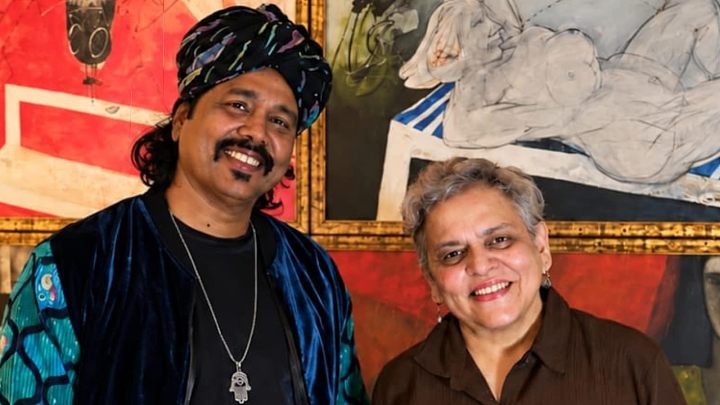
Mame Khan has a fairly uncomplicated rule for fusion: treat it like salt in flour. Enough of it can change the taste. Put too much in, and you have ruined the dough.
مصنف Yatamanyu Narain··177K بار پڑھا
Mame Khan And Brinda Miller On Rock N Roots, Kala Ghoda And The Changing Language Of Folk Music | Exclusive
Mame Khan has a fairly uncomplicated rule for fusion: treat it like salt in flour. Enough of it can change the taste. Put too much in, and you have ruined the dough.
It is an image he returns to while speaking about Rock N Roots, the upcoming performance presented in association with the Kala Ghoda Arts Festival. Khan has spent much of his career refusing the obituary language that often gets attached to folk traditions. He does not believe Manganiyar music needs rescuing, nor does he think younger audiences need Bollywood bait before they will listen to it. He has watched crowds ask for ‘Nimbooda’ and ‘Chaudhary’ with the same enthusiasm reserved for his film songs. What concerns him more is something else: folk music becoming fashionable while the communities that carried it for generations remain somewhere outside the frame.
That question of access sits differently with Brinda Miller. For her, Kala Ghoda has always depended on throwing the doors open as widely as possible. The festival remains free, sprawling and intentionally promiscuous about genre, moving between classical music, tribal traditions, rock, Bollywood, theatre and visual treat art without asking audiences to arrive with the correct cultural credentials. Rock N Roots takes that ethos into a ticketed theatre, partly to raise funds, but also to keep the festival alive beyond the few days when South Mumbai turns into its annual cultural carnival.
In an exclusive conversation with News18 Showsha, Mame Khan and Brinda Miller speak about what fusion should and should not do to folk music, why authenticity cannot be reduced to musical purity, and how social media has changed both artistic discovery and the way younger Manganiyar musicians learn. Khan also reflects on the difference between the eight-minute ‘Chaudhary’ era and today’s three-minute listening economy, while Miller opens up about curating across genres, why temperament can matter almost as much as talent, and what cultural institutions owe artists whose traditions are heard far more widely than their names.
Here are the excerpts:
Q. The name Rock N Roots itself brings together two ideas that could almost move in opposite directions. “Roots” points towards inheritance and tradition, while “rock” suggests reinvention and contemporary energy. When you are putting together a show like this, at what point do you personally decide that the experimentation has gone far enough and that the original musical grammar of the Manganiyar tradition needs to return to the centre?
Mame Khan: Absolutely. For me, the “roots” in Rock N Roots have to remain intact.
As a folk artist and as someone who comes from the Manganiyar tradition, I belong to an oral tradition. That root has to survive. Only then can you actually “rock” with the roots.
At the same time, the world has changed and the times have changed. If you want people today to listen to this music, you also have to find ways of presenting it to them. So, some amount of fusion naturally comes into the picture.
For instance, I perform songs that came from my father’s repertoire, but I also have a wonderful Western band working with me. When we bring those two together, the original character of the music remains, but the fusion is present too.
So, both things coexist. The tradition remains visible and alive, while there is also space to explore something contemporary around it.
Q. Kala Ghoda Arts Festival has built much of its identity around taking culture into public spaces and keeping access free. Rock N Roots, however, also enters the more intimate setting of a ticketed theatre performance. What interested you in changing that relationship between the performer and the audience?
Brinda Miller: A free festival always requires funding, and we don’t want to charge people to attend the festival because it is meant for the public. It is for everyone to come and experience.
So, performances such as these also help us in that regard. Mame will perform at the festival, but he is also performing for us through this format.
Over the years, we have had several musicians perform for us in this manner. We have had artists such as Rahul Deshpande and Rahul Sharma, among others. When we request artists to participate in these fundraising performances, they have been extremely supportive.
But it isn’t only about raising funds.
For me, it is also about keeping the spirit of the festival alive throughout the year. We need to keep building towards the festival rather than suddenly becoming active only when the festival arrives.
In fact, we are planning to expand this kind of programming and have more such activities throughout the year.
During the festival itself, everything continues to remain free. I sometimes wonder how we survive, but somehow we do! We rely greatly on sponsorships.
There is also an audience for these ticketed programmes that is genuinely interested in art and culture. In some ways, a dedicated theatre audience can be different from the crowd that comes to the festival, although there is certainly some overlap.
That relationship between these audiences is definitely something we would like to explore further.
Q. Folk musicians are repeatedly told that they need to add contemporary elements to their music in order to remain relevant to younger audiences. That language isn’t necessarily used in the same way when people discuss classical music or even Western music. Does it ever bother you that folk music is so frequently asked to justify its relevance by changing itself?
Mame Khan: I would say one thing: folk music is music from the people, for the people.
There was a time, particularly some years ago, when people would repeatedly say that folk music was disappearing or dying. I had decided even then that I didn’t want people to keep using that language.
A lot of us worked towards changing that perception. Other artists and musicians from the community supported that effort as well.
Today, when I perform, I can see the difference very clearly.
Yes, I have sung Bollywood songs too. But when I look at a young audience, they aren’t necessarily standing there only asking me for a Bollywood song.
They cheer for Nimbooda. They cheer for Chaudhary. They cheer for the folk songs.
That itself answers the question about whether younger audiences can connect with this music.
Of course, you have to move with the times. I completely understand that. But you have to move forward while keeping your roots intact. You can experiment, you can have fun with the music, but the root cannot disappear.
Brinda Miller: We have seen that happening at the festival as well.
I think a lot of people appreciate fusion, and sometimes fusion can actually become a way of leading someone towards more traditional music.
At the festival, we don’t only programme fusion. We have traditional music, folk music, classical music, Western music, Indian music and almost every possible kind of music.
But if fusion is what initially draws somebody in, I think that can be a very effective starting point for an audience.
Mame Khan: I always explain it through a very simple example.
When you make dough, you put some salt into the flour. That much salt is necessary.
But you cannot put the flour into the salt.
That is how fusion should work too.
The contemporary element can be there like salt in the flour. It can enhance the music. But if the original music becomes only a tiny part of the fusion, then you have reversed the equation completely.
That is the principle I have always followed.
Even with the music I have released over the years, I have tried to maintain that balance. Today, there are lakhs of people across India listening to this music and connecting with it.
Q. You recently spoke about receiving an enormous number of approaches from artists and relying on curators to make those selections. Beyond technical excellence, what makes you recognise that an artist can bring something genuinely necessary to the programme rather than simply deliver a competent performance?
Brinda Miller: The selection of artists is primarily handled by our curators.
There was a time when we would actually have to go out and request artists to perform at Kala Ghoda. But the festival is 27 years old now, and it has grown into something very large and successful.
Today, artists approach us themselves and ask whether they can perform at the festival.
We have also launched so many people over the years, and I think artists recognise that. Many people have had their first opportunity on our stage and then gone on to establish themselves.
Whether it is a musician or a fine artist, there are people who can genuinely say, “We started at Kala Ghoda.”
I feel very proud of that.
So, today we are in a very different position where we actually have the ability to select from artists who want to be part of the festival, and that is a wonderful position to be in.
Q. Since you receive requests from artists across India, what is your filtering process? How do you decide who finally makes it into the programme?
Brinda Miller: For me, one of the most important things is that the person has to be pleasant to work with.
When you are dealing with so many different kinds of people, temperament matters tremendously. Some people can be very difficult temperamentally, and I honestly think that can sometimes matter even more than talent.
If an artist has both temperament and talent, then that is wonderful. Those are the kinds of people you really want to work with.
Technology has also changed the selection process enormously.
Today, because of the internet, we can watch videos, listen to an artist’s sound and get a sense of their work before meeting them. Earlier, you would almost have to personally interact with or audition artists to understand what they could do.
That entire process has changed.
Social media, in particular, has made things much easier because you can discover people, see their work and remain connected with them.
Mame Khan: I would add something to that.
Today, being an artist alone is no longer enough. You also have to understand social media.
The advantage is that if you have talent, you can now create something, record it and upload it yourself. You don’t necessarily have to wait for somebody else to give you an opportunity.
If what you have created genuinely touches people’s hearts and minds, eventually it can find its audience.
Social media has created that possibility for artists.
Q. Folk music naturally allows a lot of freedom in performance. A singer can respond to the mood of the evening, stretch a line, hold a note longer or improvise according to what is happening on stage. But when you perform with a large band, the arrangements and rehearsals are obviously much more structured. For Rock N Roots, did you have to surrender some of that freedom as a folk singer?
Mame Khan: Not at all. I still have complete freedom.
With the musicians in my band, we improvise a great deal on stage.
If you listen to the recorded version of one of my songs and then hear the same song performed live, you will notice hundreds of little differences between the two.
Those improvisations happen naturally on stage.
Of course, there are certain boundaries.
I explain it like this: if there is a house, you still have to enter through its main door. That doorway has to remain where it is, and the house itself has to remain intact.
But once you are inside that house, there is a great deal of freedom.
That is how I look at the music as well.
We have plenty of liberty to improvise, to change something from one night to another and to enjoy ourselves on stage. We aren’t tightly bound to one fixed version of a song.
There is structure, certainly, but within that structure, there is a lot of room to play.
Q. As you mentioned, the Kala Ghoda music programme can move in a single evening from Hindustani or Carnatic music to fusion, Western music or even Bollywood. Over the years, have you found that audiences have become less conservative about genres and more willing to move between very different kinds of music?
Brinda Miller: Absolutely.
Sometimes you realise just how willing an audience is to experience something completely different.
I remember one programme which, personally, I thought was incredibly boring! But it was actually a very serious programme and, in terms of quality, it was excellent.
What amazed me was the audience.
They were completely silent and deeply attentive. They were listening to every detail of the music.
I won’t mention exactly which programme it was, but that experience really stayed with me because it showed me how different an audience’s response can be from your own expectation.
Even within one evening, we programme a range of things. We might have Western music, Indian music and different combinations in between. We deliberately mix things up rather than programming only one genre.
And you can see audiences becoming completely engrossed in whatever is being presented to them.
For me, the important thing is that we are bringing quality to a mass audience.
It is also fascinating to see the sheer variety of people who attend. You have young people and older audiences. You have people from different social and economic backgrounds. You have sponsors sitting alongside members of the general public.
It is genuinely a cross-section of the city.
That is the beauty of Kala Ghoda for me.
And very often people come up to us afterwards and simply say, “Thank you for doing this for us.”
That gives us an extraordinary amount of satisfaction.
Whether it is music, theatre, dance or any of the other art forms.
Q. Your family has preserved this musical tradition for more than 15 generations. When you look at young Manganiyar musicians today, do you notice a major change in the way they learn? Earlier, much of the learning happened directly from elders within the family, whereas today they also have YouTube, recordings, formal music training and social media. Has that changed the younger generation’s relationship with the tradition?
Mame Khan: Honestly, you are absolutely right. There has definitely been a change.
When we were learning, the process took a very long time. You stayed with your guru. You washed their clothes, carried their bags, sometimes even massaged their feet. There were so many things involved in that relationship and that process of learning.
Today, social media is everywhere. YouTube is full of songs and performances, so naturally the process has become much faster.
But if there are young musicians and friends listening to me, there is one thing I would really like to say to them.
Listen to whatever you want. Learn whatever you want. That is a good thing.
But never leave your roots behind.
For Manganiyar musicians in particular, the music that has come from our ancestors is incredibly precious. They preserved it through periods that were far more difficult than anything we face today.
Today, access is easy. Everything is available to us. But our ancestors protected this music at a time when none of those facilities existed.
That music is a treasure.
We are now trying to carry that treasure forward and pass it on to another generation. So, I would tell young musicians to remain connected to it.
Learn new music, listen to new things and explore the world, but continue listening to your own music as well. Preserve the music that belongs to your community and your ancestors.
Q. Large cultural festivals are often judged through numbers such as attendance, footfall, sponsorship and visibility. Personally, what measures feel more meaningful to you when you are assessing whether cultural programming has actually changed someone’s relationship with an art form?
Brinda Miller: I don’t think there is anything particularly painful about having large numbers of people at the festival. In fact, the crowds are part of its identity.
I think that is one of the USPs of Kala Ghoda.
Of course, sponsorship is always difficult. That is something we constantly have to work on.
Over the years, we have faced different kinds of challenges. At one point, permissions used to be a major issue, although the government is now extremely supportive, so that has become much easier.
Sponsorship, however, remains a challenge. I think that is probably a universal problem for any festival.
You constantly have to reach out to people and ask them to support what you are doing.
We are fortunate to have some very good patrons and supporters, but there is never really enough. You are always looking for more support because of the scale of what you are trying to create.
At the same time, the value of the festival cannot only be measured through those numbers. The engagement of people with the arts and the fact that they keep coming back to experience different forms of culture are equally important.
Q. We were speaking earlier about fusion. With folk-fusion projects, sometimes the fusion itself becomes so prominent that the folk vocabulary begins to recede into the background. Are there songs in Rock N Roots that you have deliberately kept relatively unembellished so that their original character remains intact?
Mame Khan: No, I wouldn’t really put it that way.
Our approach has always been that the folk element deserves respect, but whatever element we are bringing in through fusion also deserves its own respect.
Both should exist at an equal level.
Of course, I am a folk singer, so that identity is never going to disappear from what I do. That remains very much present.
For me, the important thing is balance.
Sometimes fusion can become confusion!
What matters is how naturally the two things gel with each other. How well does your music merge with the other musical language? What can you add to a song without disturbing its character?
That is what we keep thinking about.
It isn’t about one side overpowering the other. The two musical worlds have to actually speak to each other.
Q. With Rock N Roots, artists have already demonstrated that folk music can sit comfortably alongside contemporary production. Is the next challenge for cultural institutions to make audiences equally excited about music that is presented without fusion or crossover elements?
Brinda Miller: I don’t think that is particularly difficult anymore because audiences today are extremely open.
They want to see and hear something new.
At the same time, I think fusion can also become a doorway. Once somebody enjoys something popular or contemporary, it can encourage them to go further and discover where that tradition actually came from.
We programme popular music as well. We do Bollywood too, and sometimes we are criticised for that!
But Bollywood is enormously popular, so naturally we have to include some of it. We have had major Bollywood acts at the festival.
Having said that, we try to programme practically everything.
We have always done that. It isn’t a new philosophy for us.
The idea is to expose audiences to as wide a spectrum as possible rather than decide that one kind of music belongs at the festival and another doesn’t.
Q. Earlier, you objected to the phrase “dying art” being used for folk music. Today, folk sounds are everywhere, from films to independent music. So, is the larger problem no longer that folk music itself is disappearing, but that the communities which created and preserved that music don’t receive the same visibility as the sound itself? A Manganiyar song, for instance, may become extremely popular while the community behind it remains comparatively invisible.
Mame Khan: Yes, you are absolutely right.
Let me give you a very simple example.
Suppose someone takes a folk song and uses it in a film, but instead of getting a traditional folk singer to sing it, they give it to a playback singer.
I don’t want to name anybody or criticise any particular singer, but naturally the result will sound more polished.
What may be missing is the authenticity of the sound that you actually wanted people to hear.
If you are taking something from a folk tradition, then my personal view is that you should also involve the singers who have safeguarded that tradition.
It could be Rajasthan, Punjab, Assam, Bengal or anywhere else in India. Every region has communities that have protected their music and carried it forward for generations.
Whenever possible, those are the singers who should be invited to sing that music.
There is another benefit to doing that.
When a song becomes popular, listeners often begin tracing it back to its roots.
Someone may hear a song four or five times on repeat and eventually become curious about where it came from. If that journey takes them back to the original tradition, then they also discover the community behind that music.
So, even if the community initially receives less visibility than the song itself, taking the music back to its roots can eventually bring attention to the people who preserved it in the first place.
And somewhere within those roots, people begin discovering the community as well.
Q. This year, Kala Ghoda Arts Festival also has several unusual workshops for audiences. What are some of the more interesting music-related workshops or formats you are experimenting with?
Brinda Miller: Our workshops tend to be quite unusual anyway! We are always trying to do different kinds of workshops.
When it comes to music, for instance, we have explored combinations such as music and wine, and we also want to do a DJ workshop.
A lot of musicians come to the festival, particularly artists who are visiting for concerts, and we try to make the most of their presence. So, we also organise Western music workshops where musicians bring their instruments, give demonstrations and teach participants alongside their performances.
Another area that we have really been encouraging is tribal music.
We have been approached by organisations that want to promote tribal musicians, and IPRS has been a major supporter of our festival.
We also work with the Tata Steel Foundation, which sends musicians from Jamshedpur, including tribal musicians. They then collaborate with other established musicians, including rock musicians, and we present those performances at Kala Ghoda.
It becomes very interesting for the tribal artists too because they receive exposure to an audience they may not otherwise encounter.
That is something that excites us enormously.
In many ways, a festival is a catalyst. We are bringing different kinds of people together, introducing artists and audiences to one another and creating collaborations that perhaps wouldn’t have happened otherwise.
That, to me, is an important part of what a cultural festival should do.
Q. Mame sir, you have performed across the world. Do people ever approach you after performances and say that they want to learn this music from you, whether it is the singing itself, the tradition or the culture behind it?
Mame Khan: Yes, people do come to me wanting to learn about the singing as well as the culture and tradition behind it.
Our music isn’t something that was traditionally written down. There isn’t a written notation or textbook that contains everything.
So, if you want to learn this tradition properly, you eventually have to go to the people who actually carry it.
People have approached me for that as well.
In fact, around 20 years ago, I used to teach at an institute. There were around 70 or 80 students who would come to learn, and people came from different parts of India, including Delhi and Mumbai.
Even today, people still tell me that they want to learn.
Unfortunately, life has become so busy now. Sometimes people simply want a selfie, and honestly, I feel like taking a selfie with everybody who asks! But because I am constantly travelling, finding dedicated time to teach has become much more difficult.
Q. One of your recent songs on Coke Studio Bharat also became very popular. Many years ago, you sang Chaudhary for Coke Studio, and now you have returned to the platform in a very different musical era. What changes did you notice in Coke Studio itself, in the way folk music is presented, and in your experience of collaborating with a younger generation of artists?
Mame Khan: A lot has changed, of course.
Think about the journey from the time I recorded Chaudhary to where we are now in 2026.
I’ll give you one very simple example.
Chaudhary was around eight minutes long.
This newer song is around three minutes.
That itself tells you how much things have changed.
Everything moves much faster today. Audiences have so many choices available to them that their patience is naturally a little shorter.
So, as musicians, we also have to think differently. We have to improvise and adapt the format to the times.
At the same time, there are certain constraints that come with that.
If I were creating purely according to my own instinct, I might want to let a song breathe for seven or eight minutes. There is a different pleasure in that.
With Chaudhary, even though it was seven or eight minutes long, I still remember the entire song, both antaras, from beginning to end.
And there was space in that format.
Every musician received an opportunity to show their artistry. Everybody had room within the song to contribute something of their own.
Naturally, things have changed now because the format itself has changed.
But I also think the newer Coke Studio experience was very good. Rajasthan and its music were still represented, while the soundscape around that tradition was treated in a more contemporary way.
So, yes, the presentation changes with time, but the important thing is that the identity of the music should remain recognisable.
Q. Finally, for people who are going to attend Rock N Roots and the upcoming edition of Kala Ghoda Arts Festival, what should they be looking forward to? What kind of experience do you hope they take away from it?
Brinda Miller: I think, first of all, this is going to be a different audience from many of the audiences Mame has performed for before.
He performs extensively, and so many of his shows sell out, which is wonderful because it shows how many different kinds of people his music is reaching.
But this particular audience will probably be somewhat different. It will be a South Mumbai audience, although we don’t know the exact profile yet.
That is generally what happens with performances at the NCPA.
I think the NCPA is also quite excited because this isn’t necessarily the kind of performance they have there all the time.
More importantly, this concert is also a lead-up to the Kala Ghoda Arts Festival itself.
Mame has performed with us before, and there will be several other performances around the festival as well. So, programmes like this become a way of announcing that Kala Ghoda is coming and beginning to build that excitement.
We also collaborate with the museum because it is an important part of the Kala Ghoda precinct and of the festival itself.
It has been a wonderful collaboration.
Our work isn’t limited only to programming performances either. We have also been involved in restoring buildings in the area, and that larger relationship with the neighbourhood is something we want to highlight.
That is also part of what Kala Ghoda represents for us.
Q. And Mame sir, what would you tell your fans to expect from Rock N Roots?
Mame Khan: I am super excited.
It is going to be a lot of fun.
With Rock N Roots, we are presenting the band, we are presenting fusion, but of course, I am also bringing with me the fragrance of Rajasthan’s soil.
That is the most important thing.
I would simply say that I am coming to Mumbai with everything I have.
The roots, the music, the energy and Rajasthan itself are all coming together.