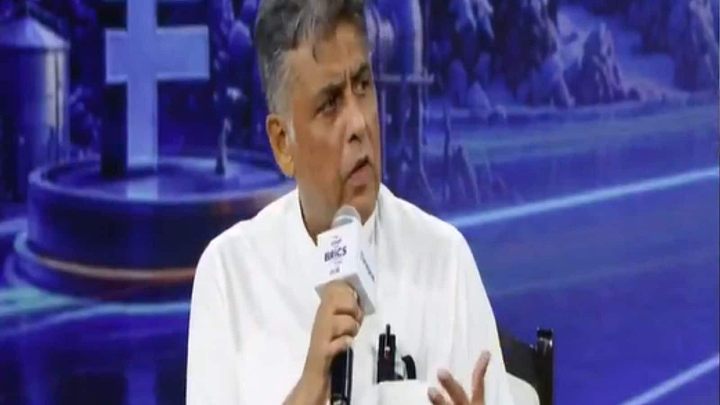
‘Interests Are Permanent, Alliances Are Not’: Manish Tewari On BRICS, China & India’s Strategic Autonomy
Speaking on CNN-News18 BRICS Dialogues, Congress MP Manish Tewari said BRICS must focus on critical technologies, global governance reforms and strengthening the New Development Bank, while India should maintain strategi
By Pragya Bahuguna··52K reads
‘Interests Are Permanent, Alliances Are Not’: Manish Tewari On BRICS, China & India’s Strategic Autonomy
Speaking on CNN-News18 BRICS Dialogues, Congress MP Manish Tewari said BRICS must focus on critical technologies, global governance reforms and strengthening the New Development Bank, while India should maintain strategic autonomy amid growing US-China rivalry.
China’s Lead In Critical Technologies Could Shape The 21st Century
Tewari said control over critical technologies emerging from the Fourth Industrial Revolution will play a decisive role in shaping the remaining decades of the 21st century. Citing a report by Australia’s Lowy Institute, he said China leads in 67 of 75 critical technologies, including areas such as artificial intelligence, quantum computing, robotics, genomics and the Internet of Things.
He warned that this technological concentration could further widen the digital divide between the Global North and Global South.
According to Tewari, BRICS should therefore work towards building consensus on guardrails and agreed rules of engagement for emerging technologies. While acknowledging that reaching such an agreement would be difficult given the growing US-China competition, he said such efforts could help prevent the technology gap from becoming even wider.
India Must Avoid Replacing One Hegemony With Another
Addressing concerns over China’s growing influence within the expanded BRICS, Tewari said India needs to carefully navigate the competition between Washington and Beijing without allowing itself to become part of either camp.
#Brics2026| In international relations, interests are permanent, but alliances are not. So, you have many different forums that are concurrently at play, like BRICS, ASEAN and others. We need to engage with all these forums based on our exceptionalism: @ManishTewari, MP Congress,… pic.twitter.com/qisWLzdiFN
— News18 (@CNNnews18) September 11, 2026
He argued that India’s foreign policy has traditionally been guided by its own interests rather than permanent alliances.
“In international relations, interests are permanent, alliances are not,” Tewari said, stressing that India can simultaneously engage with BRICS, the Quad, ASEAN and other multilateral and minilateral groupings.
He said India should identify areas where countries with different geopolitical positions can still find common ground, rather than viewing BRICS simply as an anti-Western or anti-American platform.
Strategic Autonomy Is Demonstrated Through Actions
On whether India could use BRICS to signal its strategic autonomy to the US, Tewari said New Delhi does not need to constantly proclaim its strategic autonomy.
“Strategic autonomy is demonstrated by the actions that you initiate rather than the words that you verbalize,” he said.
Tewari described multi-alignment as a continuation of India’s long-standing foreign policy approach, pointing to the country’s engagement with different powers and groupings based on its interests.
He also linked the idea of self-reliance, now articulated through Atmanirbharta, to earlier phases of India’s economic and strategic thinking.
BRICS Should Focus On Tangible Global Priorities
Tewari said assessing BRICS solely through the question of “what India gets out of it” would be too narrow. Instead, the grouping should be judged on whether it can deliver meaningful outcomes on issues of wider global importance.
Among the areas he identified were reforming global governance institutions, cooperation in frontier technologies and strengthening the BRICS New Development Bank.
He said the development bank remains significantly underfunded and argued that increasing its capital base could become an important area of cooperation among BRICS members.
India Must Closely Watch Emerging Defence Alignments
On new defence arrangements involving Pakistan and other regional powers, Tewari cautioned against becoming alarmist but said India must examine their implications carefully.
He referred to Pakistan’s history of joining earlier security alliances, including the Central Treaty Organization and Southeast Asia Treaty Organization, arguing that such arrangements have not always produced lasting strategic outcomes.
At the same time, he said India should not minimise the significance of emerging defence pacts, particularly given the security situation around the Red Sea and the potential impact on India’s interests and trade routes.
Tewari questioned how collective-defence commitments would operate in practice if one member of a new alliance came under attack, noting that the effectiveness of such arrangements ultimately depends on whether members are willing and capable of acting when a crisis occurs.
BRICS’ Real Test Is Whether It Can Build Convergence
Tewari’s broader argument was that the future relevance of BRICS will depend less on its positioning against the West and more on whether its diverse members can identify issues on which they can collectively act.
With the grouping now significantly expanded and its members often divided by competing geopolitical interests, he said the practical challenge is to find a “least common denominator” that allows countries to move forward together on issues of shared importance.