If BRICS Wants To Challenge The Dollar, Who Pays The Price And Who Benefits?
As BRICS leaders gather in New Delhi, reducing dependence on the US dollar has returned to the centre of discussions around trade, payments and the global financial system.
By Aanchal Sinha··90K reads
If BRICS Wants To Challenge The Dollar, Who Pays The Price And Who Benefits?
As BRICS leaders gather in New Delhi, reducing dependence on the US dollar has returned to the centre of discussions around trade, payments and the global financial system.
BRICS countries are discussing greater use of national currencies, cross-border payment systems and payment-system interoperability as part of efforts to strengthen financial cooperation among members.
The group is not currently working towards a common BRICS currency. India has proposed linking central bank digital currencies of BRICS countries to facilitate cross-border payments. Reuters reported that the proposal is aimed at making international transactions easier and faster, rather than replacing the US dollar as a reserve currency.
Russia has also said it is not pursuing “de-dollarisation”. Kremlin spokesperson Dmitry Peskov said Russia remains open to all acceptable methods of payment.
Why Is The Dollar So Important?
The US dollar remains the dominant currency in international finance.
The Bank for International Settlements said the dollar was on one side of 88% of all foreign-exchange transactions in 2022. It also accounted for around 60% of foreign-currency assets and liabilities in international banking. The BIS said the dollar also dominates debt-security issuance and trade invoicing.
The latest International Monetary Fund data shows that the dollar accounted for 57.13% of allocated global foreign-exchange reserves in the first quarter of 2026. The euro accounted for 20.03%, while the Chinese renminbi accounted for 1.99%.
These figures show the gap between the dollar and other currencies in official reserves and international financial markets.
Iran, Russia Back Greater Use Of Local Currencies
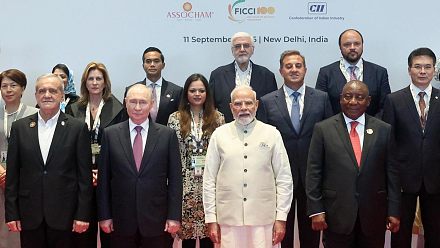
Iranian President Masoud Pezeshkian and Russian President Vladimir Putin, on Friday, addressed the BRICS Business Forum and highlighted why de-dollarisation continues to remain a key issue in the BRICS debate.
Pezeshkian called for BRICS to build a more resilient system for trade, investment and financing while increasing the use of national currencies. The Iranian president said reliance on a limited number of currencies makes economies vulnerable to political shocks.
“One of the most important steps is to expand the use of national currencies in trade among the members. This step must be accompanied by the establishment of the necessary instruments for managing currency risks and reciprocal settlements since the current financial system is vulnerable to political shocks due to its concentration on a limited number of currencies,” he said.
Before the summit, Pezeshkian had also said BRICS financial mechanisms could help member countries carry out economic transactions with reduced dependence on the dollar. He specifically referred to the New Development Bank, saying its financial capacity should support transactions among members without relying on the US currency.
The issue is particularly significant for Iran, which remains under extensive US sanctions. Tehran views the increased use of national currencies, alternative payment mechanisms and BRICS institutions as ways to reduce exposure to financial restrictions imposed through the dollar-based system.
Putin Pushes For ‘New, Sustainable Platform’
Putin, speaking at the same Forum, raised concerns over restrictions on international trade through sanctions, secondary sanctions and other measures.
He called for BRICS to develop what he described as a “new, sustainable platform for global growth.” Russia has a particularly strong incentive to develop financial channels outside Western systems after sanctions significantly restricted its access to parts of the dollar- and euro-based financial architecture.
“We acknowledge the work done to study the cross-border interoperability of payment and messaging channels, and the discussions on promoting trade settlements and investments using BRICS local currencies, while respecting national priorities and acknowledging that there is no one-size-fits-all approach,” the joint statement issued after the meeting of BRICS finance ministers and central bank governors in Mumbai ahead of the BRICS Summit said.
The statement also backed continued efforts by the New Development Bank (NDB) “to mobilise resources, expand local currency financing, strengthen project-preparation facilities, diversify funding sources, foster innovation, and support high-impact projects that contribute to inclusive and sustainable growth in member countries.”
What Is BRICS Trying To Change?
BRICS finance ministers and central bank governors have backed efforts to improve payment and messaging interoperability and develop cross-border payment systems that are fast, low-cost and secure.
The discussions also include greater use of national currencies for trade and investment. Reuters reported that India is pushing for greater integration of central bank digital currencies among BRICS countries as part of this effort.
The objective is therefore focused on expanding payment options rather than introducing a single BRICS currency.
Who Could Benefit?
One area already being developed is financing in local currencies.
The New Development Bank, established by BRICS countries, has made local-currency financing part of its strategy. Its 2022-2026 strategy sets a target of providing 30% of its total financing commitments in the national currencies of its member countries.
The NDB says local-currency financing can help borrowers with local-currency revenues reduce foreign-exchange risk and dependence on currency-swap markets.
For its proposed 2027-2031 strategy, the NDB has said it aims to raise the local-currency financing target to between 40% and 50%.
What Are The Challenges?
Using national currencies for international trade does not remove the need to manage exchange rates.
The NDB itself says local-currency financing can help borrowers mitigate foreign-exchange risk, while also noting the role of currency swaps in its financing operations.
BRICS countries also have different currencies, financial systems and regulations. Reuters reported that efforts to develop common payment arrangements face technical and political hurdles, including the need to address trade imbalances between countries.
What Does Dollar Dominance Mean For The US?
The Federal Reserve has said the dollar’s international role provides benefits to the United States.
It has said widespread use of the dollar in trade invoicing, international banking and debt markets lowers transaction and borrowing costs for US households, businesses and the government. The Federal Reserve has also said the dollar’s international role broadens the pool of creditors and investors for US investments.
A significant shift away from the dollar would therefore affect a financial system in which the currency currently has a dominant international position.
However, the available reserve data does not show a replacement for the dollar. The IMF reported that the dollar’s share of global allocated foreign-exchange reserves actually increased from 56.42% in the fourth quarter of 2025 to 57.13% in the first quarter of 2026.
Why Is Replacing The Dollar Difficult?
De-dollarisation would involve settling a greater share of bilateral trade in national currencies and improving or linking payment and messaging systems.
It would also mean reducing intermediaries in cross-border transactions, increasing local-currency financing through the New Development Bank and strengthening BRICS financial safety nets.
Other measures would include developing guarantees and other instruments to mobilise private capital and providing members with alternatives when sanctions or financial restrictions disrupt conventional payment channels.
So, What Is Changing?
The current BRICS approach is focused on expanding the use of national currencies, improving cross-border payment systems and increasing local-currency financing.
The dollar continues to dominate global foreign-exchange transactions, international banking and official foreign-exchange reserves. The IMF’s latest data also shows that the renminbi’s share of global allocated reserves remains below 2%.
For now, BRICS’ financial agenda is therefore about creating additional payment and financing options alongside the existing international monetary system, rather than replacing the dollar with a common BRICS currency.