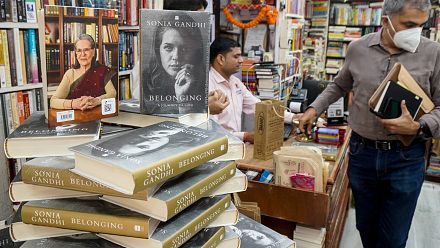
'Factually Flawed': Sonia Gandhi's Memoir Faces Flak For Unfiltered Attack On RSS
The wrong founding year, a sweeping ideological indictment and a controversial chapter on one of Indian politics’ most consequential turning points, Chapter 24 of Sonia Gandhi’s ‘Belonging: A Journey of Love’ has drawn s
By Madhuparna Das··85K reads
'Factually Flawed': Sonia Gandhi's Memoir Faces Flak For Unfiltered Attack On RSS
The wrong founding year, a sweeping ideological indictment and a controversial chapter on one of Indian politics’ most consequential turning points, Chapter 24 of Sonia Gandhi’s ‘Belonging: A Journey of Love’ has drawn sharp reactions from RSS insiders, who are questioning the memoir’s factual accuracy and its depiction of historical events.
But beyond the disputed dates lies a much bigger political argument which reflects Gandhi’s assertion that the Rashtriya Swayamsevak Sangh (RSS) dreamt of a ‘Hindu nation’ that would ‘replace India’s constitutional identity’ and relegate Muslims and Christians to second-class citizenship.
The passage is striking not merely for its description of the RSS, but for the historical and political trajectory Gandhi constructed around it. She drew a sharp distinction between the pluralistic vision of India associated with Mahatma Gandhi and Jawaharlal Nehru and what she described as the Sangh’s conception of Hindu nationhood. In her account, this ideological vision eventually found political expression through the BJP.
The historical details, however, have become a point of contention. Gandhi, in her memoir, wrote that the RSS was founded in 1921. It was actually established by Keshav Baliram Hedgewar in Nagpur in 1925. Other references in the memoir, including those concerning the Anna Hazare movement and former Congress leader Ahmed Patel’s death, have also attracted scrutiny over apparent factual inaccuracies.
The questions raised by Sangh Parivar insiders therefore go beyond a disagreement over ideological characterisation. They concern the accuracy of the historical narrative through which Gandhi built her argument.
Speaking with News18, Prafulla Ketkar, editor, Organiser Weekly, said: “The grave factual mistakes such as the wrong date of formation of RSS and accusing the Sangh of ‘replacing Constitutional ideas’ shows ignorance of Sonia Gandhi about RSS and its ideals.”
By mapping out the turbulent decade of the 1980s, Gandhi framed the rise of Hindutva not as an organic cultural awakening, but as a calculated political pivot designed to exploit the fault lines of Indian democracy. However, the Sangh Parivar called her memoir a “factually flawed” piece.
Ratan Sharda, author and RSS ideologue, said, “Sonia Gandhi has got even the year of the RSS’s formation wrong. The RSS was founded in 1925, when India was under British rule. Hedgewar was in Congress in 1921 and imprisoned for non-cooperation satyagraha. The RSS oath for members after it was established in 1925 was Free Hindu Rashtra from British. There was no Constitution of independent India at that time. So, which Constitution is she referring to? The RSS was founded during the freedom struggle, and its founder, KB Hedgewar was himself associated with the freedom movement.”
The Editorial Friction
It is precisely this highly personalised perspective on the Sangh Parivar that transformed ‘Belonging’ from a highly anticipated memoir into a political battleground long before it hit the stands.
The raw political assessments embedded in these specific pages reportedly became the primary bone of contention between Gandhi and her initial publisher, Penguin Random House India.
During the pre-release manuscript review, legal and editorial teams reportedly flagged her sweeping characterisations, particularly passages comparing their historic vision to supremacist ideologies, alongside her critiques of contemporary right-wing policy.
Fearing protracted litigation and political backlash under a dominant regime, the original publishers pushed for substantial cuts and strategic editorial dilutions. Gandhi, however, refused to sanitise her memories or soften her ideological stance, choosing instead to let the publishing contract fall through.
Shah Bano: ‘The Political Opening’
Sonia Gandhi’s larger argument emerged through her recollection of the Shah Bano controversy, one of the most consequential episodes during Rajiv Gandhi’s tenure as the prime minister.
The 1985 Supreme Court judgment granting maintenance to Shah Bano, a divorced Muslim woman, triggered a political storm over personal law, gender justice and the limits of religious autonomy. Rajiv Gandhi’s government subsequently enacted the Muslim Women (Protection of Rights on Divorce) Act, 1986, effectively overturning the immediate outcome of the judgment.
Gandhi offered a personal account of the political dilemma inside her household. She recalled being deeply disturbed by newspaper and magazine reports, particularly the criticism from Muslim women activists who believed Shah Bano’s rights were being compromised. She wrote about confronting Rajiv Gandhi and asking why he was allowing the situation to unfold as it did.
Her narrative actively attempted to rewrite the popular critique of Rajiv’ Gandhi’s ‘dual appeasement’ policy. Regarding the 1985 Shah Bano judgment, she revealed her own internal agitation, recalling how she questioned Rajiv over accusations that the Congress was sacrificing Muslim women’s interests. Her writing captured Rajiv Gandhi’s defence, a claim that his controversial legislative compromise sought a balance between women’s interests and the larger framework of Muslim Personal Law.
Her account, however, has drawn sharp criticism from Sangh insiders, who have questioned both her interpretation of the episode and the political choices made by the Congress government at the time.
“Her narration about the Shah Bano case is all the more shocking. It was a clear case of the Rajiv Gandhi government succumbing to pressure from Muslim fundamentalists. If she was so concerned about women’s rights, why didn’t she mention it earlier? Dragging the President’s office [that of Gyani Zail Singh] into politics is all the more dangerous, which shows she hardly has any regard for the Constitution,” Ketkar said.
In the piece, Gandhi connected the Shah Bano episode to the BJP’s political trajectory. She recalled that after winning just two Lok Sabha seats in the 1984 general election, the party was searching for an emotive issue that could mobilise religious sentiment and strengthen its political appeal.
“On the Shah Bano issue, it was her husband (Rajiv Gandhi) who failed to stand by the woman who had sought justice. Instead, under pressure from conservative Muslim leadership and what critics described as vote-bank politics, his government enacted a law that effectively diluted the Supreme Court’s judgment,” said Sharda.
The Crucible of 1987
Beyond the communal flashpoints, the chapter transitions into a dark account of institutional subversion from within the state. Gandhi detailed a ‘conspiracy to dismiss the elected prime minister’ in 1987, pointing directly to an alliance between an embattled President Giani Zail Singh, a prominent Mumbai business house, a media baron, and the “RSS operating in the shadows”.
Reacting to her claims, Sharda added, “She is, in effect, attempting to present a version of history that leaves out crucial facts and avoids confronting her family’s own political responsibility. And then there is the question of corruption. The Bofors scandal had already surfaced in 1987, during Rajiv Gandhi’s tenure. How, then, can she claim that there was no corruption? How can one discuss that period without addressing Bofors? She, in fact, dragged the President’s office into it.”
The chapter closed on a defensive note, invoking the tragic mythological figure of Abhimanyu from the Mahabharata. She described Rajiv as a youthful hero trapped in a hostile ‘Chakravyuh’, single-handedly fighting off a combined onslaught of political adversaries, corporate giants, and ideological shadows until he ultimately fell to their shafts.