China Has The Hardware, India Has Software Strength: Can Modi-Xi Find Common Ground On AI?
Chinese President Xi Jinping has landed in New Delhi for the 18th BRICS Summit, his first visit to India in seven years, putting the India-China relationship back in focus at a time when artificial intelligence (AI) is b
By Shilpy Bisht··137K reads
China Has The Hardware, India Has Software Strength: Can Modi-Xi Find Common Ground On AI?
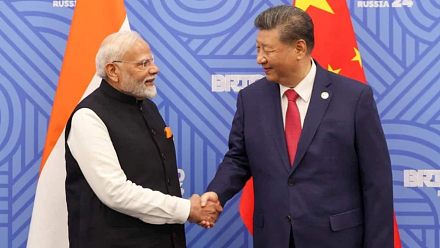
Chinese President Xi Jinping has landed in New Delhi for the 18th BRICS Summit, his first visit to India in seven years, putting the India-China relationship back in focus at a time when artificial intelligence (AI) is becoming a central pillar of economic and strategic competition. Beyond the political optics of the Modi-Xi meeting, AI offers one of the areas where the two countries have complementary capabilities, and where cooperation could potentially be pursued through the BRICS framework.
India, which is chairing BRICS this year, has placed AI, digital trade and emerging technologies prominently on its agenda. The government has been pushing for greater research collaboration in AI, advanced computing, quantum technologies and semiconductor materials, partly to reduce vulnerabilities created by concentrated global technology supply chains.
From AI Governance To Practical Cooperation
India’s BRICS vision does not just include discussing AI regulation, but also using AI for public good, developing digital infrastructure, strengthening digital trade and creating more resilient technology ecosystems across the Global South.
That creates an obvious opening for India and China. Both are large digital economies with huge domestic markets, substantial pools of engineers and researchers, and ambitions to build indigenous AI capabilities. China has developed a powerful AI and advanced-manufacturing ecosystem, while India has strengths in software, IT services, digital public infrastructure and a large technology workforce.
The question is whether these complementary strengths can translate into actual collaboration, given the strategic mistrust that has defined the relationship since the 2020 Galwan border clash.
China And India Have A Software-Computing Infra Advantage
One potential area is the intersection of AI software and computing infrastructure. China’s technology ecosystem includes major semiconductor, electronics, cloud computing and AI companies, while India has been building its own semiconductor and AI ecosystem and has a strong services sector.
India’s push for cooperation within BRICS is partly aimed at addressing what it sees as concentration in critical technologies. The proposed focus on AI, advanced computing, quantum technologies and semiconductor materials could allow member countries to collaborate on research, standards and supply chains rather than relying entirely on technology controlled by a handful of global companies.
For India and China, cooperation could potentially extend to AI research, academic exchanges, computing infrastructure, AI applications and standards. But any such partnership would have to account for India’s restrictions and security concerns around Chinese technology and investment.
The Trade Relationship Is The Biggest Constraint
Technology cooperation cannot be separated from the broader India-China economic relationship. China overtook the US to become India’s largest trading partner in FY2025-26, with bilateral goods trade reaching $151.1 billion. India imported about $132 billion worth of goods from China, while exports stood at roughly $19.5 billion, leaving a trade deficit of around $112 billion.
The relationship has continued to deepen in 2026, with bilateral trade rising 23.6% to $91.72 billion in the first half of the year, according to Chinese customs data. The figures underline both the scale of the economic relationship and India’s continued dependence on Chinese imports. That creates both an incentive and a problem.
India needs access to components, machinery and technology that China produces at scale. At the same time, New Delhi wants to reduce excessive dependence on China in critical sectors and build domestic manufacturing capacity. The emerging thaw has already seen some restrictions eased in areas such as investment and manufacturing, but sensitive technologies remain a different proposition.
How Can BRICS Become The Bridge?
The BRICS framework may offer a less politically difficult route for limited technology cooperation. Rather than an exclusive India-China technology partnership, collaboration could be structured around wider BRICS programmes involving AI research, digital infrastructure, standards, skills and responsible AI.
India’s presidency has already pushed discussions around AI and digital ecosystem integration. The bigger agenda is to connect emerging economies through digital trade, payments, resilient supply chains and technology cooperation.
This could also give India and China a practical area of engagement without requiring the two sides to resolve every bilateral disagreement first.
India has already used its BRICS chairship to advance discussions on digital ecosystems, next-generation networks and artificial intelligence. A BRICS working-group meeting in Pune in August focused on AI, advanced communications and digital ecosystem integration, while a separate standards initiative has explored common frameworks for trade and technology, including AI standardisation.
Common principles could help reduce regulatory fragmentation and compliance costs for companies operating across multiple BRICS markets, while giving member countries a greater voice in shaping global technology standards. The bigger challenge, however, will be turning broad political commitments into mechanisms that can be implemented across the bloc.
BRICS members differ widely in their technological capabilities, investment capacity, regulatory approaches and strategic relationships with the US and Europe. Any deeper cooperation involving sensitive information, research data or semiconductor technology would therefore require greater trust, sustainable financing and clear rules governing intellectual property, cybersecurity and data sovereignty.
A Huge Market On Both Sides
The scale of the opportunity is another factor. India and China together account for roughly 2.8 billion people, making cooperation between the two potentially significant for the development and deployment of AI products and services in emerging markets. Modi and Xi have previously highlighted the importance of India-China relations for their populations and the wider Global South.
AI applications in healthcare, agriculture, education, financial inclusion, manufacturing and public services could be particularly relevant to developing economies. India brings experience with large-scale digital public infrastructure, while China’s experience in manufacturing, logistics and industrial automation could complement it.
For BRICS, such cooperation could also support India’s stated objective of making AI more accessible to developing countries rather than allowing the technology ecosystem to remain concentrated among a small number of advanced economies.