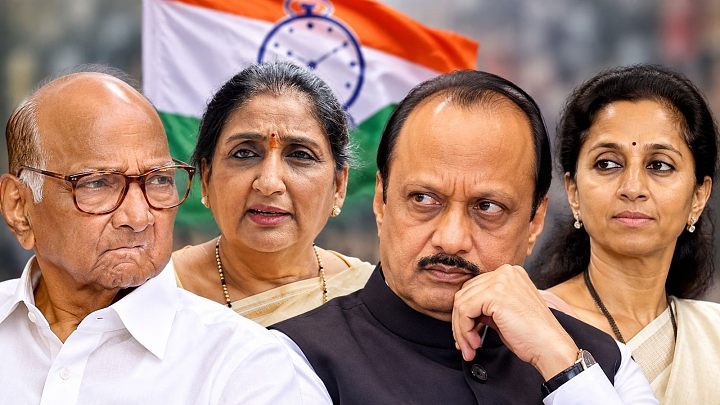
Can NCP Reunite Without Diluting Ajit Pawar's Legacy? The Question Holding Up A 'Maha' Merger
The talks of a merger between the two factions of the Nationalist Congress Party (NCP) have hit another roadblock.
By Mayuresh Ganapatye··43K reads
Can NCP Reunite Without Diluting Ajit Pawar's Legacy? The Question Holding Up A 'Maha' Merger
The talks of a merger between the two factions of the Nationalist Congress Party (NCP) have hit another roadblock.
Though spokespersons and leaders of both factions may deny that discussions were held after Ajit Pawar’s death, the fact remains that attempts were made over the last seven-eight days to resume conversations and explore the possibility of bringing the two factions together. However, according to highly placed sources in the NCP led by Sunetra Pawar, the party’s top leadership, after assessing the possible consequences of a merger at this stage, has realised that such a move could create more problems than it would resolve.
There are three major concerns. First, a merger could lead to chaos and confusion among the party cadre. Second, there is apprehension that the faction could eventually lose organisational and political control to Sharad Pawar and Supriya Sule. Third, and perhaps most importantly, the party could lose the distinct political identity that Ajit Pawar had created after breaking away from his uncle in the name of development and a different political approach.
ALSO READ | An ‘Almost Done’ Merger, Flurry Of Meetings And Pawar Family Equation: Is NCP Headed For Reunion?
The results of the 2024 assembly elections had further strengthened Ajit Pawar’s position. His faction won 41 seats, while Sharad Pawar’s NCP (SP) managed just 10. These results had boosted the confidence of Ajit Pawar and his supporters that their decision to chart an independent political course had electoral backing.
It is also a fact that Ajit Pawar and leaders of the NCP (SP) held several meetings to discuss a possible merger. His tragic death in an air crash, however, brought those discussions to an abrupt halt.
The political situation at the Centre has added another dimension to the merger question. The BJP-led government is looking for numbers to secure support for important legislative proposals, including the proposed delimitation-related constitutional changes. The government needs a special majority in both Houses of Parliament and is short of the required numbers. The support of opposition parties and regional players has therefore become significant.
The NCP (SP) and DMK together account for 30 Lok Sabha MPs. Their support could prove important to the government’s parliamentary arithmetic. This is one reason why efforts to bring the two NCP factions together have acquired political significance beyond Maharashtra. If a merger happens, a united NCP, with Sharad Pawar on board, could also strengthen the BJP’s political and negotiating position, both in Maharashtra and at the Centre.
However, what is interesting is that the Sunetra Pawar-led NCP, though not in favour of a merger, reportedly has no objection if the BJP manages to bring the Sharad Pawar faction on board independently. According to highly placed sources, this position has also been conveyed to the BJP’s state and central leadership. In other words, the party may not be interested in merging with NCP (SP), but it is not opposed to a political understanding between the BJP and Sharad Pawar’s faction.
There is another interesting dimension to the developments within the NCP. Several senior leaders are understood to have reservations about the functioning and decision-making style of Rajya Sabha MP Parth Pawar. There is discontent over the way certain decisions are being taken without keeping senior leaders in the loop. Yet, despite these differences, the senior leadership appears to be on the same page when it comes to opposing a merger at this stage.
The meeting between six NCP leaders and Union Home Minister Amit Shah, without the presence of either Sunetra Pawar or Parth Pawar, had raised eyebrows and triggered political speculation. Questions were subsequently raised about Sunetra Pawar’s leadership and the extent of her control over the party. The selective video footage of a conversation between Sharad Pawar and Praful Patel, recorded when Patel visited the former to enquire about his health at a South Mumbai hospital, also added to the speculation. Taken together, these developments indicate that there have been attempts to create a political narrative around the need for both NCP factions to come together.
The argument appears to be that both sides need each other and that a reunion is necessary. However, the leadership of the Sunetra Pawar-led faction is not convinced that a merger is necessary at this point.
The party currently shares power in Maharashtra and has its own organisational structure, political identity and leadership. A merger would immediately raise difficult questions. Who would lead the reunited party? Would Sharad Pawar become part of its leadership structure? Would Supriya Sule work under Sunetra Pawar? What happens if two power centres emerge within the same party, each attempting to establish its supremacy?
These are not merely questions about leadership positions. They have direct implications for the organisational structure, distribution of political influence and the interests of leaders and workers who have remained with Ajit Pawar’s faction. A merger could disturb the existing power-sharing arrangement in the state and create uncertainty among the local party workers who have continued to work for the organisation.
When Ajit Pawar was alive, he had the support of senior leaders and party workers. If the merger had happened under his leadership, he would have led the united NCP, while Sharad Pawar could have remained a mentor to the party. However, the situation has changed after his death.
The reported differences within the NCP over Parth Pawar’s style of functioning and his decisions without consulting senior leaders have further complicated matters. With these internal issues yet to be resolved, the party leadership appears more focused on putting its own house in order rather than creating further complications through a merger. For now, the priority seems to be strengthening the party and protecting the independent identity that Ajit Pawar had created.
Ultimately, the biggest challenge before Sunetra Pawar is not just to keep the NCP united but to establish that the party Ajit Pawar built can survive independently under a new leadership. A merger may offer political advantages, but it also brings the risk of reopening questions of leadership, control and identity that Ajit Pawar had settled through his political break from Sharad Pawar.
For the leaders and workers who stood with Ajit Pawar, the question is whether they are ready to give up the political space they fought to create. At this point, the answer from Sunetra Pawar’s camp appears to be no. The NCP may have internal differences, but when it comes to protecting Ajit Pawar’s political legacy, its leadership seems determined to hold its ground.