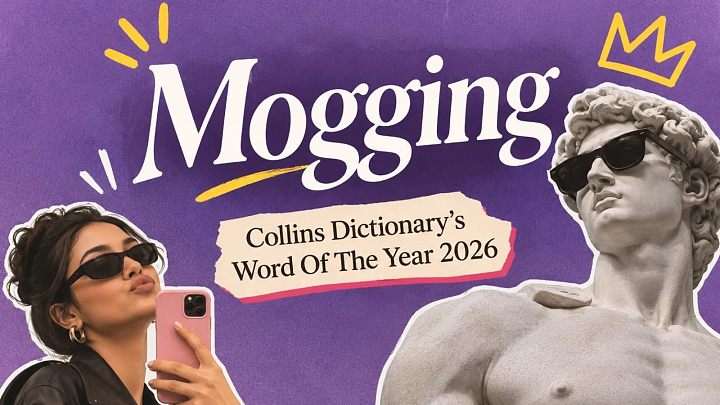
'Mogging' Is Collins Dictionary's 2026 Word Of The Year, Do You Know What It Means?
In the age of Instagram-perfect faces, carefully curated wardrobes, gym transformations and endless beauty filters, looking good sometimes feels like a competitive sport. And apparently, the internet has found a word for
By Labani Mahanandy··18K reads
'Mogging' Is Collins Dictionary's 2026 Word Of The Year, Do You Know What It Means?
In the age of Instagram-perfect faces, carefully curated wardrobes, gym transformations and endless beauty filters, looking good sometimes feels like a competitive sport. And apparently, the internet has found a word for winning that competition: mogging. Collins Dictionary has named the slang term its Word of the Year for 2026, giving official recognition to a piece of internet vocabulary that has travelled from niche online communities to everyday conversations.
If you’ve ever stood next to someone who looked impossibly tall, had a particularly enviable physique or seemed to have walked straight out of a luxury campaign, you might have experienced what the internet calls being ‘mogged’. Essentially, it means being outshone or outperformed by someone else, often in a way that makes you look comparatively less impressive. And while the word is frequently thrown around jokingly on social media, its origins reveal a more complicated relationship with beauty standards, masculinity and the pressure to measure up.
What Does ‘Mogging’ Mean?
According to Collins Dictionary, ‘mogging’ means outperforming or outshining someone or something, often making the other person appear inferior in terms of physical appearance, confidence or status.
The term is particularly popular in conversations about looks. Someone might be described as ‘mogging’ another person if they appear taller, more muscular, better dressed or conventionally more attractive. It can also extend beyond physical appearance. An exceptionally stylish outfit, an impressive fitness transformation or even a particularly photogenic holiday picture could leave someone feeling thoroughly mogged.
Think of it as the internet’s rather competitive way of saying someone stole the spotlight. The difference? Mogging often comes with an implied comparison, where one person’s perceived superiority makes another person’s appearance or achievements seem less impressive.
Where Did The Word ‘Mogging’ Come From?
As it turns out, mogging didn’t originate in the glamorous world of fashion, celebrity culture or beauty influencers. Its roots lie in bodybuilding culture and online communities focused on physical appearance.
Collins Dictionary traces the word to the acronym AMOG, which stands for ‘alpha male of the group’. Around 2016, it began circulating as a noun in bodybuilding circles, referring to the most physically dominant man in a gym or social setting. Over time, it evolved into a verb and became associated with online manosphere communities, where physical appearance, masculinity and social hierarchies were frequently discussed.
The word eventually moved beyond these niche spaces and found a much wider audience through social media. Today, it is used by younger internet users in a more playful and ironic manner, although its original associations haven’t entirely disappeared.
How Is Gen Z Using ‘Mogging’ On Social Media?
If you’ve spent enough time scrolling through TikTok, Instagram or online discussion forums, chances are you’ve encountered the language of mogging without necessarily recognising it.
The term is often used to describe someone who seemingly outshines everyone around them. It could be a particularly muscular gym-goer standing next to someone with a comparatively smaller frame, a celebrity whose red-carpet appearance steals the show or a person whose effortlessly put-together look makes everyone else’s outfit seem slightly underwhelming.
It has also become part of the internet’s increasingly elaborate vocabulary around physical appearance. Terms such as ‘looksmaxxing’, which refers to attempts to optimise one’s physical attractiveness, often appear in the same online conversations.
In its lighter usage, mogging is simply another piece of internet humour. Someone might jokingly claim that their friend’s impeccably styled hair mogged theirs or that a celebrity’s outfit mogged everyone else’s at an event. The word has become a shorthand for being outdone, whether in looks, style, confidence or performance.
Collins’ own explanation captures this shift, describing how younger generations have adopted the term and turned it into humorous slang.
The Not-So-Fun Side Of Mogging: When Looking Good Becomes A Competition
While the word might sound amusing, the culture surrounding it raises some interesting questions about how we perceive ourselves and others.
Social media has already made appearance comparisons almost unavoidable. From perfectly sculpted gym bodies and carefully edited selfies to elaborate skincare routines and celebrity beauty transformations, there is a constant stream of images telling us what looking good is supposed to mean.
Mogging adds another layer to this culture by framing attractiveness as a hierarchy. Instead of simply appreciating someone’s appearance, the conversation becomes about who looks better, who has the better physique, who is taller, who has more defined features and who wins the comparison.
The term’s association with certain manosphere communities also brings a more troubling dimension to the conversation. Some online spaces have attempted to turn physical attractiveness into a measurable competition, encouraging people to judge themselves and others against rigid appearance-based standards.
As sociology researcher Simon Copland told ABC News, some influencers use questionable scientific claims to create formulas for determining whether someone is attractive enough. This can turn subjective ideas of beauty into an apparently quantifiable hierarchy.
That is where the playful internet joke can become less harmless. When appearance becomes a constant competition, confidence can end up being measured through comparison rather than self-acceptance.
Why Has ‘Mogging’ Become Collins Dictionary’s Word Of The Year 2026?
The selection reflects just how significantly internet culture is influencing everyday language. According to Collins Dictionary, usage of the word increased by 210 per cent over the past year, with Gen Z and Gen Alpha helping move it into mainstream conversations.
The dictionary’s lexicographers monitor a database containing approximately 27 billion words, drawing from sources including social media to identify emerging language trends.
Collins managing director Alex Beecroft said the selection demonstrates how each generation leaves its mark on language, highlighting the way younger internet users have taken an existing expression and given it a new, humorous life.
And perhaps that’s the most interesting part of the story. A term that began in bodybuilding circles and became associated with online appearance-focused communities has now earned a place in one of the year’s biggest language announcements.
Whether you’re using it to describe a celebrity’s show-stopping red-carpet appearance, an impressive fitness transformation or simply your friend’s ability to look fabulous in every photograph, mogging has officially made its way into the cultural vocabulary of 2026.