Cigarettes for Shiva, Whisky for Bhairav, Toy Planes for Visas: India's Unusual Faith Traditions
Flowers, coconuts, sweets and incense are familiar offerings at Indian places of worship. But faith has never been confined to a single ritual vocabulary. Across the country, devotees arrive with offerings that can seem
By Swati Chaturvedi··21K reads
Cigarettes for Shiva, Whisky for Bhairav, Toy Planes for Visas: India's Unusual Faith Traditions
Flowers, coconuts, sweets and incense are familiar offerings at Indian places of worship. But faith has never been confined to a single ritual vocabulary. Across the country, devotees arrive with offerings that can seem unexpected to an outsider: cigarettes tucked into a shrine, bottles of liquor presented to a deity, or miniature aeroplanes placed before a Sikh gurdwara by people hoping to travel abroad.
These rituals are often the first thing that catches the eye. Yet behind them lie stories of local saints, village legends, vows made during difficult moments, beliefs about a deity’s preferences and the deeply personal ways people express faith.
In some places, the offering is tied to a deity’s fierce or unconventional form. In others, it remembers a human being who became revered after death. And in one particularly striking tradition in Punjab, a toy aeroplane became a symbol of a dream that, for many families, extends far beyond the prayer itself.
Here is a closer look at some of India’s unusual offerings and the stories behind them.
1. Lutru Mahadev Temple, Himachal Pradesh: Where devotees offer cigarettes to Shiva
At the Lutru Mahadev Temple, devotees are known to place lit cigarettes and beedis in the natural cavities of a Shivling. The temple, located inside a cave near Arki in Solan district, has become known for this unusual ritual, with videos of cigarettes smouldering in the rock formation often attracting attention online.
The temple is believed to date back to 1621, when, according to local legend, the ruler of the former Baghal princely state built it after Lord Shiva appeared in his dream and asked him to establish a shrine.
The naturally formed Shivling has cavities in which devotees place cigarettes. Smoke emerging from other openings in the rock has contributed to the belief that Shiva is accepting the offering. Some devotees believe the ritual helps fulfil wishes and is an expression of their faith.
There is also a natural explanation for the visual phenomenon. The cave’s structure and airflow may help cigarettes continue to smoulder, creating the appearance of smoke emerging from the rock. The physical phenomenon and the spiritual interpretation coexist: what science may explain as airflow, devotees may experience as a moment of faith.
The practice is particularly associated with the belief that Shiva, often represented as an ascetic, accepts offerings that reflect his unconventional and renunciant image.
2. Kal Bhairav Temple, Ujjain: The deity who receives liquor
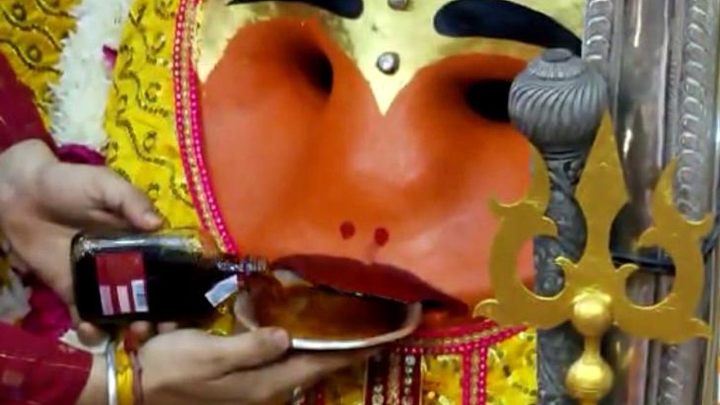
Few rituals in India are as widely recognised as the liquor offering at the Kal Bhairav Temple. Dedicated to Kal Bhairav, a fierce manifestation of Lord Shiva, the shrine is known for a ritual in which devotees bring bottles of liquor as an offering.
The priest pours a portion into a shallow vessel, recites prayers and brings it to the deity’s lips. The liquid appears to disappear, making the ritual one of the temple’s most talked-about traditions. The remaining liquor may be returned to devotees as prasad.
The practice is associated with Tantric worship, in which madya, or alcohol, forms one of the five ritual elements known as the Panchamakara. In certain traditions, these elements are interpreted symbolically or incorporated into ritual worship.
Kal Bhairav is also regarded as Ujjain’s guardian deity. Many devotees believe that seeking his blessings is an important part of a pilgrimage to the city, particularly before visiting Mahakaleshwar.
The liquor offering is not compulsory. Flowers, coconuts, incense and sweets are also accepted, and devotees may visit simply for darshan.
What makes this tradition fascinating is that it challenges the idea that every form of worship must look the same. The offering is not treated as an act of indulgence, but as part of a ritual relationship between devotee and deity, shaped by tradition and belief.
3. Khapri Temple, Karwar: Cigarettes, alcohol and the memory of a healer
At Khapri Temple in Kodibag, Karwar, the offerings include cigarettes, beedis and country liquor. During the annual jatra, devotees may even perform aarti using lit cigarettes, while liquor is offered as part of the rituals.
The story associated with Khapri is quite different from that of a conventional deity. Local accounts describe him as a man of African origin who came to the region centuries ago. He is remembered as a healer who helped people, treated ailments and was believed to possess extraordinary powers.
According to local folklore, Khapri was fond of tobacco and alcohol. After his disappearance or death, he came to be revered, and the offerings associated with his life became part of the worship.
Devotees reportedly make vows when facing difficulties related to health, work, family or other aspects of life. When their wishes are fulfilled, they return to make offerings in gratitude.
The annual festival attracts people from Karwar as well as neighbouring Goa and Maharashtra. Reports also describe participation from devotees of different religious communities, making the shrine an example of how local faith can cross familiar religious boundaries.
Here, the cigarette or bottle is not merely an unusual object placed before a shrine. It is part of the memory of a person believed to have helped the community—and a way of continuing that relationship through ritual.
4. Bhoot Mama Temple, Surat: Cigarettes as a way of making a wish
In Surat, Gujarat, the Bhoot Mama shrine is associated with devotees offering cigarettes instead of the more familiar flowers and sweets. Local accounts describe the shrine as being dedicated to Banjara Bhoot Mama, a guardian figure believed to help devotees with their wishes and personal concerns.
The shrine is believed to be more than a century old. Devotees bring cigarette packets, and some light cigarettes and leave them at the shrine as an offering.
The practice is rooted in the belief that Bhoot Mama was fond of smoking. As with other shrines associated with local guardian figures, the ritual is less about a prescribed religious text and more about a story that has been carried through generations.
People come seeking blessings, protection and help with personal matters. Some also turn to the shrine with prayers relating to marriage and family life.
It is a reminder that Indian devotional traditions frequently develop around local figures whose stories become inseparable from the communities that worship them. Over time, the objects associated with their lives become offerings—and the ritual itself becomes a way of remembering.
5. Khabees Baba Temple, Sitapur: Liquor offered at a saint’s memorial
In the forested area near Sandana in Sitapur, Uttar Pradesh, lies the shrine associated with Khabees Baba, a saint believed to have lived around 150 years ago.
Unlike many conventional temples, the shrine reportedly has no idol and no priest. Instead, a raised platform holds two slipper-shaped structures believed to represent the saint’s feet.
Local accounts say Khabees Baba worshipped Lord Shiva and was known for his evening drink. Devotees also believed he possessed healing abilities and that his words carried unusual truth. People suffering from ailments are said to have sought his blessings.
After his death, disciples and locals are believed to have built a shrine in his memory. The tradition of offering liquor continued as an act of homage.
Devotees pour liquor over the symbolic feet of the saint. A small portion is collected and distributed as prasad. The shrine attracts people from nearby villages and elsewhere, particularly around Guru Purnima.
What makes this offering different is that it is directed not towards a conventional deity’s idol but towards the memory of a spiritual figure. The ritual is, in a sense, a continuation of the relationship devotees believe they had with the saint during his lifetime.
6. Shaheed Baba Nihal Singh Gurdwara, Punjab: Toy aeroplanes offered for overseas dreams
Perhaps the most striking offering of all is not found at a Hindu temple, but at a Sikh gurdwara in Talhan village near Jalandhar. The Shaheed Baba Nihal Singh Gurdwara became popularly known as the Hawai Jahaj Gurdwara because devotees began offering miniature aeroplanes.
People seeking visas, overseas employment, opportunities to study abroad or the chance to reunite with family in another country would bring toy planes to the shrine while making their prayers.
The tradition reportedly grew from a story about a devotee who promised to offer a toy aeroplane if his visa wish was fulfilled. When he reportedly received the visa, he returned with the miniature aircraft. Other devotees began following the practice.
The symbolism is easy to understand. The aeroplane represents a journey, a border crossed, an opportunity and, for many families, the possibility of a better life. In a region where migration overseas has long shaped family aspirations and economic realities, the toy plane became a physical expression of hope.
The offerings grew in popularity, and shops selling miniature aircraft appeared near the gurdwara. The practice eventually became so prominent that, in 2023, the gurdwara management stopped accepting toy aeroplanes following an advisory from the Akal Takht discouraging the practice.
The story is particularly fascinating because it shows how devotional rituals can evolve around contemporary aspirations. A traditional prayer for a blessing took the form of an object associated with a modern dream: flying abroad.
The toy aeroplane was not simply a miniature aircraft. For the person placing it at the shrine, it represented a visa, a job, a future, a family reunion—or a life that had yet to begin.
What these offerings tell us about faith in India
Taken together, these rituals reveal something fascinating about the way faith is practised in India: it is not always confined to the familiar, the formal or the prescribed.
The offerings are shaped by the stories devotees tell about the figures they worship. A saint remembered for drinking becomes associated with liquor. A local healer remembered for smoking becomes associated with cigarettes. A deity believed to accept unconventional offerings becomes the recipient of objects that might otherwise seem entirely out of place in a shrine.
There is also a deeply personal element to many of these practices. Devotees often make a mannat—a vow or prayer tied to a wish—and return with an offering once they believe it has been fulfilled. The ritual becomes a way of expressing gratitude, remembering a promise and reaffirming faith.
And then there is the toy aeroplane. Unlike cigarettes or alcohol, it is not associated with a deity’s supposed personal preference. It represents something the devotee hopes to receive: a chance to travel, a new job, a visa or a future abroad.
The objects may appear unusual, but the emotions behind them are familiar. People pray for health, protection, prosperity, love, work, family and a little reassurance when life feels uncertain.
Perhaps that is the most interesting part of these rituals. The offering may be a cigarette, a bottle of liquor or a toy aeroplane, but the prayer behind it is often remarkably ordinary.
And in a country where faith is woven into everyday life in countless forms, even the most unexpected offering can tell a story about hope.