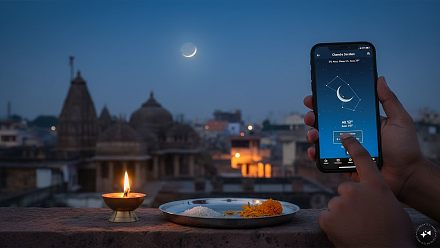
Moon Sighting Apps: How Technology Is Changing Traditional Chandra Darshan
Chandra Darshan will be observed on Saturday, September 12, 2026, following the Amavasya or New Moon. The occasion marks the first sighting of the crescent Moon after the dark lunar phase. Traditionally, devotees step ou
लेखक Nibandh Vinod··30K पढ़े गए
Moon Sighting Apps: How Technology Is Changing Traditional Chandra Darshan
Chandra Darshan will be observed on Saturday, September 12, 2026, following the Amavasya or New Moon. The occasion marks the first sighting of the crescent Moon after the dark lunar phase. Traditionally, devotees step outdoors after sunset and scan the western sky for the thin crescent. The exact sighting time varies by location because sunset, Moonset and the Moon’s position differ from city to city.
According to Drik Panchang, the Moon-sighting window is between 6:29 PM to 7:31 PM, but these should not be treated as universal. Devotees should check a location-specific Panchang, including Drik Panchang, for accurate September 12 timings.
How Technology Is Changing Chandra Darshan
For generations, Chandra Darshan has involved patience, observation and a direct connection with the evening sky. Families would wait after sunset, look towards the western horizon and watch for the first faint crescent of the Moon.
Today, smartphones are adding a new layer to this traditional practice.
A growing range of Moon-phase, astronomy and sky-observation apps can help users identify the Moon’s position, track lunar phases and estimate when the Moon will be above the horizon. For devotees preparing for Chandra Darshan, these digital tools can make the process easier, particularly when the crescent is difficult to spot with the naked eye.
Technology, however, is assisting the traditional practice rather than necessarily replacing it. The actual sighting remains an important part of the observance for devotees who follow the custom.
How Moon Sighting Apps Work
Most Moon and astronomy apps use astronomical calculations, geographic coordinates and local time to show where the Moon will appear in the sky.
Depending on the app, users may be able to see:
The current phase of the Moon.
The Moon’s altitude and direction.
Moonrise and Moonset times.
The percentage of the Moon that is illuminated.
A visual representation of the Moon’s position in the sky.
Calendar information for upcoming lunar phases.
Augmented-reality or sky-map features to help locate celestial objects.
These features can be particularly useful when the crescent is extremely thin and difficult to distinguish from the twilight sky.
Why September 12 Chandra Darshan Is Location-Specific
One of the biggest advantages of technology is its ability to provide location-based information.
The Moon does not appear at precisely the same time from every location. Sunset, geographical coordinates, atmospheric conditions and the Moon’s position all influence when and whether the crescent can be observed.
As a result, devotees in Delhi, Mumbai, Kolkata, Bengaluru or other cities may receive different Moon-sighting information.
A location-specific Panchang can therefore be more useful than relying on a single nationwide timing.
Traditional Chandra Darshan Meets Smartphone Technology
Traditionally, families may have relied on elders, local priests, Panchangs or simply their own observation of the sky.
Smartphones now put astronomical information in the hands of users within seconds.
A devotee preparing for Chandra Darshan can check a lunar calendar, identify the direction of the Moon, determine the approximate viewing window and then step outside to look for the actual crescent.
This creates a combination of traditional religious practice and modern astronomical assistance.
Can an App Replace the Actual Moon Sighting?
Not completely.
For devotees who follow the traditional practice, an app can indicate where and when to look, but it cannot substitute for physically sighting the crescent Moon.
This distinction is important because Chandra Darshan centres on the first visible crescent following Amavasya. A digital representation of the Moon is an aid to observation, not necessarily the observation itself.
Some devotees may also prefer to follow their family customs or the guidance of a priest or Panchang rather than rely entirely on an application.
Benefits of Using Moon Sighting Apps
Moon-sighting technology can be particularly helpful for people living in cities, where buildings, pollution and bright artificial lights can make a thin crescent difficult to see.
Key advantages include:
Quick access to Moon-phase information.
Location-based astronomical data.
Direction indicators for finding the Moon.
Moonrise and Moonset information.
Visual sky maps.
Notifications and reminders in some applications.
Easy access to lunar calendars while travelling.
For younger generations, these tools can also make traditional astronomical observations more interactive and accessible.
Challenges of Digital Moon Sighting
Technology does not guarantee that the crescent will be visible.
Weather conditions, clouds, haze, atmospheric clarity, buildings and light pollution can all affect visibility. An app may accurately calculate where the Moon should be, but the actual crescent may remain difficult to see.
The very thin crescent following Amavasya can be especially challenging because it appears close to the horizon and may remain visible for only a short period after sunset.
Therefore, users should treat apps as guidance rather than as a replacement for actual sky observation.
Apps and the Changing Experience of Chandra Darshan
The use of technology reflects a broader change in how people experience traditional festivals and religious observances.
Panchang apps, digital calendars, weather applications and astronomy tools are increasingly being used alongside conventional practices. Instead of asking only when to perform a ritual, users can now access information about the astronomical event behind it.
For Chandra Darshan, this means a centuries-old practice of watching for the crescent Moon can now be supported by real-time digital information.
The Future of Moon Sighting
As smartphones become more sophisticated, Moon-sighting technology could become even more precise. Augmented-reality sky maps, improved location data and better astronomical modelling may make it easier for users to locate extremely thin lunar crescents.
However, the cultural significance of Chandra Darshan remains rooted in tradition.
Technology can tell a devotee where to look and approximately when to look, but the moment of seeing the first crescent in the evening sky remains a personal and cultural experience.
For September 12 Chandra Darshan, devotees can therefore combine the convenience of modern technology with traditional observances. Checking a reliable, location-specific Panchang before sunset and then looking towards the western horizon after sunset can help bridge the gap between digital tools and an age-old lunar tradition.