India Wants Its Single Malts To Go Global. Whisky Insiders Tell Us What It Will Take
“I believe the first battle has already been won. Indian single malts have demonstrated that India can make exceptional whisky.” Prem Dewan, Chairman and Managing Director, DeVANS Modern Breweries is sure of this when we
लेखक Mallika Bhagat··21K पढ़े गए
India Wants Its Single Malts To Go Global. Whisky Insiders Tell Us What It Will Take
“I believe the first battle has already been won. Indian single malts have demonstrated that India can make exceptional whisky.” Prem Dewan, Chairman and Managing Director, DeVANS Modern Breweries is sure of this when we discuss the present, and future, of the Indian single malt.
The modern single-malt’s Indian story began in 2004, when Amrut Distilleries of Bengaluru—founded in 1948 by J.N. Radhakrishna Rao Jagdale and later guided by his son Neelakanta Rao Jagdale and master distiller Surrinder Kumar—unveiled India’s first contemporary single malt in Glasgow, the spiritual home of Scotch. It was there that this challenge found its footing, and two decades on, grown into a confident category with its own awards and its own emerging sense of place.
We are a country that loves its tipples, and the conversation for us, in no uncertain terms, has moved well beyond the question of whether India can produce fine whisky. We can, and we have. For Godawan, which has crossed 125 global awards, the real test is what happens after the medal is won.
“We are at 125 global awards and counting and this has been incredibly encouraging for us. It is a strong validation of the quality of the liquid, the approach to design and craftsmanship overall,” Vikram Damodaran, Chief Innovation Officer, Diageo India, tells us elatedly. Awards, he says, give consumers a reason to discover a whisky, but they are not the final measure of success. “The real translation of that recognition is when consumers come back to Godawan because they genuinely enjoy the liquid and the experience associated with it. That repeat choice is what tells us that the awards have translated into meaningful consumer demand.”
Prem Dewan, Chairman and Managing Director, DeVANS Modern Breweries Ltd, which makes GianChand, sees the same distinction between recognition and lasting success. GianChand recently won Double Gold at the 2026 San Francisco World Spirits Competition.
“Recognition can open the door but repeat purchase is what builds a brand,” says Dewan. For Indian single malts to become enduring global luxury brands, he believes consumers need to experience the whisky repeatedly, understand its provenance and develop an emotional connection with the story behind it.
“That requires consistency in quality, availability, strong distribution and patience,” he says. “The more meaningful measure is whether consumers in those markets actively seek out Indian single malts again. The award gives us credibility; the responsibility now is to convert that credibility into long-term consumer trust and loyalty.”
“We are at 125 global awards and counting and this has been incredibly encouraging for us. It is a strong validation of the quality of the liquid, the approach to design and craftsmanship overall,” says Vikram Damodaran, Chief Innovation Officer, Diageo India
For Crazy Cock, the awards are similarly a starting point rather than the finish line. “Awards are important validation, but they are not the destination,” says Rupi Chinoy, Director, South Seas Distilleries and Breweries Pvt Ltd. Crazy Cock’s Rare won Gold at the 2026 World Whisky Masters, but Chinoy believes the larger opportunity lies in helping consumers understand why Indian whisky is different. “The bigger opportunity is to build understanding of what makes Indian single malt distinctive—our climate, maturation conditions, local grain, cask management, and distilling traditions.”
For the brand, the challenge is therefore twofold: building Crazy Cock while also helping shape the broader identity of Indian single malt. “Ultimately, we want consumers to choose Indian single malt not only because it has won awards, but because they understand and appreciate what makes it distinctly Indian.”
A Whisky Map Still Being Sketched
One of the most interesting possibilities for Indian single malt is that the country’s diversity could become part of its appeal.
GianChand’s identity is closely tied to Jammu and its Himalayan environment. Dewan believes that geography could eventually become a defining feature of Indian whisky. “I strongly believe regional identity can become one of the most compelling differentiators for Indian single malts,” he says. “India is a geographically and climatically diverse country, and whisky made in Jammu will inevitably experience a different environment from whisky matured in Goa, the Himalayan foothills or other parts of the country.”
Prem Dewan, Chairman and Managing Director, DeVANS Modern Breweries Ltd, which makes GianChand, sees the same distinction between recognition and lasting success.
Rather than presenting Indian whisky as one homogeneous category, he sees an opportunity to develop a collection of regional expressions. “It may be premature to directly compare India’s whisky regions with Scotland’s centuries-old regional classifications, but the foundation for such a conversation is certainly emerging,” he says.
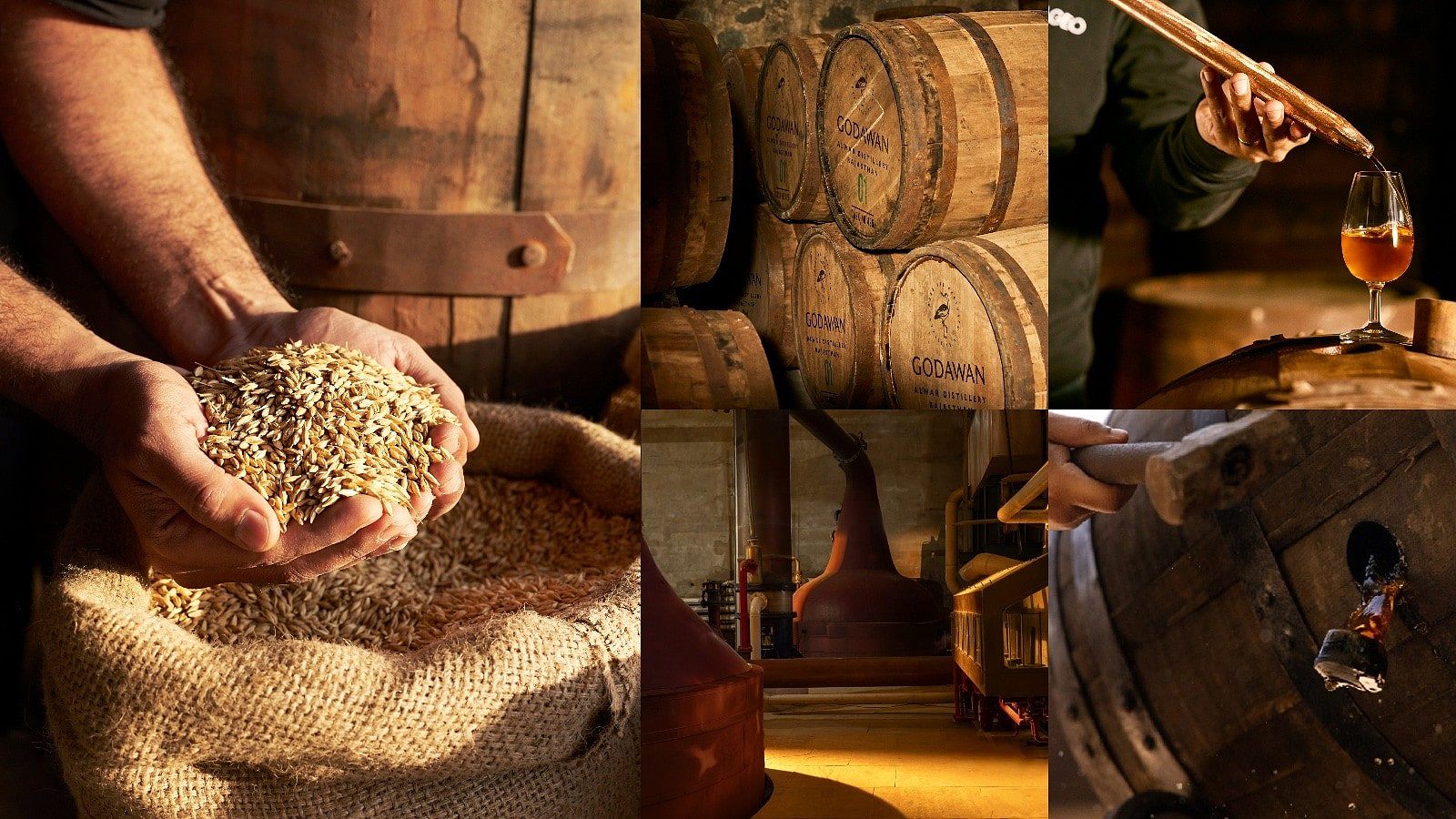
For Godawan, that sense of place is already central to the brand. Its identity is built around Rajasthan, desert maturation and the story of the Great Indian Bustard. “We built Godawan as a purpose-driven brand, rooted in a strong sense of place and a larger story,” says Damodaran. “Our connection to Rajasthan, desert maturation and the story of the Great Indian Bustard are integral to our identity and give us a distinctive point of view.”
But he does not believe every Indian single malt needs to tell the same story. “What matters is having a clear and authentic identity.” And when it comes to Scotch, Damodaran believes the Indian category has moved beyond trying to play by someone else’s rules. “We are well past competing with Scotch on Scotch’s terms. Indian single malts have raised the bar significantly and earned their own distinction in the global whisky category.”
Kick The Old Rulebook
What the owners think is one thing. It is the drinker that rules the roost. Mukul Kumar, Beverage Head at She’s Here in Gurgaon, watches a generation come of age alongside the rise of Paul John, Indri and a growing roster of craft labels. “They simply do not feel limited by rules that were made centuries ago. The way we enjoy whisky has constantly evolved, and it is evolving again with this generation.”
Mukul Kumar, Beverage Head at She’s Here, watches a generation come of age alongside the rise of Paul John, Indri and a growing roster of craft labels.
That can mean a premium single malt in a classic cocktail, paired with flavoured ice or served in a completely unexpected way. “For them, it is less about following a prescribed way of drinking and more about discovering what they enjoy. And honestly, that is making the category a lot more exciting.”
Kumar does not see this as the death of Scotch either. “Scotch will always have its audience,” he says, pointing to the centuries of whisky making and history behind iconic names such as Glenfiddich, Macallan and Lagavulin.
“At the same time, Indian single malts have really come into their own,” he says. “So I would not say Indian whisky is replacing Scotch but it is expanding the conversation.” Over the last five years, he says, Indian single malts have seen a significant rise in interest and consumption as consumers become more curious and willing to experiment.
The Bottle Matters Too
Luxury has expanded beyond the liquid itself and the bottle itself is becoming part of the experience. “Luxury today is as much about the story and the way a bottle makes you feel as it is about the liquid inside,” says Kumar.
The shape, materials, detailing and overall look of a bottle can create a sense of luxury, while local craftsmanship can give it a stronger connection to its place of origin. “With more people also creating bars at home, how a bottle looks on the shelf and how it is displayed has become increasingly important,” he says.
Limited editions add another layer, creating rarity and exclusivity. “Ultimately, luxury is no longer just about how expensive the whisky is. It is about the story, the craftsmanship, the experience and, increasingly, how special that bottle feels to own.”
The Crazy Cock Indian Single Malt Whisky Madhuca uses casks that previously held Mahura spirit, bringing an Indian distilling tradition into the whisky-making process.
That idea of scarcity is already beginning to appear in Indian single malt. Dewan points to limited editions and exclusive small batches, with some prices crossing the one lakh mark, as evidence that the category is beginning to enter genuine luxury territory.
“Luxury is built through a combination of quality, provenance, scarcity, consistency, craftsmanship and storytelling. It is also built over time,” he says.
Heritage Meet Indian Signature
For Indian brands, the opportunity is not only to mature whisky differently but to experiment with flavours and casks in ways that give consumers something they cannot easily find elsewhere.
At Godawan, innovation has been central to the portfolio. Damodaran points to the brand’s 01 Rich & Rounded and 02 Fruit & Spice expressions, which use rasna and jatamansi to create distinct flavour profiles. Godawan 173, meanwhile, uses Asha liquor casks and is described by the brand as the world’s first artisanal liqueur cask-finished Indian single malt. “Our core portfolio is built around exploring the four flavour quadrants,” says Damodaran. “We will continue to innovate as we explore the other two.”
At She’s Here, Kumar says Godawan has emerged as a strong favourite across the restaurants, particularly because of its balance of warm spice, dried fruit, gentle sweetness and oak. “It has enough depth to be interesting without being too heavy or intimidating,” he says.
It also works beyond the traditional neat pour. “You can enjoy it neat or over ice, but it works beautifully in classic cocktails like an Old Fashioned as well.” That versatility has also made it a fit with Japanese cuisine, where its profile works with umami, grilled and smoky flavours.
Chinoy too believes the country has an opportunity to develop what she calls a distinct “Indian vocabulary” for single malt whisky. “I believe the next phase of Indian single malt is not simply about producing whisky that can compete with established international expressions, but about developing a distinct Indian vocabulary for Indian Single Malt Whisky,” she says. “Our ingredients, climate, indigenous spirits, and long-standing traditions offer us the opportunity to create flavour profiles that cannot be replicated anywhere else.”
The Crazy Cock Indian Single Malt Whisky Madhuca expression is an example of that approach. The expression uses casks that previously held Mahura spirit, bringing an Indian distilling tradition into the whisky-making process. “Mahura has a deep cultural and distilling heritage in India, and the use of casks that previously held Mahura spirit allows us to bring that legacy into the whisky-making process in a contemporary and meaningful way,” says Chinoy.
The Hardest Part May Be Waiting
There is one thing that cannot be accelerated by marketing, awards or a clever bottle design: time.
Dewan describes single malt as “ultimately a business of patience”. In India, he says, it takes a minimum of three to four years to come up with a good product. “You cannot rush things simply because of market demand but have to be patient and plan far ahead,” he says.
GianChand’s maturation programme has grown from a handful of barrels to more than 7,000, with the company now embarking on a new expansion plan to substantially increase maturation capacity.
“It is not simply about increasing production; it is about creating sufficient aged inventory to support future demand while maintaining the quality and character expected from the whisky,” says Dewan. For an industry growing quickly, that long view could be crucial. “The brands that will still be relevant 10 or 20 years from now will be those investing today in cask inventory, maturation programmes, blending expertise and quality control,” he says.
For Crazy Cock, the challenge of building a modern Indian single malt is closely connected to its history. South Seas Distilleries has more than a century of distilling experience, while Crazy Cock itself is a relatively young brand.
For Chinoy, the two do not have to compete. “For us, heritage and experimentation go hand in hand. More than a century of distilling experience at South Seas Distilleries gives us depth, discipline, and craftsmanship, while Crazy Cock Indian Single Malt Whisky, as a young brand, gives us the freedom to challenge convention and explore new ideas.” The aim is not to reproduce the past, she says, but to use it as a foundation.
“We do not want to recreate the past; we want to build on it. India’s climate, raw materials, cask possibilities, and distilling traditions give us the opportunity to create expressions that are genuinely our own, rather than follow established global templates.”
Godawan sees the next five years in similar terms. For Damodaran, the quality of Indian single malt is already being established through blind tastings against some of the world’s best whiskies. “The bigger opportunity is to build the ecosystem around Indian single malts,” he says.
“Scotch did not earn its global stature through one great distillery. It was built over decades by an entire industry developing standards, consistency, and credibility together.” India, he believes, is now at the beginning of that journey.