Saanson Ki Mala In Mirzapur The Movie: The Fascinating History Behind Nusrat Fateh Ali Khan’s Classic
Of all the musical choices in Mirzapur: The Movie, one of its most talked-about moments belongs to a composition that predates the franchise by decades. “Saanson Ki Mala Pe”, immortalised in the voice of Ustad Nusrat Fat
लेखक Yatamanyu Narain··78K पढ़े गए
Saanson Ki Mala In Mirzapur The Movie: The Fascinating History Behind Nusrat Fateh Ali Khan’s Classic
Of all the musical choices in Mirzapur: The Movie, one of its most talked-about moments belongs to a composition that predates the franchise by decades. “Saanson Ki Mala Pe”, immortalised in the voice of Ustad Nusrat Fateh Ali Khan, arrives during the film’s mid-credit sequence and has sent listeners back to a song that has repeatedly found new lives across qawwali mehfils, Hindi cinema, streaming platforms and social media.
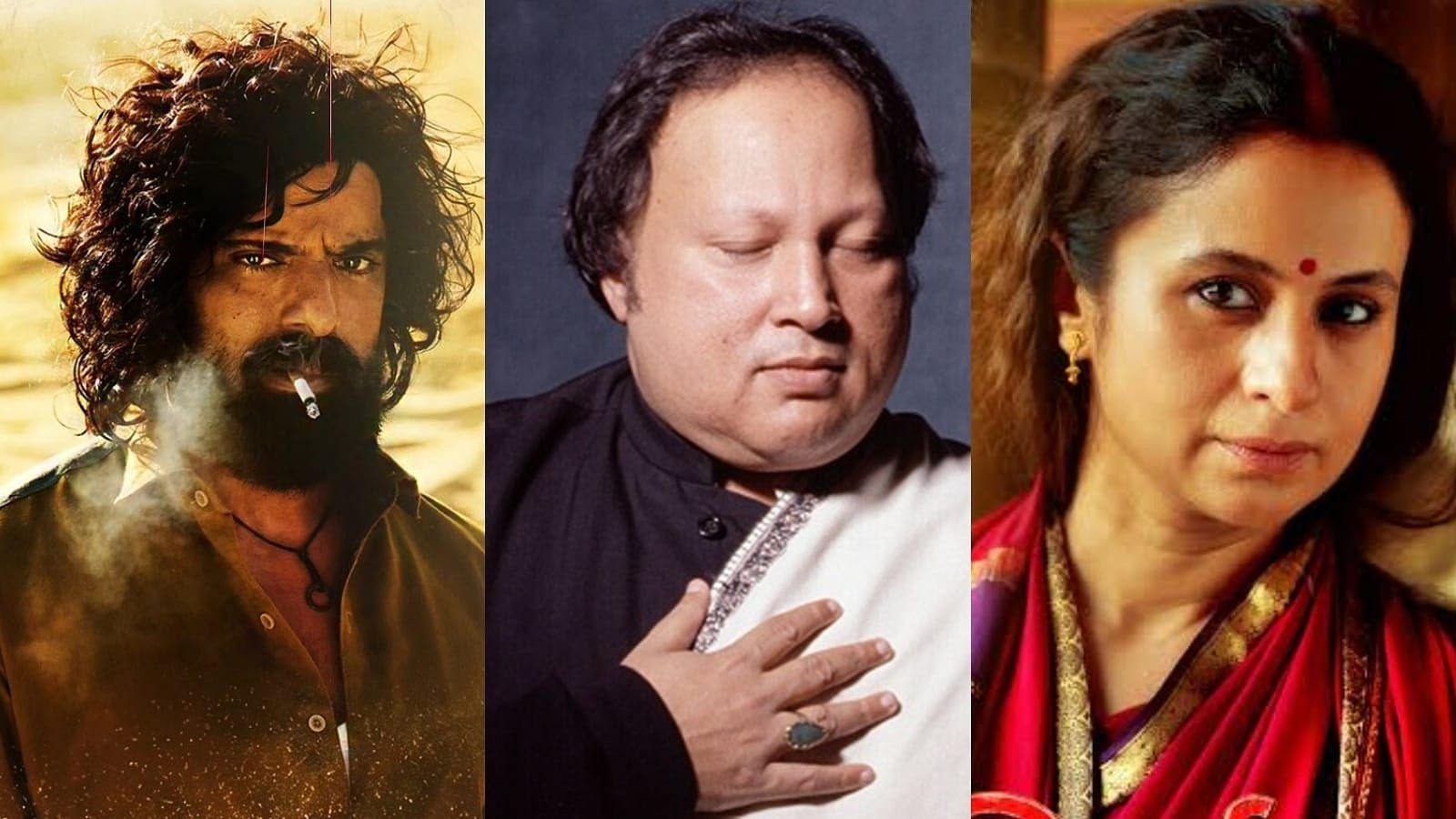
The version heard on the film’s nine-track album combines Nusrat’s vocals with a contemporary treatment by Madhur Sharma and Vaibhav Pani. Released on August 31, it accompanies a sequence involving Beena Tripathi and a man from her romantic past. The irony is deliciously dark. As Beena declares, “Love hi toh hai, lifetime thodi hi rehta hai,” a composition built around the remembrance of an eternal beloved plays underneath.
View this post on Instagram
A post shared by Madhur Sharma (@madhur_sharmaofficial)
Viewers noticed. One called it an “amazing song selection”, while another singled out the stretch from the pre-climax through the “Saanson Ki Mala” sequence among the film’s strongest pay-offs.
But how did a decades-old qawwali arrive here?
The Nusrat Fateh Ali Khan Connection
The story of “Saanson Ki Mala Pe” and Nusrat’s association with India goes back to 1979. During his first visit to the country, Nusrat was invited by Raj Kapoor to perform at Rishi Kapoor’s wedding. Accounts of the composition trace one of its earliest celebrated Indian performances to that occasion. It subsequently appeared on Nusrat’s commercial releases, including Supreme Collection, Vol. 12 in 1982.
Nusrat’s treatment gave the composition the ecstatic architecture of qawwali. A later live performance from Birmingham in 1983 is also among the recordings associated with its enduring popularity.
There is, however, an interesting wrinkle in the song’s authorship.
Who Actually Wrote Saanson Ki Mala?
The composition is frequently associated with Mirabai, largely because its language and imagery are steeped in Krishna devotion. However, Sufinama identifies “Saanson Ki Mala Par Simroon Nis-Din Pi Ka Naam” as the work of poet Tufail Hoshiarpuri, who lived from 1914 to 1993. The text itself contains unmistakable references to Shyam, Mohan, Vrindavan and Gokul.
Early commercial releases of Nusrat’s rendition reportedly listed the words simply as “Traditional”. The poem later appeared under Hoshiarpuri’s name in his collection Soch Mala, and a 2001 commercial release also credited him. Its devotional vocabulary, meanwhile, helped create the longstanding association with Mirabai.
That ambiguity is almost appropriate for a composition that refuses to stay inside one musical or spiritual compartment.
What Does Saanson Ki Mala Pe Mean?
Its central image is remarkably simple: every breath becomes a bead in a rosary, and every bead carries the beloved’s name.
“Saanson ki mala pe simroon main pi ka naam” describes remembrance so complete that breathing itself becomes an act of devotion. “Pi” or “Piya” can be read as the beloved, but the poetry repeatedly moves between human love and divine surrender. The speaker becomes so immersed in love that the distinction between lover and beloved begins to disappear.
That permeability is crucial to the song’s longevity. It can inhabit a qawwali gathering and retain its Sufi intensity, while its references to Shyam, Mohan, Vrindavan and Gokul allow it to sit naturally within Krishna bhakti too. Romantic longing and spiritual yearning are never forced to choose between each other.
From Koyla To Rahat Fateh Ali Khan
Long before Mirzapur, Hindi cinema had already discovered the composition.
It was revisited in Jeet in 1996 and again in Koyla in 1997. The latter version, composed by Rajesh Roshan and sung by Kavita Krishnamurthy, was picturised on Shah Rukh Khan and Madhuri Dixit. Michael Winterbottom later used Nusrat’s original in his 2011 film Trishna.
In 2020, Rahat Fateh Ali Khan recorded another version as a tribute to Nusrat, his uncle and mentor, and his father Farrukh Fateh Ali Khan. The rendition was released as a fusion track and remains available on streaming platforms including Spotify.
Why Saanson Ki Mala Keeps Returning
Its afterlife extends far beyond official recreations. YouTube and streaming services have effectively become a second archive for “Saanson Ki Mala”, where musicians have repeatedly pulled the composition away from its familiar qawwali setting and discovered that it survives almost any rearrangement.
Among the most popular contemporary interpretations is Pakistani instrumental duo Leo Twins’ violin-led rendition, released during their Quarantine Sessions. Their version strips away the vocal performance altogether and lets the melody travel through violin and guitar. The cover became a YouTube favourite, accumulating tens of millions of views, while the duo have continued performing the composition live.
Another significant reinterpretation arrived from Rahat Fateh Ali Khan in 2020. Rather than attempting to simply reproduce his uncle and mentor Nusrat Fateh Ali Khan’s recording, Rahat presented “Sanson Ki Mala” as a fusion track conceptualised by Salman Ahmed. He dedicated it to Nusrat as well as his father, Ustad Farrukh Fateh Ali Khan. The rendition remains available alongside Nusrat’s recordings on streaming services such as Spotify.
Perhaps the most unexpected mutation came from Portuguese guitarist Andre Antunes. In 2022, he placed heavy-metal guitar riffs underneath Nusrat’s vocals for a video titled “Legendary Pakistani Singer Goes Metal”. Instead of sounding like a novelty stitched together for the internet, the combination demonstrated just how much rhythmic force already existed in Nusrat’s performance. The experiment went viral on YouTube, taking the qawwali into an entirely different musical community.
Hindi cinema has produced its own enduring version too. Rajesh Roshan recreated “Saanson Ki Mala” for the 1997 Shah Rukh Khan-Madhuri Dixit film Koyla, with Kavita Krishnamurthy singing the track. That recording remains available on Spotify alongside Nusrat and Rahat’s versions, meaning listeners can move between three very different interpretations of essentially the same musical idea.
The song has travelled into devotional music as well. Contemporary streaming catalogues carry adaptations that replace the beloved of the familiar composition with explicitly devotional invocations. Aishwarya Pandit’s “Saanson Ki Mala Pe Shiv Ka Naam”, for instance, appears on Spotify through Zee Music Devotional, while Priyanka Singh released “Saanson Ki Mala Pe Simru Main Shiv Ka Naam” in May 2026.
Then there are countless independent singers and instrumentalists who continue approaching it as qawwali, acoustic ballad, devotional song, fusion piece or concert improvisation. That abundance of versions explains something about its durability. “Saanson Ki Mala” does not depend upon one production style to remain recognisable. Take away the harmonium, alter the tempo, replace the voice with a violin or put distorted guitars underneath Nusrat, and its melodic spine remains intact.
Spotify itself continues to carry multiple Nusrat recordings, including shorter editions as well as extended live performances. Almost five decades of reinterpretation have therefore created an unusual chain: Nusrat to Kavita Krishnamurthy, Rahat Fateh Ali Khan, instrumentalists, metal guitarists, devotional singers and now Madhur Sharma and Vaibhav Pani for Mirzapur: The Movie.