Mukesh Khanna SLAMS Sharmila Tagore Over Vande Mataram Remark: ‘You Became Ayesha Begum For Marriage’
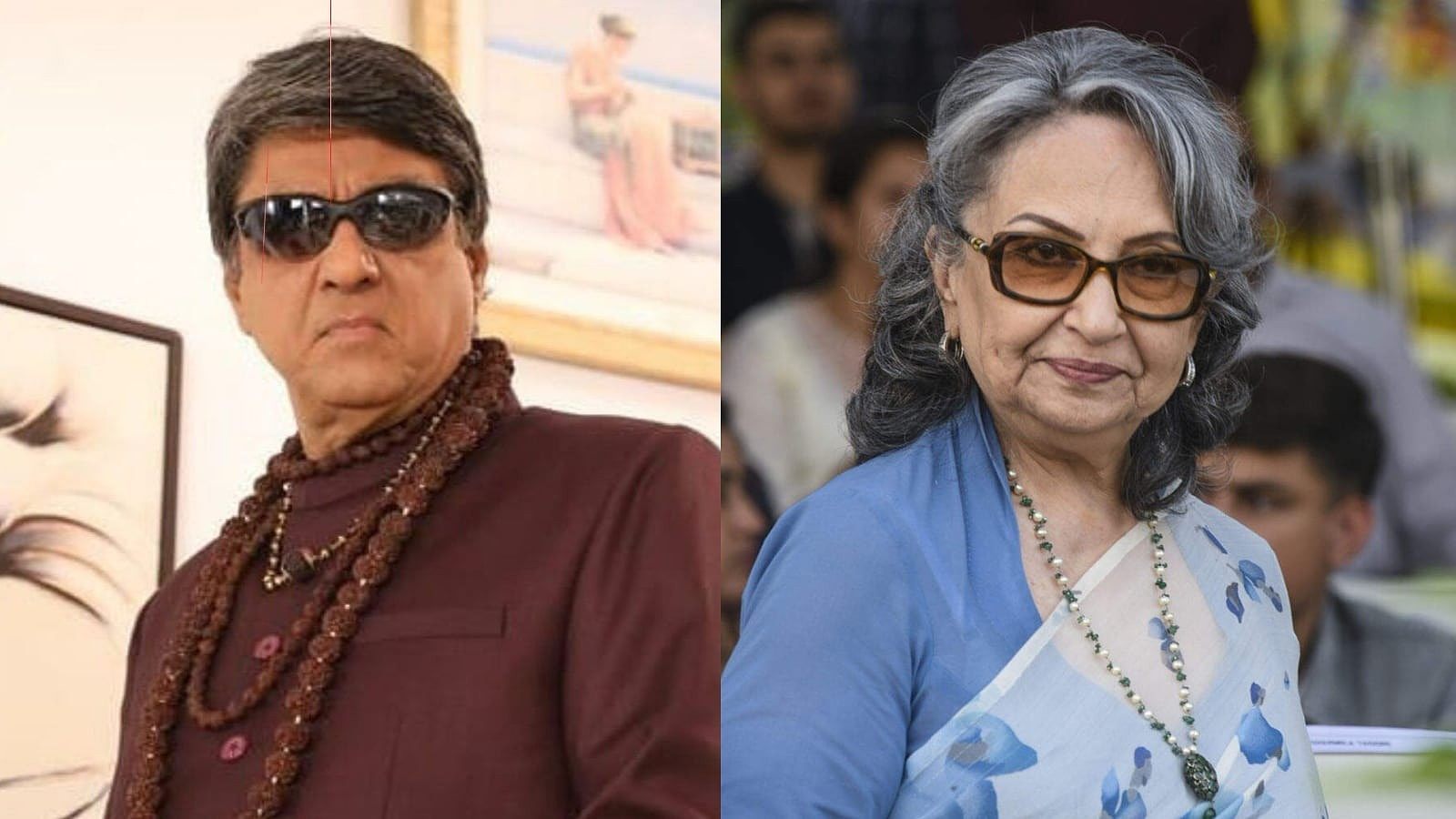
Mukesh Khanna has strongly criticised Sharmila Tagore over remarks attributed to her in the ongoing debate surrounding Vande Mataram. The veteran actor, known for playing Bhishma in Mahabharat and the titular superhero i
लेखक Yatamanyu Narain··126K पढ़े गए
Mukesh Khanna SLAMS Sharmila Tagore Over Vande Mataram Remark: ‘You Became Ayesha Begum For Marriage’
Mukesh Khanna has strongly criticised Sharmila Tagore over remarks attributed to her in the ongoing debate surrounding Vande Mataram. The veteran actor, known for playing Bhishma in Mahabharat and the titular superhero in Shaktimaan, questioned why religious considerations should determine whether the national song is sung in its entirety.
Speaking to The Free Press Journal, Mukesh was asked about Sharmila’s reported view that only the opening stanzas of Vande Mataram should be sung, keeping India’s religious diversity and the sentiments of different communities in mind.
Mukesh disagreed with the argument and, during his response, referred to Sharmila’s marriage into the Pataudi family, her Bengali upbringing and her association with Hindu cultural traditions.
Mukesh Khanna Questions Sharmila Tagore’s Stand
Mukesh began by saying that Sharmila was entitled to her interpretation but questioned the reasoning behind it.
“She is speaking according to her own understanding. I don’t know why she said it. Maybe while explaining her point of view, she ended up saying that people from other religions may not understand or accept it,” he said.
The actor then referred to Sharmila as “Ayesha Begum” while discussing her marriage into the Pataudi family.
“Did you realise only after marriage that Islam also exists? When you became a Begum, did you then realise that Muslims follow a different faith? You became Ayesha Begum for marriage, but today you are speaking as Ayesha Begum. I’m surprised that after living your whole life with Hinduism, you have suddenly become concerned about other religions,” Mukesh said.
He also brought up Sharmila’s Bengali roots, arguing that she had grown up surrounded by traditions such as Kali Puja.
“You grew up in Bengal, where Kali Puja is celebrated on such a large scale. You have grown up with Bengali culture and Bengali films. Why is it only now that you feel that people from another religion may not accept this?” he asked.
Mukesh Khanna Explains His Understanding Of Hinduism
Mukesh went on to discuss his interpretation of Hindu belief and the idea of multiple deities. He argued that the existence of numerous devi-devtas should not be interpreted as belief in numerous separate Gods.
“We have 33 crore devi-devtas, but that does not mean there are 33 crore Gods. There is one God, who is nirakar, without a form. A devotee may see that God in Hanuman, Shiva, Ram or Krishna,” he said.
According to Mukesh, different forms allow individual devotees to visualise the same divine presence according to their faith.
“So they are the avatars of God. They come in every yuga. If God appears before me, perhaps he will appear as Shiva because that is the form I believe in. For someone who believes in Krishna, he may appear as Krishna,” he added.
Mukesh Khanna On Religious Objections To Vande Mataram
Returning to Vande Mataram, Mukesh claimed that objections from sections of the Muslim community have historically involved more than references to Hindu deities in the song’s later verses.
“Their objection did not begin today. The argument has been that they bow only before Khuda and therefore would not bow before anyone else,” he claimed.
Mukesh then cited different musical renditions of Vande Mataram, mentioning Lata Mangeshkar, Hemant Kumar and AR Rahman.
He particularly referred to Rahman’s Maa Tujhe Salaam, arguing that its language similarly addresses the country as a mother. “He says ‘Maa Tujhe Salaam’. He is calling her Maa and offering a salute,” Mukesh said.
‘We Are Not Forcing Them To Bow’
Mukesh maintained that respecting the country does not necessarily mean physically bowing before an image or symbol. He said people who do not wish to bow should not be compelled to do so, but questioned extending that objection to singing Vande Mataram itself.
“We bow before Bharat Mata. If someone does not want to bow, fine, we are not forcing them to bow. But then saying that Vande Mataram itself should not be sung is something I do not understand,” he said.
The actor concluded by accusing political parties of treating the controversy as an electoral issue rather than taking a consistent position.
“You are not following a principle, you are following appeasement. You are trying to show Muslims that you are still with them so that they vote for you. That is the whole problem,” Mukesh said.