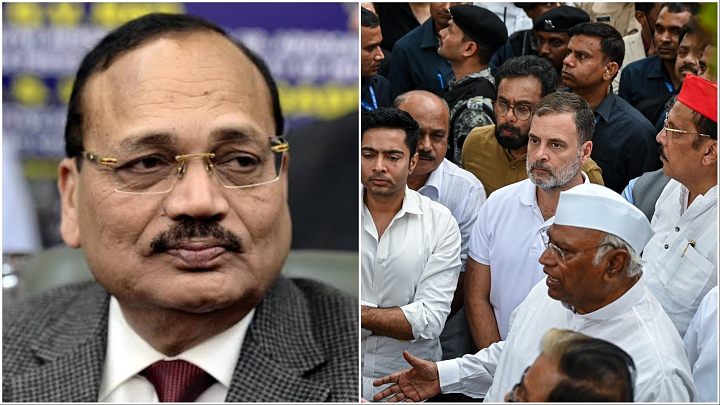
Chief Justice of India (CJI) Surya Kant has explained why he declined a request from INDIA bloc leaders Rahul Gandhi and Mallikarjun Kharge for a meeting to submit a memorandum over alleged electoral irregularities, incl
Chief Justice of India (CJI) Surya Kant has explained why he declined a request from INDIA bloc leaders Rahul Gandhi and Mallikarjun Kharge for a meeting to submit a memorandum over alleged electoral irregularities, including the controversy surrounding the Special Intensive Revision (SIR) of electoral rolls.
The CJI received the opposition leaders’ letter on Sunday and responded the same night, outlining the reasons he would not be able to meet the delegation. The opposition had sought an appointment between 4 pm and 5 pm on Monday to raise its concerns over the Election Commission and allegations of “vote chori”.
According to reports, the CJI’s response highlighted the pending judicial proceedings on the issues, the limits of the Supreme Court’s administrative powers, and the appropriate legal route for seeking relief. He also reiterated that the court remains accessible to citizens whose fundamental rights are violated.
Here are the four key points behind the CJI’s decision.
1. The Issues Raised By The Opposition Are Already Sub Judice
One of the principal reasons for declining the meeting was that matters concerning the opposition’s grievances, including the SIR exercise and issues related to the Chief Election Commissioner (CEC), were already pending before the Supreme Court.
News agency PTI reported that the CJI declined Rahul Gandhi’s request, stating that similar matters were sub judice in the Supreme Court. With judicial proceedings already underway, the opposition was advised to pursue its concerns through the legal process rather than seek a separate meeting to submit a memorandum.
The INDIA bloc has been protesting against the Election Commission and demanding accountability over alleged irregularities in the electoral process. Its memorandum was also expected to raise demands concerning CEC Gyanesh Kumar, the continuation of SIR and a return to paper ballots.
2. The Court Cannot Take Up Such Grievances On The Administrative Side
The second point concerned the distinction between the Supreme Court’s administrative functions and its judicial powers.
According to PTI, the CJI said that orders could not be passed on the administrative side and that the Supreme Court could not interfere with the executive’s functions through that route.
This distinction was central to the rejection of the meeting request, as the opposition was seeking action on matters connected to the functioning of the Election Commission and alleged electoral irregularities.
3. The Opposition Was Asked To Approach The Court Through A Petition
Instead of submitting a memorandum through a meeting, the opposition leaders were advised to approach the Supreme Court by filing a petition on the judicial side.
PTI reported that the CJI indicated that a petition filed on Monday could be taken up on Tuesday, when related matters were already scheduled to be heard.
An Indian Express report, which provided further details of the CJI’s response, stated that the court could exercise judicial review under Article 32 of the Constitution and its other applicable powers.
The proposed course of action would allow the opposition to formally place its grievances before the court for judicial consideration, rather than seek orders through an administrative representation.
4. The Supreme Court Remains Open To Citizens Seeking Legal Relief
The fourth point was the CJI’s reiteration that the Supreme Court’s doors remain open to citizens seeking relief under the law.
Speaking to reporters after the National Human Rights Commission’s 33rd Foundation Day function on Monday, Justice Surya Kant said that every Indian citizen had the right to approach the court.
“The Supreme Court’s doors are open to everyone. Any petition from any common citizen or member of an elected body is welcome,” he said, according to ANI.
He added that the court would hear citizens’ concerns and grant whatever relief was due under the law.
INDIA Bloc’s Protest March To The Supreme Court
The opposition’s meeting request came ahead of its planned march to the Supreme Court on Monday as part of its continuing agitation against the Election Commission.
Congress leaders Rahul Gandhi and Mallikarjun Kharge had sought time to submit a memorandum raising demands linked to alleged “vote chori”, the resignation of CEC Gyanesh Kumar, the halting of SIR and a return to paper ballots.
Rahul Gandhi had said that opposition parties, civil society groups, young people and others who believed in democracy and the Constitution would participate in the march. The Congress described the protest as “Chalo Delhi – March for Democracy”.