When The Bridge Becomes A Wall: Srinagar’s Vanishing Photographic Memory
For centuries, the bridges of Srinagar have offered more than a way across the Jhelum. They have been vantage points from which the city has looked at itself. From these bridges, photographers have recorded the river, wo
Ni Ieshan Wani··168K nabasa
When The Bridge Becomes A Wall: Srinagar’s Vanishing Photographic Memory
For centuries, the bridges of Srinagar have offered more than a way across the Jhelum. They have been vantage points from which the city has looked at itself. From these bridges, photographers have recorded the river, wooden houses, shrines, markets, boats, mountains, and the everyday life of the old city. Some of the earliest surviving photographs of Srinagar were made from these very vantage points, turning the bridges into accidental archives of the city.
Today, however, those same vantage points are slowly disappearing behind metal.
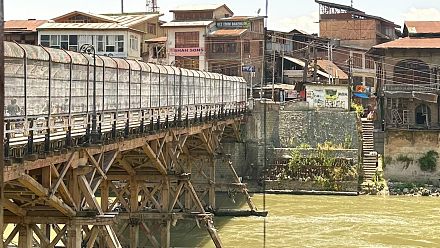
A walk through downtown Srinagar, including Zaina Kadal, offers a glimpse of what may become a larger problem. Fencing installed along historic bridges has made the river and the buildings beyond increasingly difficult to photograph. In places, the chain-link fencing used is so closely knitted that even a mobile phone camera struggles to find an unobstructed opening.
The fences may be designed to keep people from jumping into the Jhelum and to prevent the throwing of waste into the river. The intention, particularly where human lives are concerned, is difficult to dispute. Srinagar has been fencing vulnerable bridges precisely because of concerns over suicide attempts and pedestrian safety. But there is another consequence, quieter and less immediately visible.
What happens when the very places from which Srinagar has historically been photographed can no longer be used to photograph Srinagar?
The bridge as a camera
Consider Zaina Kadal. Built by Sultan Zain-ul-Abidin in 1427, the bridge has for centuries been part of the physical and cultural fabric of the old city. It was not merely a crossing over the Jhelum. It stood amid markets, river traffic and the dense urban life of downtown Srinagar. And the bridge has been part of the photographic memory of that city for well over a century.
In 1868, photographer Samuel Bourne photographed Zaina Kadal, capturing the bridge and its surroundings at a time when shops lined the structure. That image survives today as evidence of a Srinagar that no longer exists in quite the same form. A later account of the photograph notes the bridge’s distinctive cantilever construction and its use as a market.
Another historic image in the British Library archive is titled “Srinagar from Zeina Kadal 4th Bridge”, photographed by Frederick Bremner. The camera looks along the Jhelum towards Shah Hamadan Shrine. The bridge was not simply appearing in the photograph. The bridge was the place from which the photograph was possible.
Remove that viewpoint, and an entire category of photographs disappears with it.
The same story can be found elsewhere along the Jhelum. Samuel Bourne’s 1864 photograph of Srinagar was probably taken from the Old Fateh Kadal bridge. From there, the frame brought together the Jhelum, Shah Hamadan Mosque and Hari Parbat, creating precisely the kind of layered cityscape that today forms part of Srinagar’s historical visual vocabulary.
Another Bourne photograph records a bridge over the Jhelum, small boats and the Maharaja’s palace. These are not merely pretty old photographs. They are documents of a vanished city.
They tell us what the river looked like, where boats travelled, how buildings related to the water, what the skyline looked like and how the bridges fitted into the urban landscape. They allow today’s Srinagar to be compared with yesterday’s Srinagar.
A city remembered through its viewpoints
The importance of these vantage points becomes even clearer in photographs from the twentieth century. Collections of old Srinagar photographs contain images of houseboats along the Jhelum near Budshah Bridge in 1969, boats moving through Zaina Kadal in 1985 and people crossing Amira Kadal in 1962 on bicycles, on foot and in tongas.
Each photograph freezes something that was otherwise destined to disappear. The boat disappears. The shop disappears. The house changes. The bridge is reconstructed. The river changes. The people grow old. But the photograph remains.
That is why the seemingly mundane act of looking over a bridge railing has historical importance. A person standing on Zaina Kadal today, holding up a phone to photograph an old wooden building across the river, may not realise that they are participating in the same long tradition of looking that produced some of Srinagar’s earliest visual records.
The difference is that the nineteenth-century photographer had an open frame. The twenty-first-century photographer may now have a wall of metal between the camera and the city.
There is an important distinction to be made here. The question is not whether Srinagar should have safety barriers. It should.
Authorities have cited suicide prevention, garbage dumping, pedestrian safety and public demand as reasons for fencing vulnerable bridges. In 2024, fencing was initiated at several major bridges specifically to prevent suicide attempts. The more difficult question is how those barriers are designed. There is already evidence that safety and visibility need not necessarily be treated as opposites.
The treatment of Budshah Bridge, for instance, shows the possibility of designing a barrier that provides protection while retaining some visual permeability. In May, the administration said the proposed fencing of Budshah Bridge and Cement Kadal should strengthen safety while maintaining aesthetics, surrounding visibility and heritage value.
That principle deserves to be applied consistently. A safety fence does not necessarily have to become a visual barricade. There is a difference between preventing a person from climbing over a railing and preventing a camera from seeing through it. A difference between making a bridge safer and making it photographically blind.
What will Srinagar look like in 50 years?
This may sound like a small concern in a city dealing with much larger problems. Cities are remembered not only through official heritage records, maps and government documents. They are remembered through millions of informal photographs taken by residents, visitors, journalists, artists and families.
Someone photographing the wooden façade of an old house from Zaina Kadal today may unknowingly create the only easily accessible record of that building before its façade is altered. Someone photographing a row of riverside houses, a shrine, a boatman or the changing skyline may create a visual reference that becomes invaluable decades later.
The photograph does not have to be famous to become historical. It simply has to survive. Instead, something subtler will happen. The city will become harder to photograph from the places where it has historically been photographed.
Future generations may possess thousands of photographs of Srinagar’s monuments, but fewer photographs of how those monuments actually sat within the city: the angle of the river, the neighbouring houses, the bridges, the boats, the markets and the ordinary visual relationships that make a historic city recognisable.
There may be a simple principle worth considering while the remaining fencing projects are designed and reviewed: If a bridge is historic, its safety infrastructure should protect people without unnecessarily blocking the historic view. That could mean wider visual openings, transparent or less visually obstructive sections, carefully positioned viewing points, designated photographic apertures, or sections deliberately designed to preserve important sightlines.