UP Opposition's 2027 Puzzle: SP-Congress Seat Tussle, BSP’s Solo Plan And Owaisi's New Alliance
With the Samajwadi Party and Congress yet to settle the contours of their electoral understanding, the Bahujan Samaj Party (BSP) preparing to rebuild independently and the AIMIM seeking a larger role, the Opposition’s ch
Ni Oliver Fredrick··195K nabasa
UP Opposition's 2027 Puzzle: SP-Congress Seat Tussle, BSP’s Solo Plan And Owaisi's New Alliance
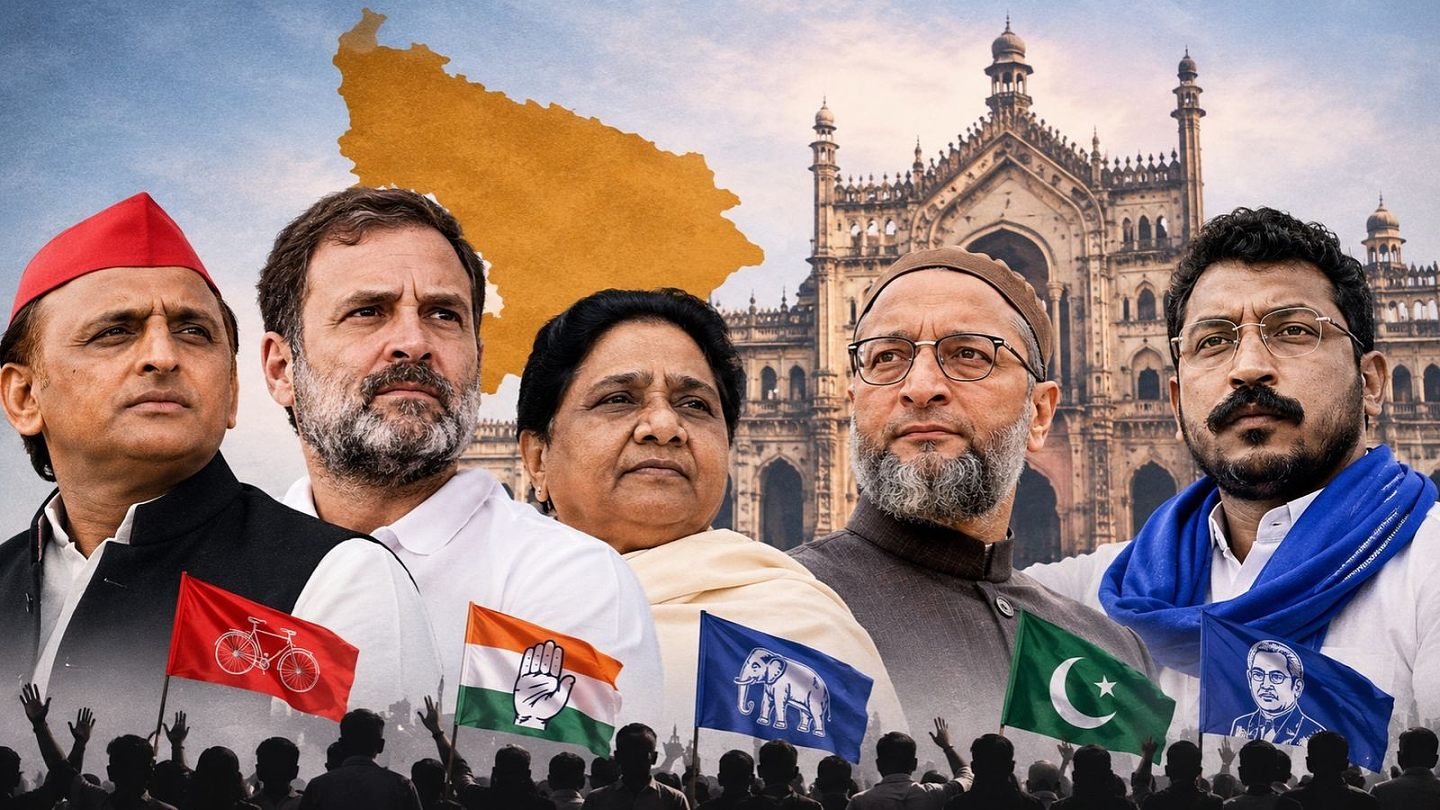
With the Samajwadi Party and Congress yet to settle the contours of their electoral understanding, the Bahujan Samaj Party (BSP) preparing to rebuild independently and the AIMIM seeking a larger role, the Opposition’s challenge in Uttar Pradesh is not limited to taking on the BJP. It is also about negotiating leadership, social coalitions and political space within its own ranks.
The political contest within the Opposition has acquired a new dimension with the coming together of the All India Majlis-e-Ittehadul Muslimeen (AIMIM) and the Azad Samaj Party (Kanshi Ram), led by Nagina MP Chandrashekhar Azad, to form the ‘Samajik Parivartan Morcha’ (SPM).
At a joint press conference in Lucknow, Owaisi said the parties would work together to build a political alternative in the state and prevent the BJP from securing a third consecutive term in Uttar Pradesh. “Our brother Chandrashekhar Azad will be the chief ministerial candidate for the SPM. We will all work together to ensure not only the success of this alliance but also that the people of Uttar Pradesh benefit from its success,” Owaisi said.
The development is significant because Owaisi had earlier sought an understanding with the Samajwadi Party and had also explored the possibility of an alliance with the BSP. AIMIM’s Uttar Pradesh chief Shaukat Ali has said the party turned to Azad after its efforts to reach out to the SP, Congress and BSP did not yield a political understanding.
The AIMIM-ASP alliance is now seeking to bring Dalit and Muslim political mobilisation on a common platform, challenging the traditional support bases of both the SP and the BSP.
For the SP, the immediate challenge remains managing its relationship with the Congress while retaining its position as the principal opposition force in the state. The two parties fought the 2024 Lok Sabha elections together as part of the INDIA bloc and won 43 of Uttar Pradesh’s 80 seats. The SP secured 37 seats, while the Congress won six. The result gave the alliance a strong electoral foothold and reinforced the argument that opposition votes could be consolidated to challenge the BJP.
However, the negotiations for the 2027 assembly elections have exposed differences over the number of seats each party should contest. Congress Uttar Pradesh in-charge Rajendra Pal Gautam has said the party has submitted an initial list of 175 to 200 constituencies to the SP. He has argued that the Congress deserves a larger share based on its organisational strength and performance in the last Lok Sabha election.
“We have given a list of 175 to 200 seats to the SP on which we want to field our candidates. My personal view is that a final decision on seat-sharing should be taken soon so that we can expedite our preparations for the assembly elections,” Gautam said.
He has also defended the party’s demand for seats, saying, “We also want winnable seats and why should we not get them?”
The SP, meanwhile, is understood to be assessing the Congress’s electoral strength constituency by constituency before arriving at a formula. The party is reportedly seeking feedback from constituencies traditionally associated with the Nehru-Gandhi family, including the Rae Bareli-Amethi belt, to assess the Congress’s current voter base and its prospects in these areas. The exercise is important because the SP wants any seat-sharing arrangement to reflect ground-level strength rather than only the results of the 2024 Lok Sabha elections.
The two parties are expected to constitute separate committees to take the negotiations forward. However, the delay in finalising the arrangement, along with differences among local leaders, indicates that the alliance will have to manage competing claims before the election campaign gathers momentum.
For the Congress, the negotiations are also about rebuilding its organisation in Uttar Pradesh. The party has only two MLAs in the state but won six Lok Sabha seats in 2024. It wants to convert that parliamentary performance into a stronger assembly presence. The SP, on the other hand, is unlikely to concede a large number of constituencies without assessing the Congress’s ability to win them.
The BSP presents a different challenge for the Opposition. Under Mayawati, the party has maintained that it will contest the 2027 assembly elections independently. The BSP chief has been reviewing the organisation and electoral preparedness, including the functioning of district units and the selection of candidates. On November 5, she held a meeting with senior office-bearers and presidents of all 75 district units to review preparations for the Assembly election and issue fresh organisational directions.
The party is attempting to rebuild its political base after a sharp decline in its electoral performance. In the 2022 assembly election, the BSP won only one seat and secured around 12.88 per cent of the vote. It failed to win a seat in the 2024 Lok Sabha election in Uttar Pradesh.
Despite this setback, the party retains a state-wide organisational network and a history of mobilising Dalit voters. Its decision to stay out of a broader opposition alliance could therefore influence contests in constituencies where the BSP retains pockets of support.
The possibility of an AIMIM-BSP understanding had earlier drawn attention because of Owaisi’s repeated references to a Dalit-Muslim political combination, popularly described as the ‘Bhim-Meem’ formula. With the AIMIM-ASP alliance, that political pitch has taken a different direction. Azad has emerged as a prominent Dalit political voice, particularly after winning the Nagina Lok Sabha seat in 2024. An alliance with AIMIM could give both parties a platform to expand their presence beyond their existing constituencies.
Owaisi has also sharpened his political pitch in Uttar Pradesh. At a public meeting in Rampur in October, he said AIMIM would promote young Muslim men and women and made a pointed reference to the political dominance of established family names. The party has indicated that it intends to contest a substantial number of seats, with a focus on constituencies where it believes it can build a support base. Its proposed alliance with the ASP could now give that campaign a wider social and electoral framework.
Political analyst Shashikant Pandey, head of department of political science at Dr Bhimrao Ambedkar University, Lucknow, said the emerging situation presents the Opposition with two simultaneous challenges. The SP and Congress must settle their seat-sharing arrangement without weakening their combined electoral strength. “At the same time, the BSP, AIMIM and ASP are seeking to establish or revive independent political space among Dalit, Muslim and other social groups,” Pandey said.
The 2024 Lok Sabha results demonstrated that opposition coordination can produce electoral gains in Uttar Pradesh. But the assembly election will involve a different contest, with 403 constituencies, local leadership equations and candidate selection playing a decisive role. The distribution of seats, the ability to transfer votes between allies and the strength of local organisations will matter as much as the announcement of political alliances.
The question for the Opposition, therefore, is not simply whether its parties can come together against the BJP. It is whether they can prevent competing political ambitions from fragmenting the very social constituencies they are seeking to mobilise.